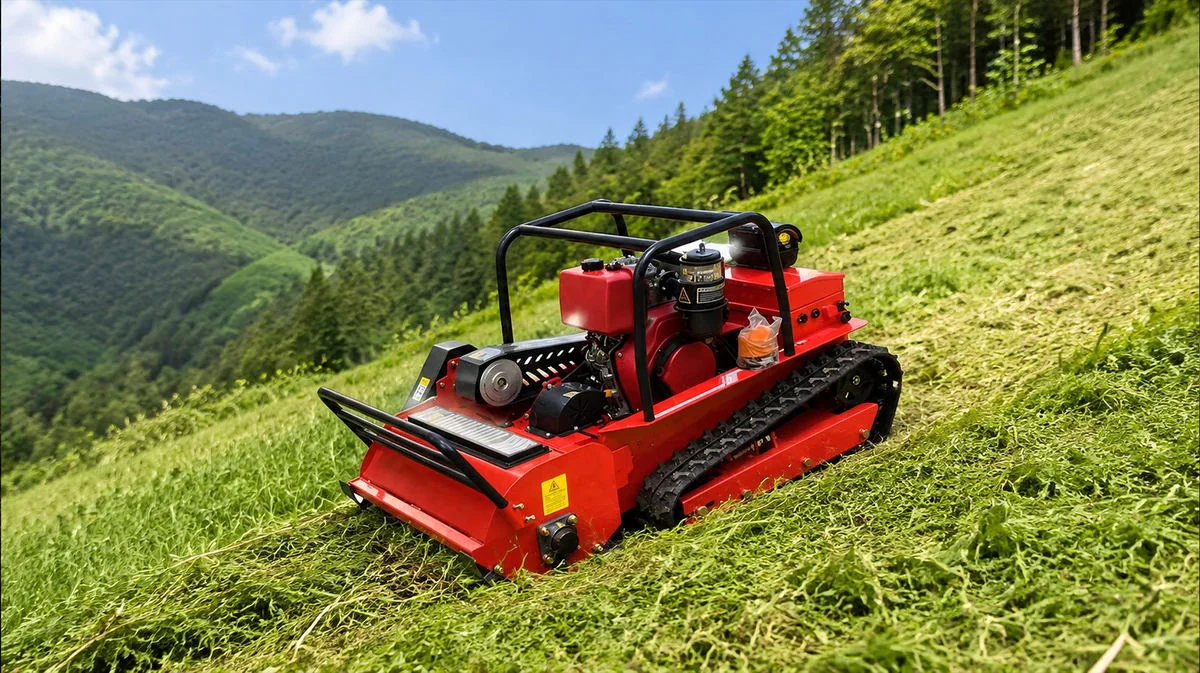
The best lawn mower for a steep hill is not determined by engine size alone. Grade, surface condition, vegetation, site access, working width, and the position of the operator all affect the decision. A machine that performs well on a smooth residential bank may be unsuitable for a commercial embankment, orchard, or solar farm.
This guide explains the main mower types and the questions buyers should answer before requesting a quotation.
Start with the real slope and ground conditions
Measure the steepest sustained working area rather than estimating from a photograph. Record whether the figure is expressed in degrees or percentage grade, because the two are not interchangeable. Note any short transitions, drop-offs, drainage channels, terraces, or narrow access points.
Ground condition matters as much as geometry. Wet clay, loose gravel, leaf litter, exposed roots, and recently disturbed soil reduce available traction. A responsible machine selection therefore includes a safety margin instead of matching the mower’s maximum rating exactly to the steepest measured point.
Ride-on mowers: productive on moderate, open ground
Ride-on and tractor-mounted mowers can cover large areas efficiently when the terrain is open and within the equipment manufacturer’s operating limits. They also support many attachments. Their main disadvantage on steep ground is that the operator travels with the machine, increasing exposure to rollover and slide hazards.
They are generally most suitable when access is wide, turning space is generous, and the surface is consistent. Buyers should follow the specific slope limits, ballast instructions, rollover protection requirements, and tire recommendations for the chosen equipment.
Autonomous robot mowers: best for frequent light maintenance
Robot lawn mowers are designed primarily for regular trimming of maintained grass. They can be convenient on sites with predictable boundaries and limited vegetation height. Their performance depends on traction, navigation method, charging access, obstacle management, and the manufacturer’s stated incline capability.
They are less suitable when the job includes tall grass, woody growth, changing work zones, rough surfaces, or obstacles that require continuous operator judgment. Read the detailed remote control vs robot lawn mower comparison before treating the two machine types as interchangeable.
Remote control tracked mowers: designed for difficult working areas
A remote control tracked mower separates the operator from the machine while retaining real-time control. The tracked undercarriage spreads contact over a larger area than small wheels and can provide useful traction on uneven ground. Operators can respond immediately to obstacles, vegetation changes, and restricted spaces.
MERI models are available with gasoline or diesel power, 24V or 48V control systems, different cutting widths, and flail or turf-oriented cutting configurations. The correct model depends on the work rather than a simple “bigger is better” rule.
Choose the cutting system and width
- Flail cutting systems are appropriate for heavier grass, weeds, and mixed vegetation where material needs to be processed rather than finely finished.
- Flat-blade turf systems suit maintained lawns, landscaping, sports areas, and sites where finish quality matters.
- Narrow machines improve access between orchard rows, around posts, and through restricted gates.
- Wide machines can increase coverage on open sites but require more transport and turning space.
Questions to include in a supplier enquiry
Provide the steepest measured slope, total working area, typical vegetation height, preferred cutting height, narrowest access point, working hours per day, local fuel preference, transport restrictions, and required spare parts. Ask for the operating manual, technical data sheet, relevant certification documents, warranty terms, and recommended maintenance schedule.
Include transport, maintenance, and support in the decision
A mower must also fit the buyer’s trailer, loading ramp, storage space, and service capability. Confirm total dimensions and working weight before ordering. Ask which routine service items can be sourced locally and which model-specific parts should be included with the shipment. Blades or flails, belts, filters, track components, remote-control parts, and commonly used fasteners should be considered according to the selected model.
The strongest quotation is not simply the lowest machine price. It should clearly state the included equipment, spare parts, delivery terms, documentation, commissioning support, warranty process, and expected lead time. Comparing these items on the same basis helps prevent an apparently inexpensive machine from becoming costly after arrival.
Browse the complete MERI mower catalog, compare the Gasoline 48V series, or review the dedicated slope mower guide. For a model recommendation, send MERI the details of your terrain.