Plan access, turning and slope conditions together.
Remote Control Mower Applications by Terrain
Purpose-built tracked mowers for every commercial application — orchards, slopes, solar farms

Orchard Management
Precision Care for High-Value Crops. MERI orchard mowers navigate tight rows between fruit trees with precision. The compact tracked design and 800m remote range prevent costly trunk and root damage — ideal for apple, citrus, and olive orchards where traditional mowers simply can't fit.

Slope & Embankment
Master slopes up to 45° safely. From highway embankments to river dams, MERI tracked mowers turn dangerous manual labor into a remote-controlled precision operation — keeping crews safe on level ground.

Solar Farm Maintenance
Low-profile tracked design clears vegetation beneath solar panels without risk of panel damage. Remote-controlled precision eliminates the need for manual trimming in confined, hazardous under-panel spaces.
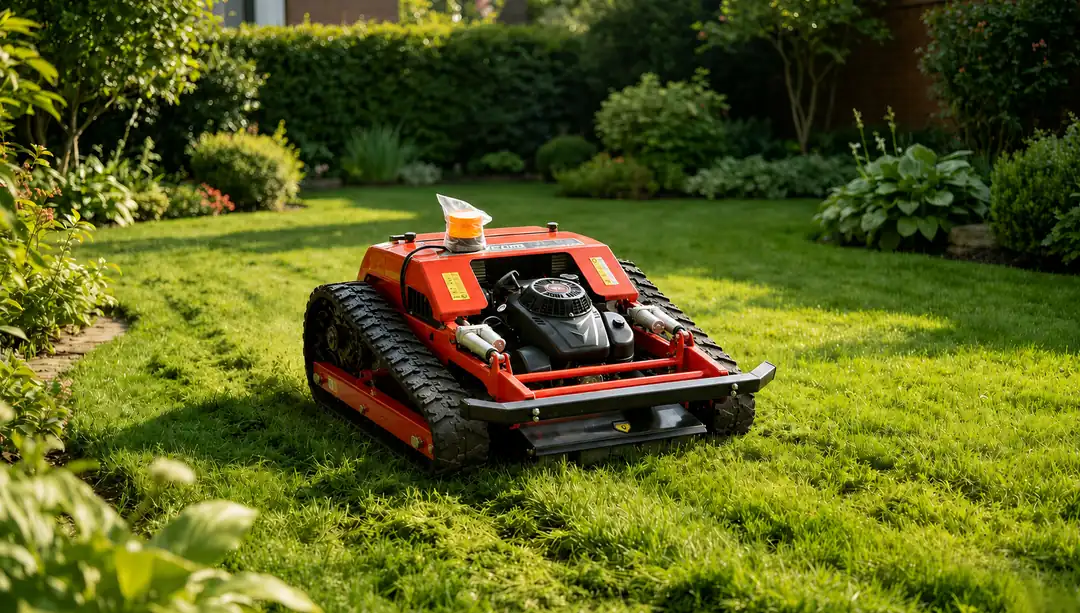
Commercial Landscaping
Professional-grade finish for parks, golf courses, and estates. MERI's T-Series flat-blade system delivers a pristine, uniform cut across large areas — controlled remotely for maximum efficiency.
Match the Machine to the Working Conditions
Terrain alone does not determine the correct mower. Vegetation density, cutting frequency, access width, ground moisture, transport limits and the required daily coverage all affect model selection. Compact machines suit confined routes, while wider and heavier platforms support open areas and demanding vegetation.
Review the recommended product families for each application, then compare individual specifications and technical data sheets. MERI can confirm the final configuration after reviewing site photos, slope information, destination-market requirements and any attachment or spare-parts needs.
Explore application-specific planning guides
Choose the route and working environment closest to your project. Each guide covers site inputs, configuration decisions and the next information to send MERI.
Orchards and vineyards
Compare row access, low branches and recurring floor maintenance.
Account for canopy clearance, irrigation and vegetation.
Review uneven routes, terraces, roots and transitions.
Measure row ends, headland turning and the complete route.
Solar farms
Measure the full machine envelope and protected asset zones.
Separate open-area work from routes near equipment and fences.
Roads, rail and water infrastructure
Plan access and vegetation work within site traffic controls.
Review corridor permissions, working limits and configuration.
Account for ground stability, water edges and maintenance access.
Measure ditch geometry, access, edges and recovery routes.
Review ground conditions, water levels and work windows.
Match equipment to the operator’s access and work controls.
Identify vegetation, access and utility protection requirements.
Public and commercial grounds
Match recurring maintenance to access, users and required finish.
Distinguish maintained turf from rough and sloping work areas.
Plan routes and working zones around equipment and facility operations.
Vegetation and difficult ground
Evaluate bearing capacity and changing conditions before selection.
Match material and desired finish to the compatible cutting system.
Define vegetation tasks and approved work zones around infrastructure.