
Choosing a remote control mower is much easier when the conversation starts with the actual site. A model name by itself tells us very little. We need to see the slope, the vegetation, the access points, the open areas and the awkward edges.
This article looks at two real enquiries from the UK. One came from a landscaping contractor maintaining commercial grounds in Northern Ireland. The other came from a customer dealing with severely overgrown land in Scotland. Both customers sent site photos so that we could make a more useful recommendation.
These are real site assessments, not completed customer performance tests. The photos show the conditions that informed our recommendation; they do not claim that a machine has already been purchased or used at either location.
Why site photos matter before choosing a mower
“I need a mower for a slope” is a starting point, but it is not enough for a responsible recommendation. Two slopes can look completely different. One may be a wide, even bank with clear access. Another may be narrow, wet, uneven or bordered by walls and buildings.
The same is true for overgrown land. Tall grass is different from mixed weeds, brambles, hidden stones or woody growth. Photos help us ask better questions before discussing a machine.
For both enquiries, we looked at four practical factors:
- the shape and apparent steepness of the ground;
- the type and density of the vegetation;
- the size of the open working areas;
- the edges, obstacles and access limitations around the site.
Case 1: Commercial grounds maintenance in Northern Ireland
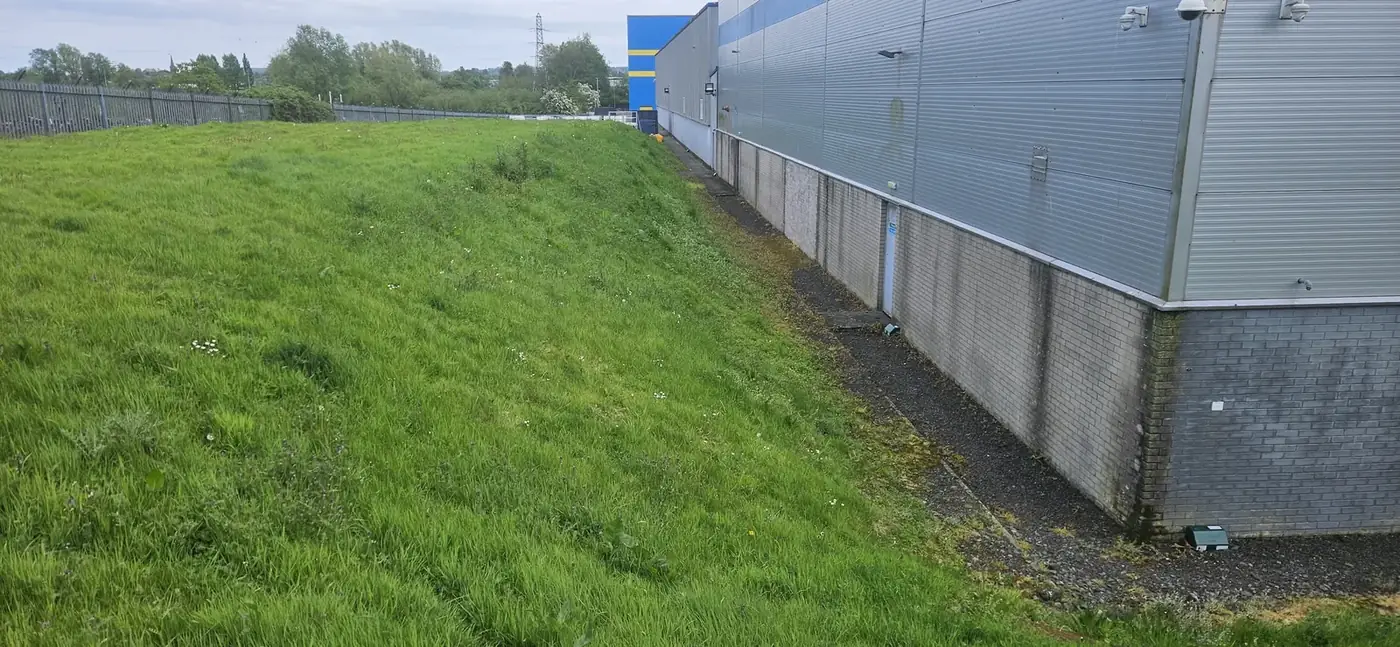
The first enquiry came from a landscaping contractor working around Ballymena, County Antrim. The job involved commercial grounds beside industrial buildings, large grass areas and several noticeable banks.
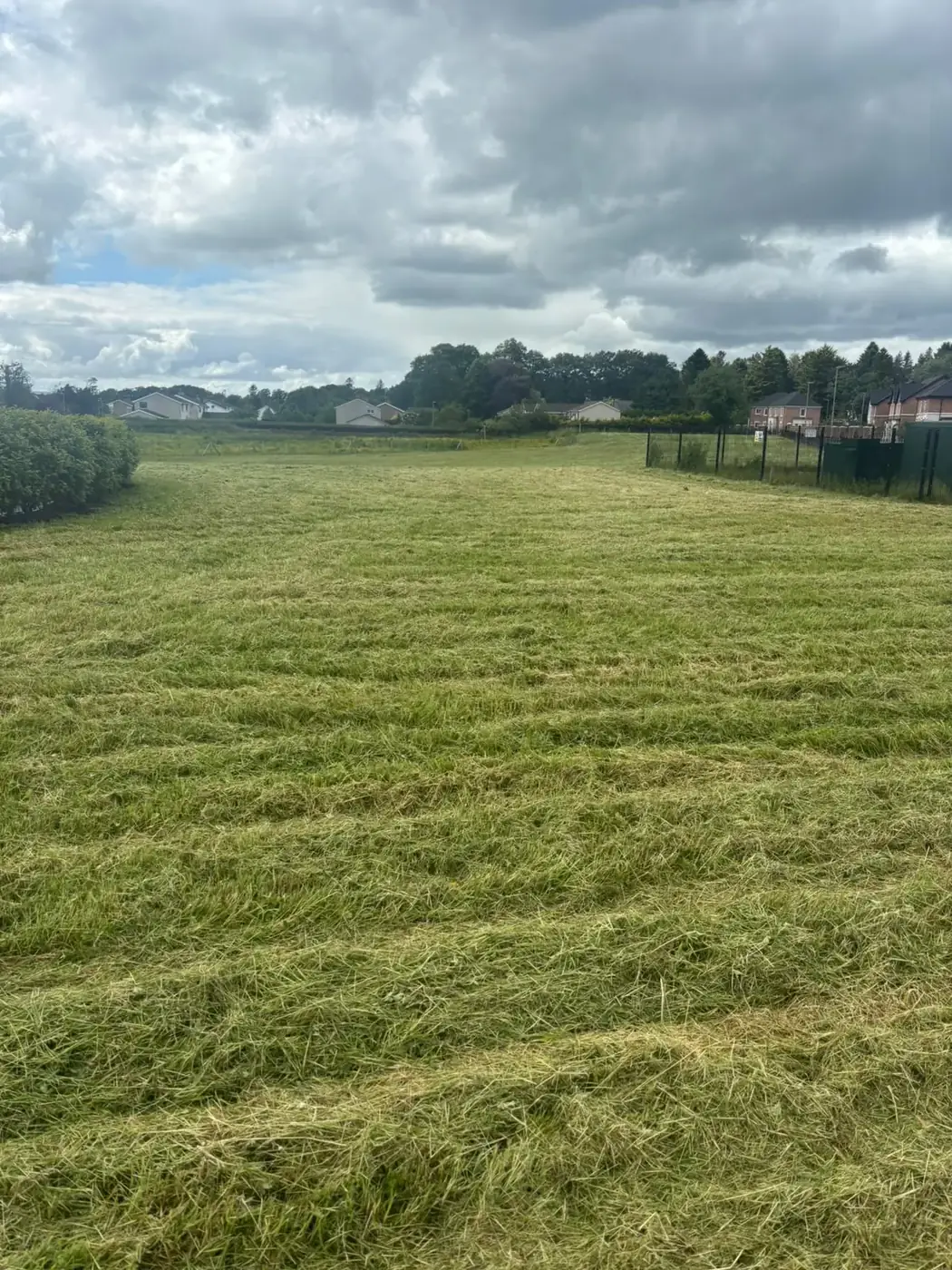
The photos show why this is more than ordinary lawn care. Some sections are broad and open, so cutting width matters. Other sections run along buildings, fences and service paths, so the machine also needs to remain manageable in tighter working areas.
The sloping ground is the most important part of the assessment. A conventional ride-on mower may be suitable for many open lawns, but a contractor should not assume that the same equipment is right for every bank. The actual gradient, ground condition and safe operating method must be checked before work starts.
Why we recommended the ME1000D-24 for this site
Based on the photographs and the contractor’s commercial application, we recommended the ME1000D-24 diesel remote control mower as the model to evaluate in more detail.
The recommendation was based on a simple balance. Its 1000 mm cutting width is suitable for covering open ground without moving immediately to a larger machine. The tracked layout is relevant to uneven and sloping work, while remote operation allows the operator’s position to be planned separately from the mower’s path.
The diesel configuration also made sense for a contractor expecting regular commercial work. However, the photographs alone cannot confirm every operating condition. The maximum slope, wet-ground behaviour, access width, transport plan and vegetation type still need to be checked against the current manual and the exact machine configuration.
Case 2: Severely overgrown land in Scotland
The second enquiry came from the Dundee area in Scotland. The customer described the site as “overgrown waste land,” with some vegetation reaching about six feet.
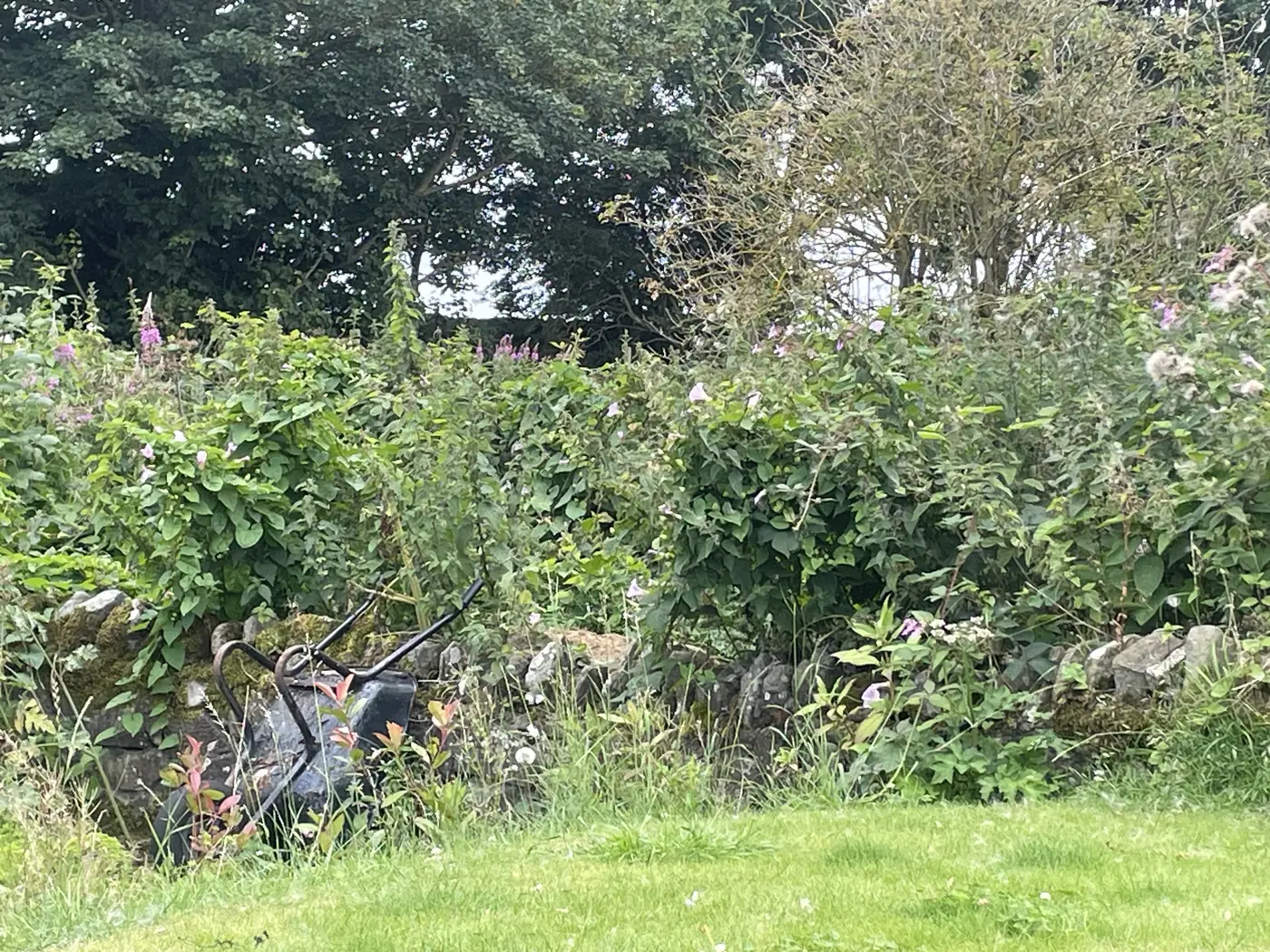
The three submitted photos support that description. They show dense mixed vegetation around an old stone wall, tall weeds at the edge of a maintained lawn and areas where a normal mower would have difficulty entering cleanly.
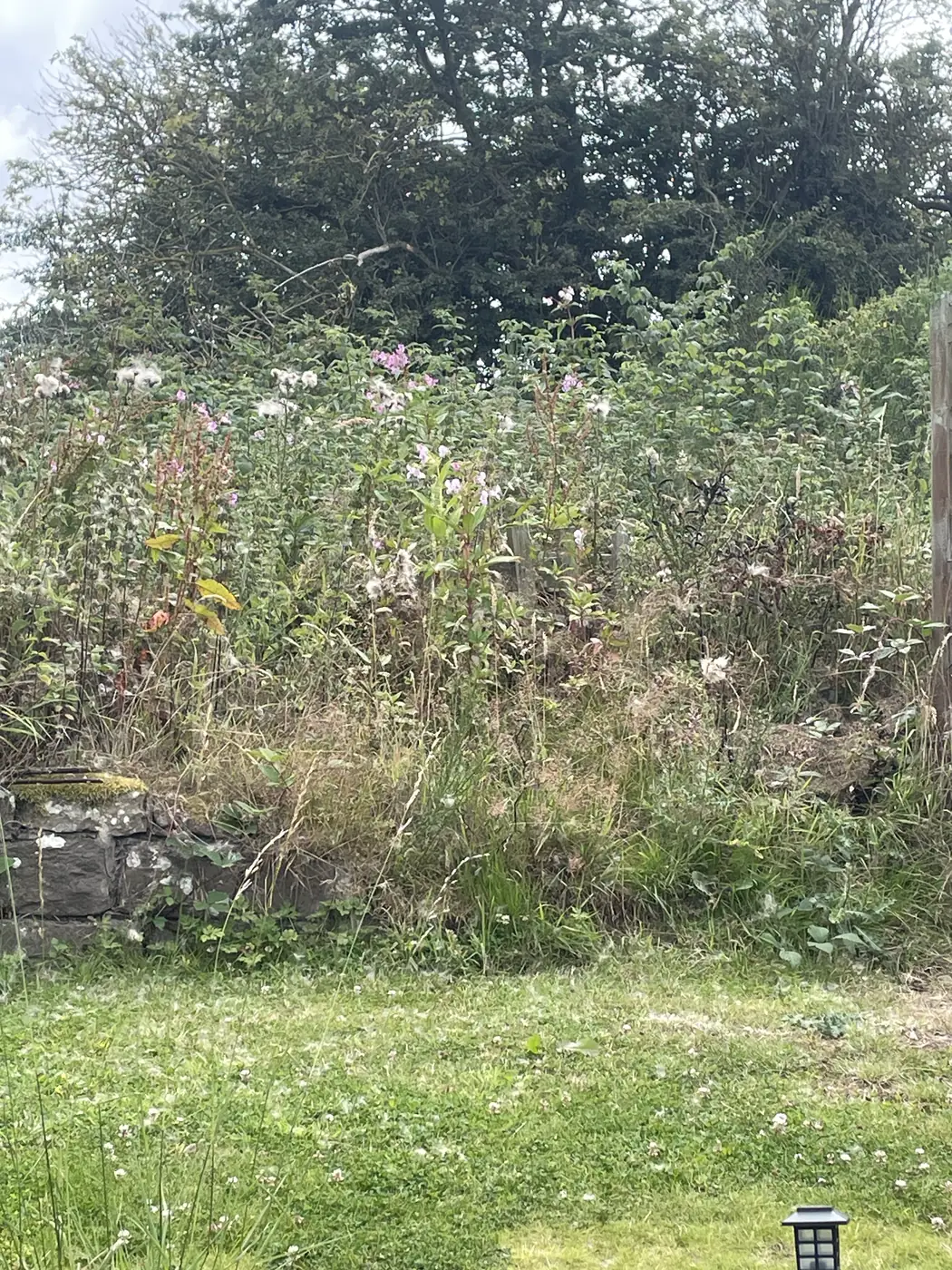
This is not simply a question of mowing long grass. Before any machine enters an area like this, the operator needs to check for hidden stones, wire, timber, holes and other debris. The stone boundary and uneven edge also reduce the amount of clear manoeuvring space.
The photos do not show one uniform field. They show a mix of maintained lawn, neglected edges and heavy growth. That variety is exactly why a site assessment is more useful than choosing a mower from one headline specification.
Why the same model was recommended for a different job
We also recommended the ME1000D-24 as the starting point for the Scottish site, but for different reasons.
Here, the priority was not a polished finish across commercial lawns. It was access to difficult ground, mixed vegetation and extended clearing work. The tracked layout and diesel configuration were relevant, while the 1000 mm cutting width offered a practical middle ground between coverage and manoeuvrability near walls and irregular edges.
That does not mean one model is automatically suitable for every six-foot patch of vegetation. The customer would still need to confirm whether the growth is mainly soft weeds, brambles or woody material. Hidden debris must be removed where possible, and any branch size or cutting limit must be checked against the current machine documentation.
What these two enquiries teach us
Both customers were directed toward the same model, but the reasoning was not identical.
- Northern Ireland: the main balance was commercial coverage, slope access and manoeuvrability around buildings.
- Scotland: the main balance was difficult access, dense mixed growth and control near stone walls and irregular edges.
This is an important buying lesson. Model selection should follow the site, not the other way around. A buyer should never begin with “Which is your biggest machine?” The better question is “What does this site actually require?”
A practical checklist for your own site
If you are comparing remote control mower options, send clear photos from several angles and include the following information:
- the steepest part of the site and whether the figure is in degrees or percent grade;
- the total working area and the size of the difficult sections;
- whether the vegetation is grass, weeds, brambles, brush or mixed growth;
- the narrowest access point and any walls, fences, drains or buildings;
- ground conditions, including soft soil, wet areas, stones or hidden debris;
- how often the site will be maintained and whether the buyer is a contractor or end user.
This information helps a supplier explain the trade-offs clearly. It also reduces the risk of recommending a model from an incomplete description.
Frequently asked questions
Are these completed customer projects?
No. They are genuine customer enquiries and photo-based site assessments. The article explains how the conditions shaped the recommendation; it does not claim a completed sale or verified on-site performance.
Why was the ME1000D-24 recommended for both sites?
Both sites called for a balance of tracked access, diesel power and a 1000 mm cutting width, but the priorities differed. The commercial site focused on slopes and coverage, while the Scottish site focused on dense growth and awkward edges.
Can photos confirm the final mower choice?
Photos are extremely helpful, but they are only part of the assessment. Buyers should also confirm slope, vegetation, access, ground condition, working area and the current technical documentation for the exact model.
Start with the ground, not the brochure
Real sites are rarely neat rectangles. They include banks, walls, wet corners, buildings, rough edges and vegetation that changes through the season. A useful recommendation begins by looking closely at those details.
If you would like a photo-based assessment for your own project, contact Merimow with several site images, your location, approximate working area, slope and vegetation description. We can then discuss which current configuration is worth evaluating.