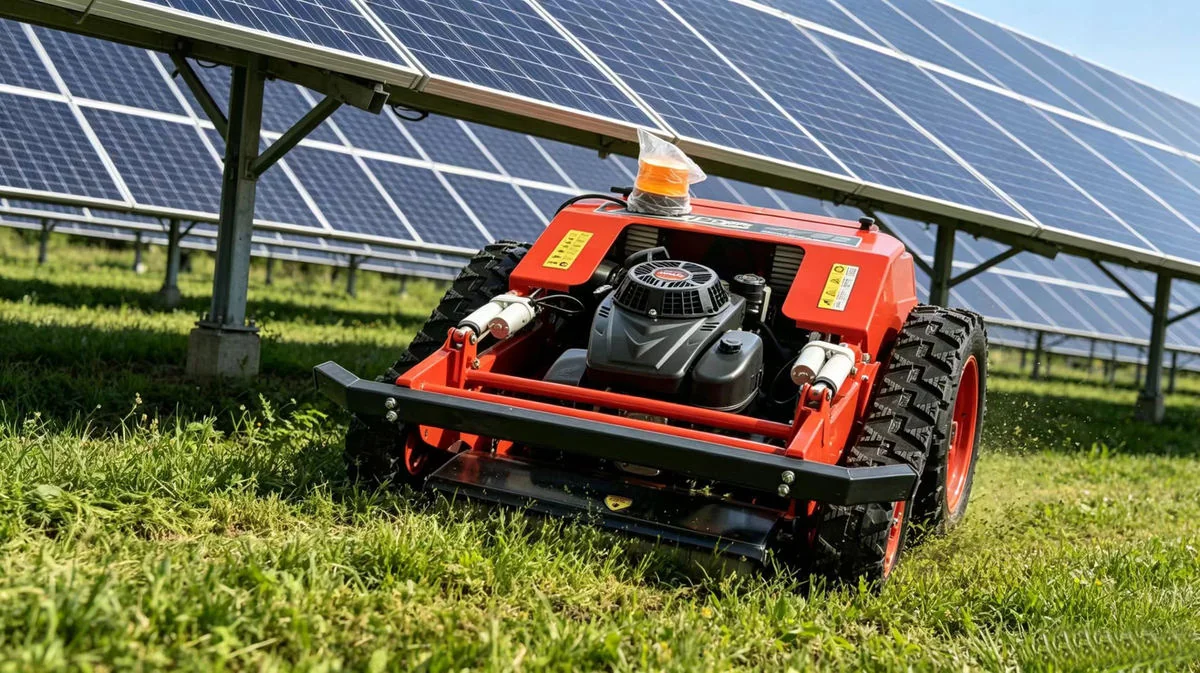
Tracked and wheeled remote control mowers can both be effective, but they are optimized for different ground conditions. The correct choice depends on traction, soil protection, maneuverability, transport, cutting load, and the layout of the orchard or work site.
Choosing only by purchase price can lead to poor traction, unnecessary soil disturbance, difficult turning, or a machine that cannot reach the areas where it is needed most.
How tracked and wheeled undercarriages differ
Wheels concentrate the machine’s weight into relatively small contact patches. This can reduce rolling resistance and make a wheeled machine responsive on firm, even ground. Tires can also be simpler to inspect and replace.
Tracks distribute contact over a longer area and provide many engagement points with the surface. This generally benefits traction on uneven, soft, or sloping ground. The tradeoff is that tracked machines can create more surface disturbance during tight turns, especially when the soil is wet or the operator pivots in one place.
Where wheeled remote mowers make sense
A wheeled mower may be a good fit for open parks, firm turf, broad lanes, and sites where the ground is relatively level and dry. It can be attractive when transport weight, simple servicing, and quick steering are priorities.
Buyers should examine tire type, drive configuration, ground clearance, slope rating, turning radius, and the ability to maintain traction when the cutting deck is under load. A machine that drives well without mowing may behave differently when it encounters dense vegetation.
Why tracked mowers suit many orchards
Orchards commonly combine narrow rows, loose or irrigated soil, roots, fallen fruit, pruning debris, and changes in grade. A tracked mower can provide consistent contact as it crosses small ruts and uneven ground. Its low-profile configuration may also help it work beneath branches where larger ride-on equipment cannot enter.
Track width and machine weight still matter. Soil compaction is influenced by total load, contact area, moisture, turning technique, and the number of passes. Operators should avoid repeated pivot turns near trunks and should test the machine on sensitive ground before beginning full production work.
Compare maneuverability, not just traction
Measure the narrowest row, headland turning space, gate width, transport ramp, and clearance beneath branches. A mower that fits between rows may still require additional room to turn without contacting trees, posts, irrigation equipment, or protective guards.
For obstacle-dense orchards, smooth proportional control and good visibility are as important as maximum remote range. The operator should be able to make small steering corrections without tearing the surface or swinging the cutting deck into nearby assets.
Select the cutting deck for the vegetation
- Flail systems are useful where grass is mixed with weeds, light brush, suckers, or fallen organic material.
- Rotary or flat-blade systems are better suited to regularly maintained turf and a cleaner visual finish.
- Adjustable cutting height helps protect roots, uneven soil, and irrigation components.
- Replaceable, locally stockable wear parts reduce downtime during the growing season.
A practical buying checklist
Before choosing tracks or wheels, record soil type, wet-season conditions, maximum slope, row width, headland space, vegetation, required finish, daily operating hours, and transport limits. Ask the supplier for machine dimensions, working weight, slope test information, cutting-tool specification, track or tire replacement guidance, and a recommended spare-parts package.
Ownership cost should include wear parts, routine service time, fuel or charging, transport, and the effect of downtime during the busiest part of the season. Ask how quickly the supplier can identify parts from a serial number and whether service diagrams, maintenance schedules, and remote technical support are available. A machine that can be maintained predictably is usually more valuable than one selected only on its initial price.
Explore the complete MERI remote control mower range, see the T-Series turf models, or read more about crawler mower use in orchards. For a recommendation based on row width and terrain, contact the MERI factory team.