Boom for low row crops
Review directed, even coverage for low crops and the actual nozzle/boom arrangement. A pesticide sprayer machine is selected for delivery requirements; it is not a guarantee of a chemical’s efficacy.
MERI RCS Series
Tracked spraying platforms for orchards, vineyards, greenhouses and row crops. Choose a 100–800 litre tank and match the boom or airblast configuration to the crop canopy, access width and required coverage.
To prepare your configuration, send the crop type, row spacing, canopy height, access width and refill conditions. We can use these details to narrow down the tank size and boom or airblast setup.


1 / 6

MERI · Commercial equipment selection
Choose a remote control agricultural spraying machine by crop, canopy, row access and refill logistics. MERI’s seven public RCS capacities support boom and airblast configuration planning for the agricultural task.
Review directed, even coverage for low crops and the actual nozzle/boom arrangement. A pesticide sprayer machine is selected for delivery requirements; it is not a guarantee of a chemical’s efficacy.
For orchard/vineyard canopy penetration, consider row access, canopy size, nozzle/fan setup and the required application method.
Compare 100/120/200/300/400/500/800 L with chassis width, work duration and refill access. Larger capacity is not the only selection criterion.
Configuration comes before price
| Capacity class | Tank volume | Chassis width | Remote range | Configuration |
|---|---|---|---|---|
| ME-RCS100 | 100 L | 400 mm | 100–200+ m* | Boom -B / Airblast -A |
| ME-RCS120 | 120 L | 520 mm | 100–200+ m* | Boom -B / Airblast -A |
| ME-RCS200 | 200 L | 700 mm | 100–200+ m* | Boom -B / Airblast -A |
| ME-RCS300 | 300 L | 900 mm | 100–200+ m* | Boom -B / Airblast -A |
| ME-RCS400 | 400 L | 960 mm | 100–200+ m* | Boom -B / Airblast -A |
| ME-RCS500 | 500 L | 980 mm | 100–200+ m* | Boom -B / Airblast -A |
| ME-RCS800 | 800 L | 1100 mm | Up to 500 m | Boom -B / Airblast -A |
Chassis width is not ground clearance or the full implement envelope. Confirm the full configured machine dimensions, turning space and nozzle/fan arrangement for your crop. Seven capacities; no 600 L model is listed.
Factory support
Use the selected model’s technical sheet and operating guide to plan loading, daily checks and wear parts. Send configuration and service needs with your enquiry.
No. The confirmed RCS field is chassis width, with the seven public values shown below.
No. This range is tracked agricultural spraying equipment; boom controllers and industrial blasting systems are different products.
Crop/canopy, rows and gate width, terrain, application requirements, working duration, refill access and destination.
Talk to MERI
Crop/canopy, row and gate width, terrain, boom or airblast task, daily work, refill access and destination.
Send these details with site photos. We can narrow the machine and supply scope before preparing the quotation.
One platform, two spraying systems
Boom configurations apply spray across rows or low crops. Airblast configurations move droplets into orchard and vineyard canopies. Final pump, nozzle, fan and engine selection is confirmed for each order.
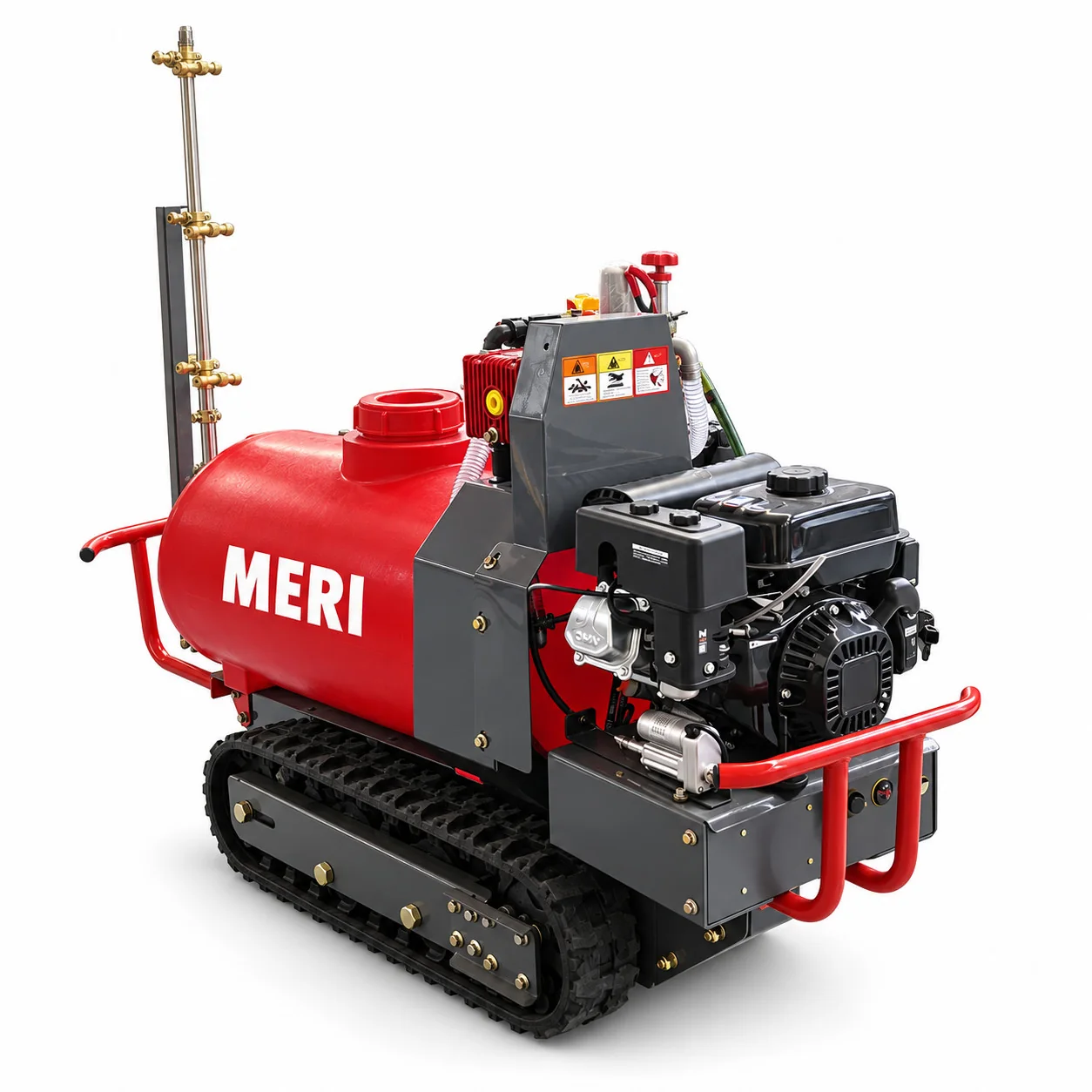
For greenhouses, row crops, nurseries and sites that need controlled horizontal coverage.
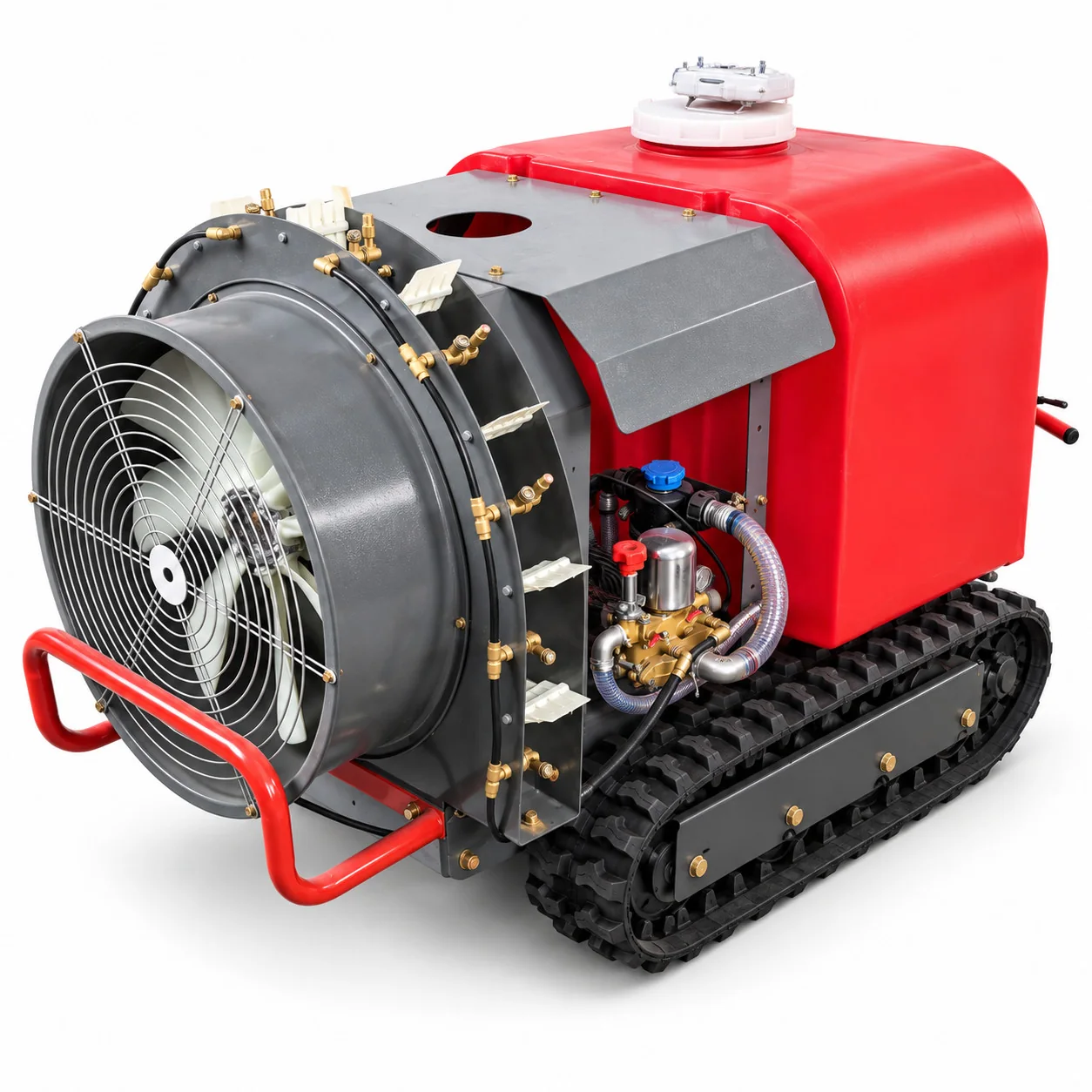
For orchards and vineyards where airflow helps carry spray into dense or elevated canopies.
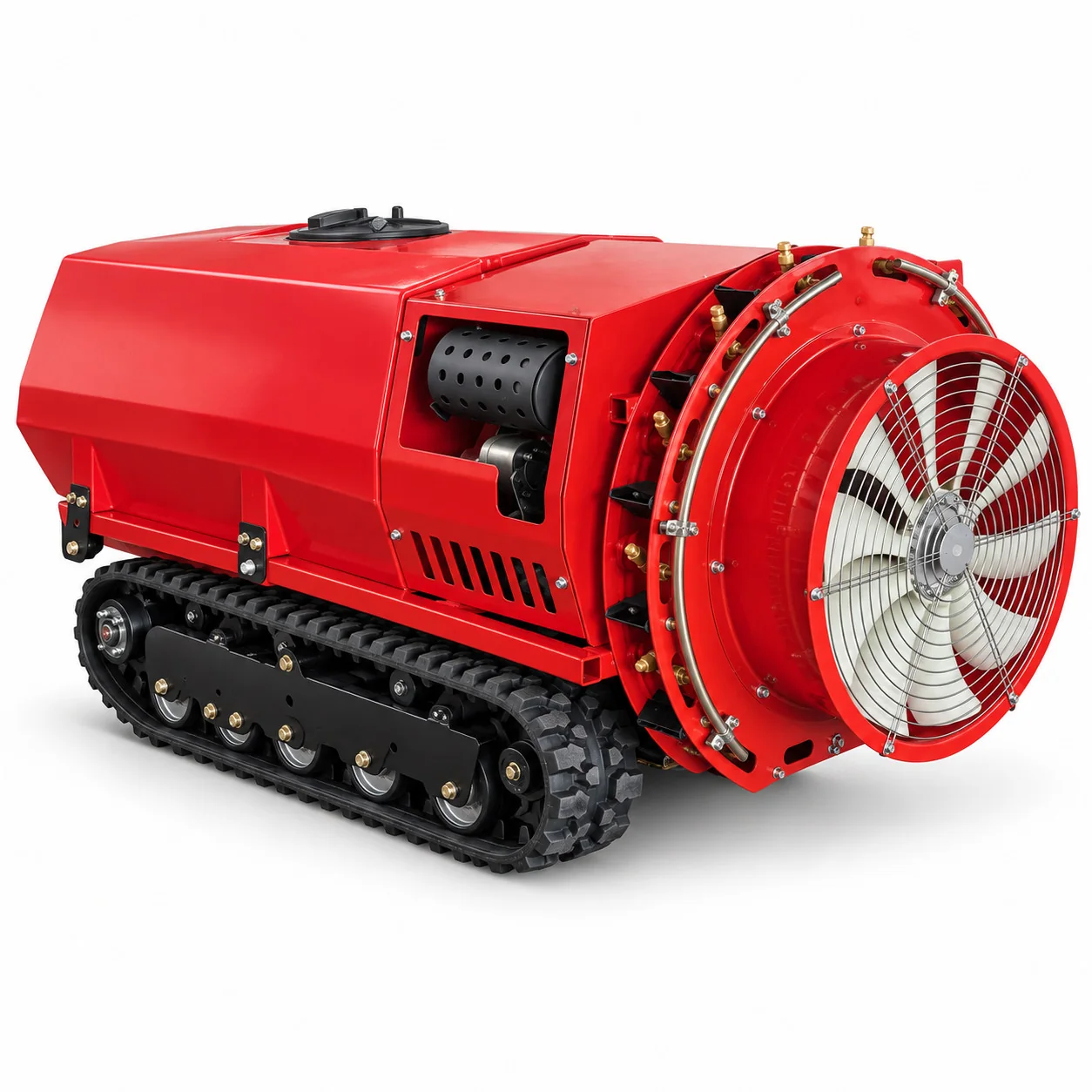
An 800 litre tracked platform for longer work cycles and larger agricultural sites.
Configuration guide
The spray system should be selected by crop structure, canopy height and sensitivity—not by tank size alone.
Boom configuration · -B
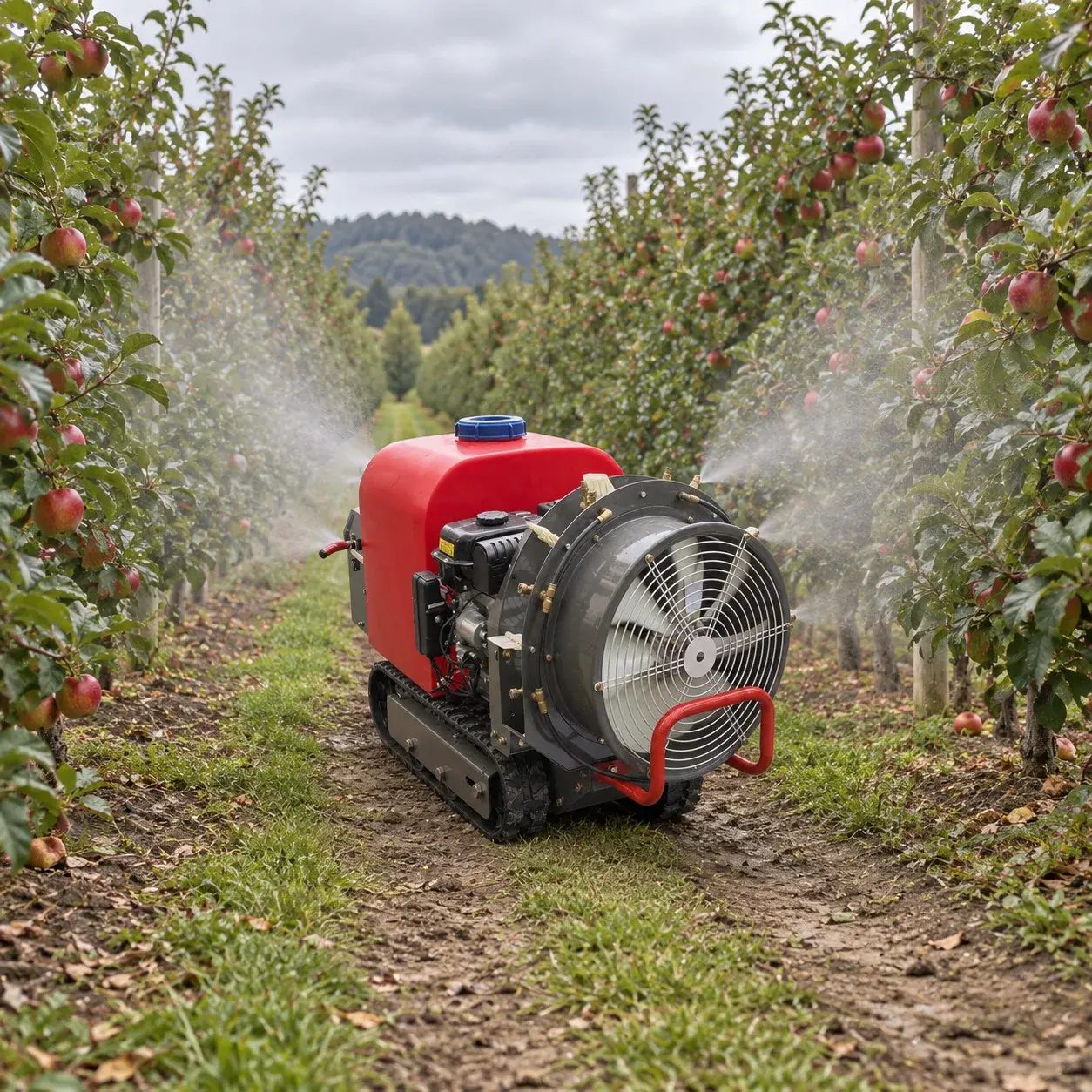
Airblast configuration · -A
| Selection factor | Boom (-B) | Airblast (-A) |
|---|---|---|
| Primary crop structure | Low, evenly arranged or trellised crops | Tall trees and dense three-dimensional canopies |
| Spray delivery | Liquid pressure through boom-mounted nozzles | Atomized spray assisted by high-volume airflow |
| Coverage pattern | Controlled horizontal swath | Vertical, lateral and canopy-penetrating coverage |
| Typical applications | Greenhouses, vegetables, wheat, rice, flowers and nurseries | Apple, pear, citrus, walnut, vineyards, woodland and landscape trees |
| Key site data | Row spacing, boom width, crop height and turning room | Canopy height, density, required reach and airflow |
Quick model selection
Start with the crop and available passage width, then choose tank capacity by continuous working time, refill access and canopy demand.
Vegetables and narrow rows
Orchards under approximately 100 mu
| Site condition | Starting recommendation | Confirm before ordering |
|---|---|---|
| Narrow vegetable rows | ME-RCS100 boom | Row spacing, turning room, boom width and nozzle layout |
| Orchard, narrow access or easy refilling | ME-RCS120 airblast | Chassis passage width, canopy height and required work cycle |
| Orchard, balanced capacity and manoeuvrability | ME-RCS200 or ME-RCS300 airblast | Row width, refill distance, liquid demand and canopy density |
| Orchard, longer work cycle or dense canopy | ME-RCS400 airblast | 960 mm chassis width, turning clearance and refill plan |
| Larger sites and extended work cycles | ME-RCS500 or ME-RCS800 | Access width, ground conditions, capacity and transport limits |
Available customization: boom height, boom width, nozzle quantity, chassis width and engine selection are confirmed for the crop and site. Share crop type, row spacing, canopy size, working area and refill conditions for a factory recommendation.
Model range
Remote control range is 100–200+ m (indicative) for ME-RCS100 to ME-RCS500; the ME-RCS800 is listed at up to 500 m. Values marked configuration dependent are finalized with the selected engine, pump, fan and spray system. The airblast fan size applies to the airblast (-A) configuration. Values marked * are indicative and vary by engine, pump, nozzle, fan and order configuration.
| Model | Tank | Dimensions (L×W×H) | Chassis width | Weight | Travel speed | Remote | Airblast fan | Indicative spray coverage | TDS |
|---|---|---|---|---|---|---|---|---|---|
| ME-RCS100 | 100 L | 1500×450×1000 mm | 400 mm chassis width | 150 kg | 80 m/min | 100–200+ m* | By configuration | Up to 7 m* | |
| ME-RCS120 | 120 L | 1500×620×850 mm | 520 mm chassis width | 190 kg | 80 m/min | 100–200+ m* | 450 mm | Up to 12 m wide / 5.5 m high* | |
| ME-RCS200 | 200 L | 1650×850×960 mm | 700 mm chassis width | 280 kg | 80 m/min | 100–200+ m* | 500 mm | Up to 14 m wide / 6 m high* | |
| ME-RCS300 | 300 L | 1720×900×1140 mm | 900 mm chassis width | 351 kg | 60–80 m/min | 100–200+ m* | 600 mm | Up to 16 m wide / 8 m high* | |
| ME-RCS400 | 400 L | 1850×960×1140 mm | 960 mm chassis width | 420 kg | 60–80 m/min | 100–200+ m* | 600 mm* | Up to 16 m wide / 8 m high* | |
| ME-RCS500 | 500 L | 2000×980×1170 mm | 980 mm chassis width | 465 kg | 60–80 m/min | 100–200+ m* | 600 mm | Up to 16 m wide / 10 m high* | |
| ME-RCS800 | 800 L | 2200×1100×1060 mm | 1100 mm chassis width | 350 kg net | 100–133 m/min | Up to 500 m* | 600 mm | Airblast reach up to 13 m* |
Application planning
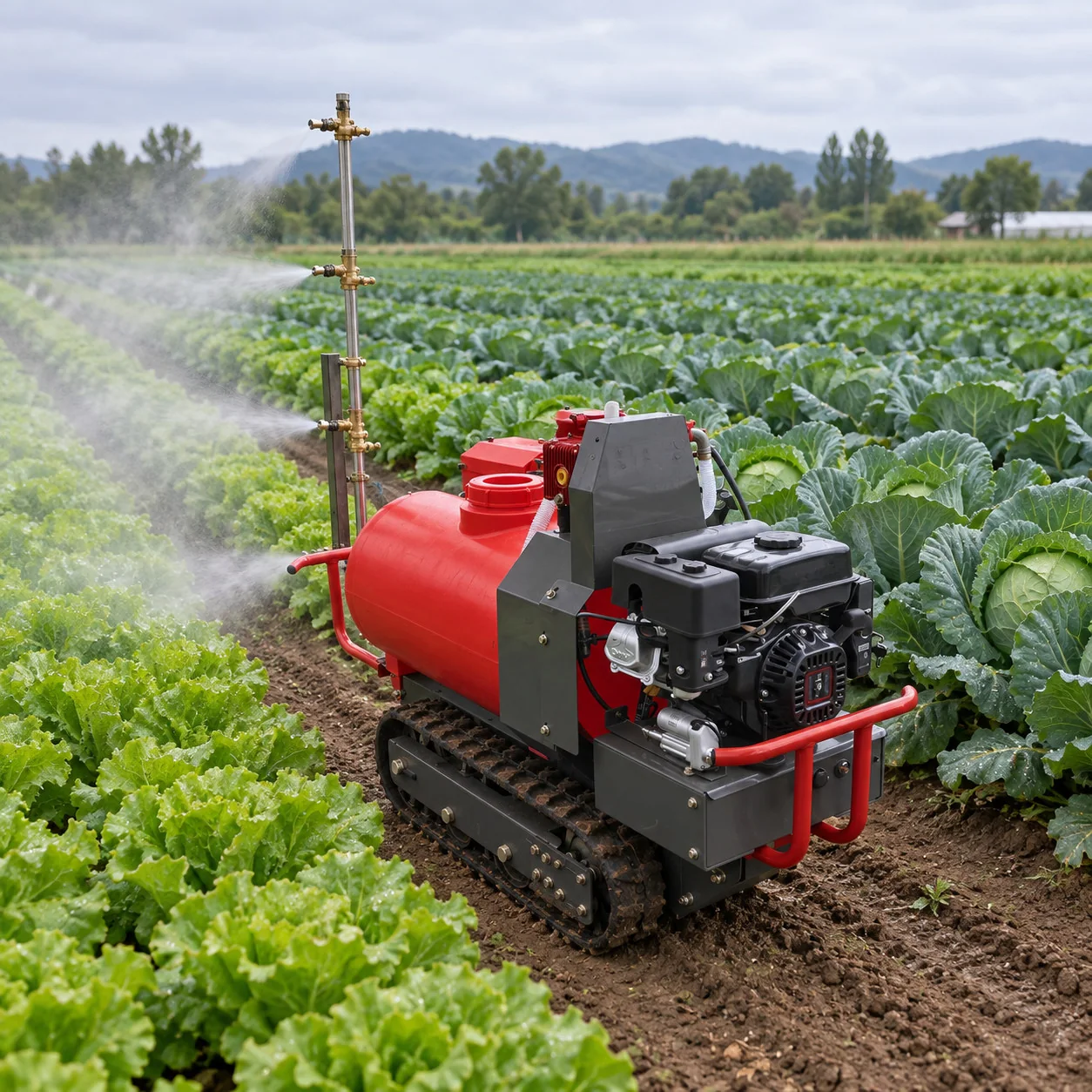
These application images are visualizations for configuration planning. Final suitability depends on crop height, row spacing, chemical requirements and local operating rules.
Boom coverage for open rows and low crop canopies.
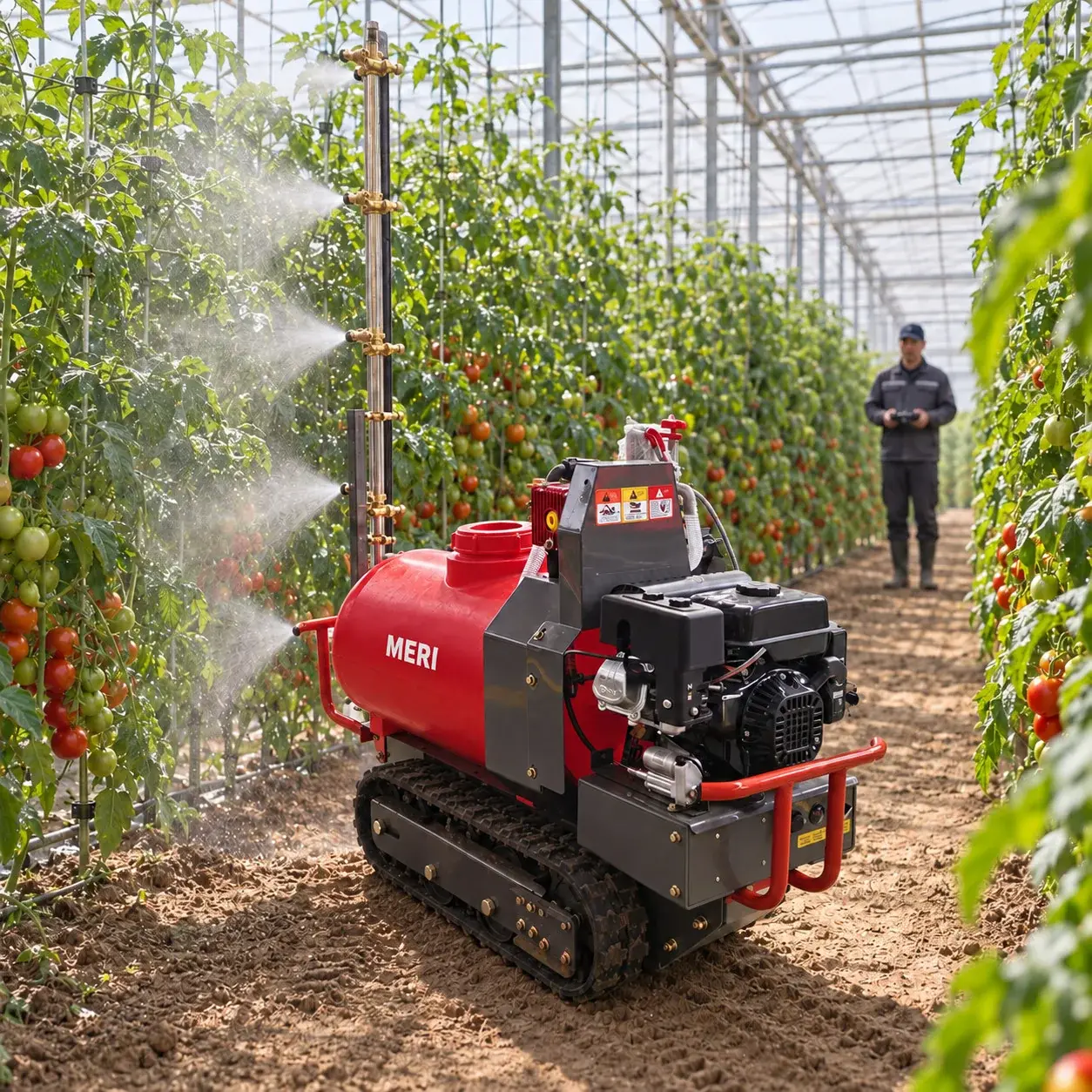
Tracked mobility and remote operation for restricted access routes.
Air-assisted coverage for vertical and dense canopies.
Core equipment
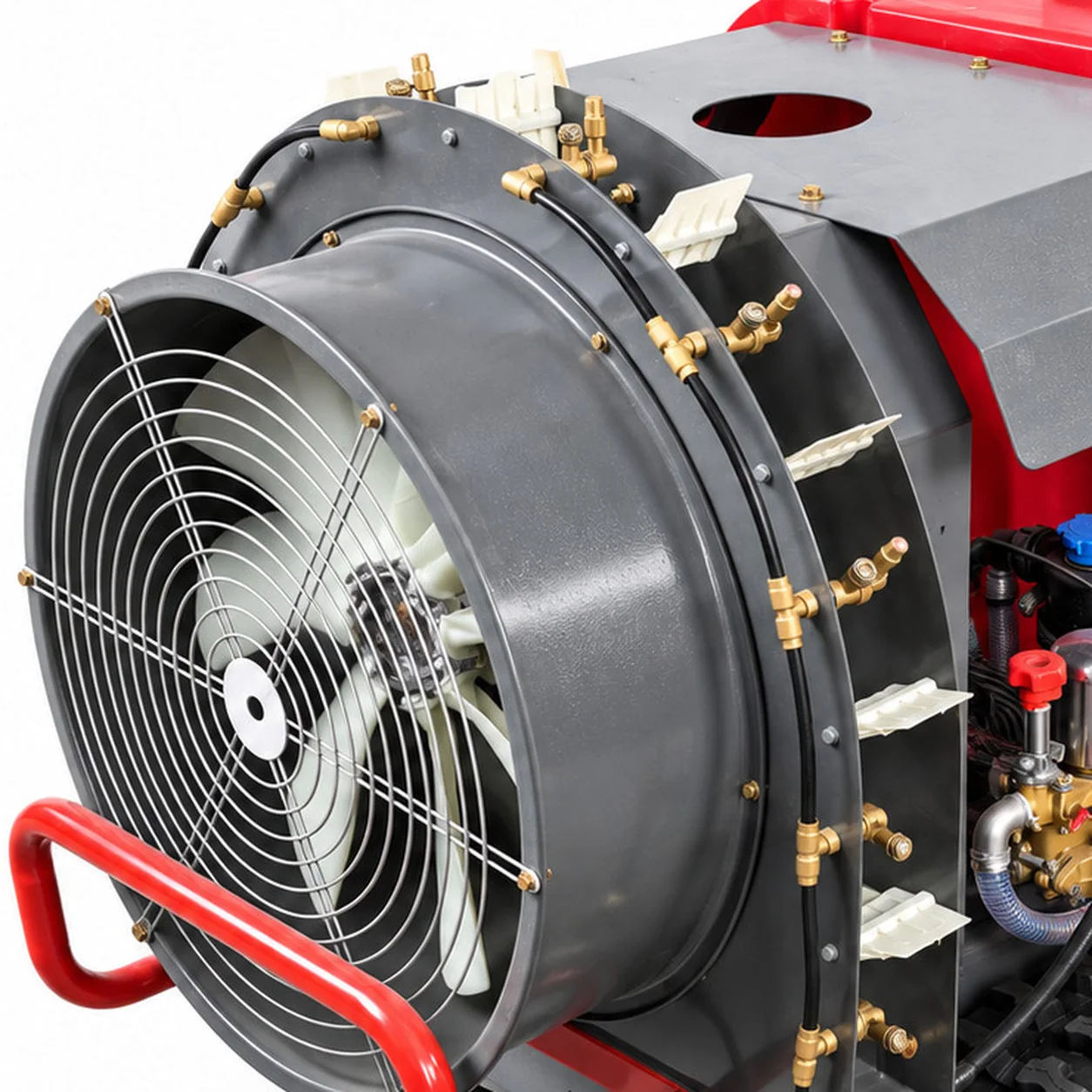
Fan size and airflow are selected for canopy height and density.
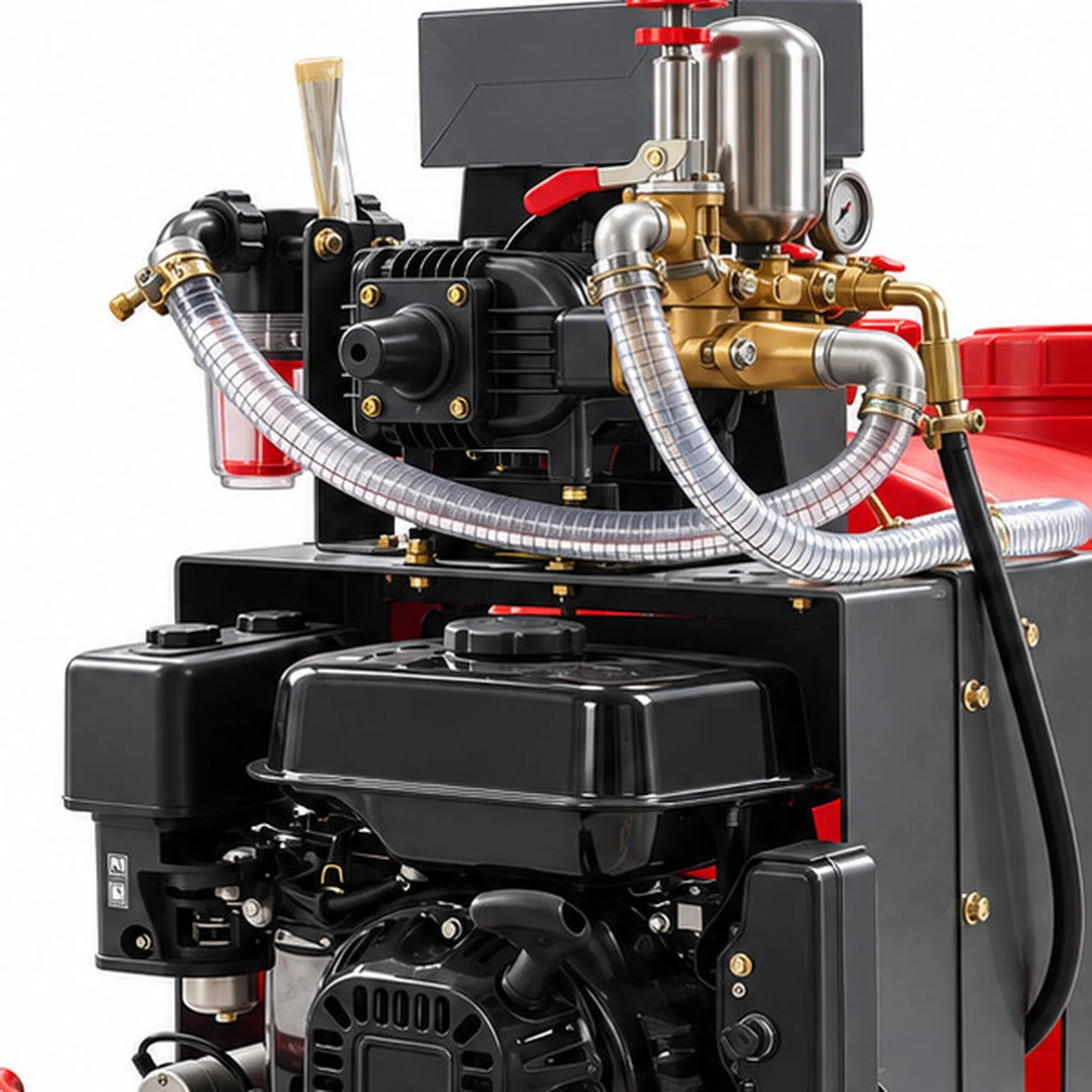
Pump, filters, nozzles and plumbing are matched to the chemical and coverage plan.
Model coding: use -B for boom and -A for airblast after tank capacity and configuration are confirmed.
Buyer questions
Answers to common crop, tank and spray-system questions for the MERI RCS tracked sprayer series. The final model and component setup should be confirmed for the crop and site.
Boom configurations use pressure-fed nozzles for a defined horizontal swath and suit low, evenly arranged or trellised crops. Airblast uses fan airflow to carry atomized spray into taller or denser canopies such as orchards and vineyards. Choose based on crop structure, canopy height, coverage needs and access.
The series covers 100–800 L. Start with crop and route access, then consider row spacing, continuous work time, refill distance, water availability and canopy demand. A larger tank is not automatically the best fit if it cannot pass or turn comfortably on the site.
The page recommends the ME-RCS100 with a boom configuration as the first model to consider for narrow vegetable rows. Confirm row spacing, turning room, boom dimensions and nozzle layout.
Use -B for a boom configuration and -A for an airblast configuration after the tank capacity and final setup are confirmed.
No single setup is stated for every order. The series page says the final pump, nozzle, fan and engine selection is confirmed for the crop and site. Provide the crop and coverage requirements for configuration review.
Send crop type, row spacing, canopy height and density, narrowest passage, turning room, slope, refill conditions, work area and desired work cycle. The team can use these details to compare a suitable model and spray system.
ME-RCS100 to ME-RCS500 are listed at 100–200+ m (indicative) and the ME-RCS800 at up to 500 m. Real range depends on terrain, trees and obstacles, so review the selected model TDS and confirm the final configuration before ordering.
Practical field resources
Simple checks and troubleshooting steps help crews prepare for work and report problems clearly. Always follow the manual for the actual machine and installed components.
Walk-around checks for hoses, pump, fan guard, spray outlets, tracks and remote response—plus clear stop-work signs.
Trace low output across the supply, accessible lines, filters, pump symptoms, nozzles and controls before replacing parts.
Match the spray system to crop targets, coverage requirements and the selected machine configuration.
Understand how fan setup and canopy structure shape orchard coverage planning.
Follow the video-led guide to the C7 controls, engine start-up and core spraying functions shown on the demonstration machine.
Review a practical post-use cleanout sequence for the tank and spray circuit, with label- and manual-based handling guidance.
Send crop type, canopy height, row spacing, site slope and preferred tank capacity. MERI will recommend the appropriate model and spray configuration.