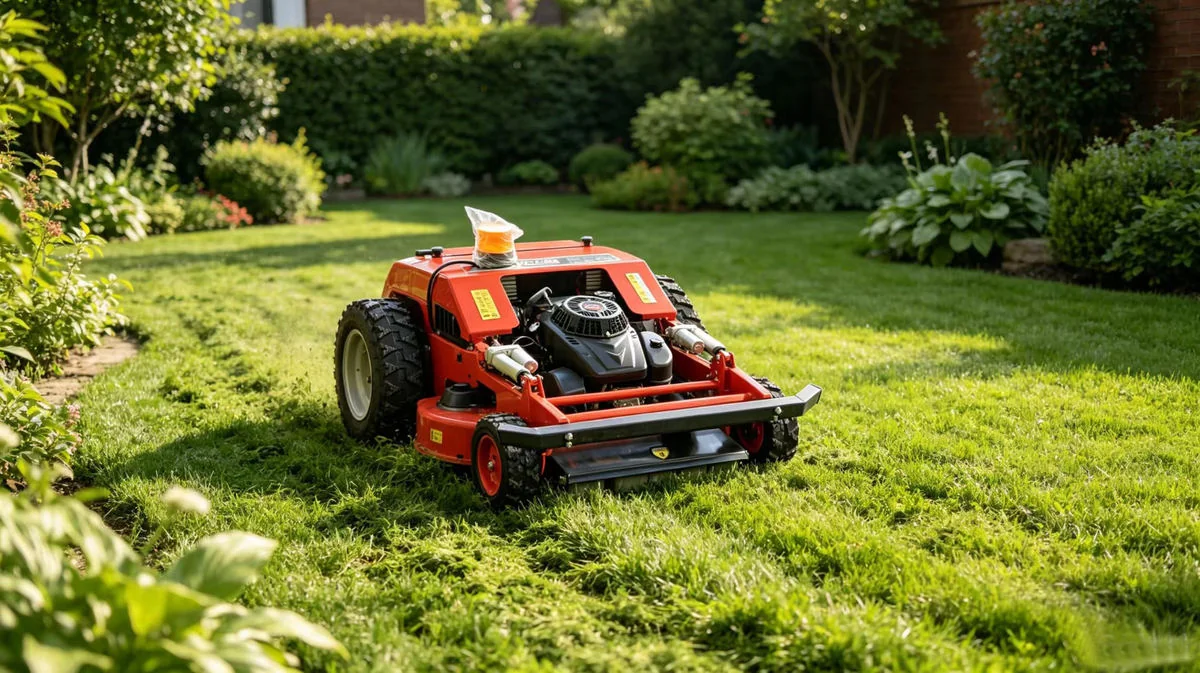
Remote control and autonomous robot lawn mowers solve different maintenance problems. A robot is designed to trim predictable grass repeatedly with minimal daily supervision. A remote control mower keeps a human operator in real-time control while moving the operator away from the cutting deck and difficult ground.
The better choice depends on the work site, vegetation, acceptable supervision, and the consequences of the machine becoming stuck or missing an area.
How autonomous robot mowers work
Most robot mowers maintain grass by making frequent light passes. Depending on the model, navigation may use a boundary wire, satellite positioning, cameras, local beacons, or a combination of sensors. The machine normally returns to a charging station and works within a configured area.
This approach can be effective for maintained residential or commercial lawns with reliable boundaries, manageable obstacles, and vegetation that is cut often. Site preparation and installation requirements should be included in the purchase decision.
How remote control mowers work
A remote control mower is driven by an operator who can see the terrain and respond immediately. Tracked commercial models are intended for work areas such as embankments, orchards, solar farms, infrastructure corridors, and overgrown sites where conditions change during the job.
The operator chooses the cutting path, avoids hazards, adjusts speed, and stops the machine when visibility or traction becomes uncertain. This makes the equipment more flexible, but it still requires a trained person during operation.
Compare the vegetation, not only the lawn size
Robot mowers perform best when they remove a small amount of grass on each pass. Tall, wet, tangled, or woody vegetation can exceed the capacity of a light mulching system. A commercial remote mower may use a flail or heavy-duty cutting deck designed for more demanding growth.
Buyers should record typical vegetation height, stem thickness, cutting frequency, desired finish, and whether the site contains fallen fruit, pruning waste, or light brush. The correct cutting system matters as much as the drive system.
Slope, surface, and obstacles
Published incline ratings are measured under defined conditions and should not be treated as universal performance promises. Wet clay, loose soil, gravel, leaf litter, holes, roots, and cut material can reduce usable traction. Small robot wheels may struggle where a longer tracked contact area remains stable, but every machine must still be operated within its instructions.
Continuous obstacles also influence the choice. A robot needs reliable detection and a predictable boundary. A remote operator can make judgment calls around posts, drainage channels, tree rows, panel supports, and changing work zones.
Labor and supervision are different, not eliminated
A robot reduces hands-on driving but requires installation, monitoring, blade changes, cleaning, recovery, and boundary maintenance. A remote control mower requires an operator during the task but can complete heavier work and move between unrelated sites without a permanent navigation installation.
Commercial buyers should compare total labor across the full maintenance cycle rather than comparing “autonomous” with “manual” in isolation.
Which machine fits which site?
- Choose a robot mower for frequent light cutting on a stable, prepared lawn where unattended scheduling is the priority.
- Choose a remote control mower for changing sites, heavier vegetation, difficult access, operator-visible hazards, or commercial slope work.
- Consider both when a facility has maintained lawn near buildings and separate rough ground, banks, or perimeter vegetation.
Questions to ask before buying
Ask about the tested slope condition, navigation or remote-control method, emergency stop, cutting capacity, access width, daily operating time, weather restrictions, transport, spare parts, warranty, and operator training. Request the relevant manual and technical data rather than relying only on a headline incline figure.
Read the full RC vs robot buyer guide, review robot mower slope limitations, compare the MERI remote control mower range, or send MERI your site details for a model recommendation.