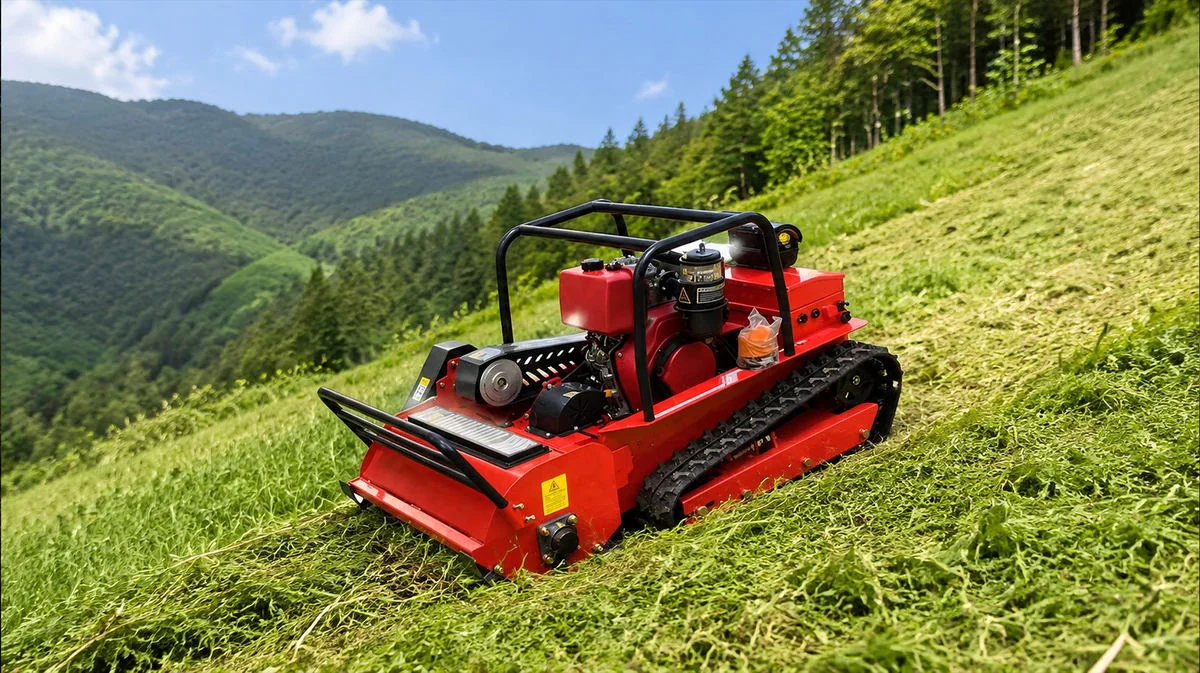
Remote control lawn mowers change the safety equation on steep slopes by allowing the operator to stand away from the cutting deck and unstable ground. That advantage is significant, but it does not replace a disciplined operating procedure. Terrain, weather, machine condition, and operator position still determine whether a job is completed safely.
The following five practices provide a practical pre-shift framework for commercial slope mowing. Always follow the operating manual supplied with your specific machine and comply with local workplace requirements.
1. Inspect the entire work area before starting
Walk the slope while the mower is switched off. Look for hidden ditches, loose stones, irrigation lines, wire, tree stumps, animal holes, soft shoulders, and sudden changes in grade. Tall grass can hide hazards that are impossible to identify from the operating position.
Mark hazards that cannot be removed. Define a clear operating boundary and identify safe entry and exit points. If the site includes a public road, footpath, building, vehicle, or solar equipment, create an exclusion zone large enough to contain thrown objects and unexpected machine movement.
2. Choose a safe operator position and maintain visibility
Stand on stable ground with a clear view of the mower, the cutting path, and the area below the machine. Whenever practical, remain uphill or to the side rather than directly downhill. Never position yourself between the mower and a fixed obstacle.
The advertised remote range is a capability, not a recommended everyday operating distance. Use the shortest distance that gives you a complete view and reliable control. Buildings, vegetation, terrain folds, and electrical equipment can affect visibility or signal quality. Stop immediately if you lose a clear view of the machine.
3. Select the travel pattern for the actual terrain
There is no single mowing direction that suits every slope. A contour pattern may improve stability on a consistent hillside, while an up-and-down pattern may be more appropriate when the manufacturer specifically recommends it for the machine and ground conditions. Avoid making abrupt turns at the steepest point of the slope.
Begin at low speed and test traction in a clear area. Maintain smooth steering inputs and leave enough space for a controlled turn. If the tracks begin to slide, reduce the load and return to a safer line instead of trying to correct with a sudden direction change.
4. Adjust for wet ground, loose soil, and heavy vegetation
A mower rated for a particular maximum slope under suitable conditions may have less usable traction on wet clay, loose gravel, leaf litter, recently disturbed soil, or ground covered by cut material. Treat the machine rating as an upper technical limit, not a target for every site.
Reduce speed in uncertain conditions and make a short test pass before committing to the full slope. Heavy brush also increases cutting load. Use a suitable cutting height and avoid forcing the deck into material faster than it can discharge it.
5. Complete a pre-start machine check
Before every shift, inspect track condition and tension, blade or flail condition, guards, fasteners, fuel or battery status, oil level where applicable, remote-control battery, and emergency-stop operation. Remove accumulated grass from cooling and ventilation areas only after the engine and cutting system are fully stopped.
- Confirm that all guards and covers are installed.
- Test the emergency stop in a clear area.
- Check for damaged, loose, or unevenly worn cutting tools.
- Verify that the remote-control commands respond correctly.
- Keep unauthorized people outside the work zone.
Build safety into machine selection
Safe operation begins before the machine arrives. Buyers should compare slope capability, machine width, center of gravity, cutting system, emergency controls, parts availability, and the manufacturer’s operating documentation. A model that matches the vegetation and working width is easier to operate smoothly than a machine selected only by maximum specification.
See how MERI remote control slope mowers are configured for difficult terrain, compare the full remote control lawn mower lineup, or review crawler mower operation and maintenance guidance. For help matching a machine to a specific site, send MERI your slope, acreage, and vegetation details.