
Remote Control Mower for Solar Farm Vegetation Management
Solar sites can contain long panel rows, restricted clearance, uneven ground and vegetation that grows around supports, cables and drainage routes. A remote control mower for solar farm vegetation lets the operator control the machine from a separate viewing position while managing grass and mixed soft vegetation between and beneath arrays. Final suitability depends on panel clearance, row width, terrain, vegetation, obstacles and the selected mower configuration.
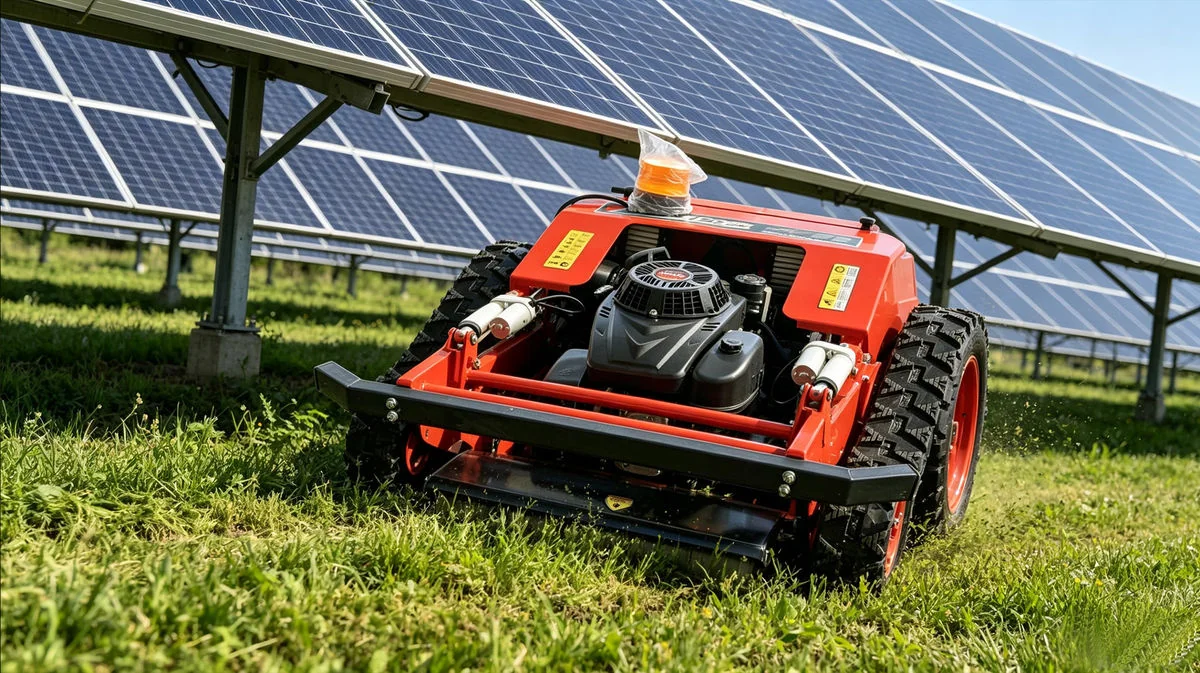
Why Solar Farms Need Specialized Vegetation Control
Uncontrolled vegetation can restrict inspection access, grow around equipment and increase dry combustible material during hot periods. Manual trimming, herbicide programs and grazing each have different labor, site-policy and consistency trade-offs. Mechanical mowing can form part of the maintenance plan where the machine fits beneath the array and the operator can maintain clear sight of supports, wiring routes and other obstacles.
Challenges of Traditional Mowing Around Solar Arrays
Solar panel rows often sit on uneven, sloped ground with limited clearance underneath. Ride-on mowers cannot fit beneath low-mounted panels. Walk-behind mowers expose workers to heat, dust, and the risk of contacting electrical infrastructure. On ground-mounted arrays built on hillsides — increasingly common as flat land becomes scarce — slope angles of 20 to 35 degrees make conventional equipment unstable. Remote control slope mowers, designed for steep and rough terrain, solve this by keeping the operator at a safe distance while the machine navigates tight rows and inclines.
Panel supports, exposed connectors, loose cable ties, stones and maintenance debris must be identified before mowing. No cutting system removes thrown-object or impact risk. The operator should establish an exclusion zone, keep clear line-of-sight, use the guards supplied with the selected machine and stop before entering areas where cable position or ground hazards are uncertain.
How a Remote Control Mower Handles Solar Farm Terrain
A tracked remote mower can be useful on uneven ground and around sloped access routes because the operator’s position is separate from the mower’s path. Machine height, width, remote-control range and working-slope limits vary by model and configuration; they must be checked against the current technical data sheet and the measured site. Tracks can support contact on irregular ground, but they do not guarantee grip on wet soil, loose gravel or every cross-slope route.
Key Features for Solar Farm Vegetation Management
When selecting equipment for solar site maintenance, several specifications matter:
Machine dimensions and cutting width: Measure the narrowest clear row, the lowest panel edge, turning space and access gates. Compare these measurements with the full machine width and height—not only the cutting width—and retain an operating margin around supports and cables.
Power system: MERI gasoline and diesel models use a lead-acid battery within an engine-driven generating system. While the engine operates, the generator continuously supplies electrical power to the drive and control system, so working time depends mainly on fuel supply, workload and site conditions rather than lithium-battery endurance.
Slope and ground condition: Measure the normal working slope and the steepest short transition. Model capability depends on surface grip, moisture, travel direction, vegetation load and the exact configuration, so a headline maximum angle is not enough for final selection.
Track and ground interaction: Rubber tracks spread machine contact over a wider area than small wheels, but actual marking, compaction and grip depend on machine weight, soil moisture, turning method and surface condition.
Operational Tips for Solar Site Maintenance
To maximize efficiency and safety when using a remote control mower on a solar farm, follow these practices. Mow during early morning or overcast days when panel surfaces are cool and visibility is best. Establish a grid pattern that follows the panel rows, completing one section before moving to the next. Inspect the cutting deck for debris after each session — solar sites often have loose wire, zip ties, and panel fragments that can damage blades. Train at least two operators so maintenance schedules are never delayed by personnel availability. For sites with real customer site assessments, conduct a walk-through to mark drainage channels and soft ground before the first mowing pass.
Maintain a seasonal schedule that aligns with local growing cycles. In temperate climates, vegetation growth peaks in spring and early summer, requiring biweekly mowing. During dry seasons, monthly passes may suffice. Always log mowing dates, areas covered, and any incidents — this record supports insurance claims and demonstrates regulatory compliance during audits.
MERI Models to Review for Solar Farm Maintenance
Useful starting points include the compact ME550-T where access is narrow, the ME800-24 for mixed row and open-area maintenance, and the ME1000-24 where wider access supports greater coverage. These are comparison starting points, not universal recommendations. Confirm full machine dimensions, clearance, slope, vegetation and total working area before choosing the final model.
SITE-BASED MODEL ADVICE
Need a Model Recommendation for Your Site?
Send us your steepest gradient, vegetation type, working area, narrowest access width and delivery country. MERI will recommend a suitable model and configuration for comparison.
Request Model AdviceFAQ: Remote Control Mowers for Solar Farms
Can a remote control mower fit under solar panels?
Only when the full machine height, width and turning envelope fit the measured array. Panel systems do not share one standard clearance, and mower dimensions vary by model. Measure the lowest panel edge and all support or cable obstructions before selecting a machine.
Does the mower stop when a traction battery is discharged?
MERI uses an engine-driven generating system with a lead-acid support battery. While the engine is running, electrical power is supplied continuously to the drive and control system. Practical runtime therefore depends mainly on fuel, workload and routine operating checks.
How much area can a MERI mower cover?
Current MERI product pages list 5,000 m²/hour for the ME800, ME1000 and ME1200 families. Actual solar-site output depends on panel-row spacing, turning room, vegetation density, slope and obstacles, so buyers should confirm the applicable model value again when requesting a quotation.
What happens if the mower hits a panel support post?
Stop the cutting system and inspect the mower, support post, guards and surrounding cables before continuing. Operators should maintain line-of-sight, keep people outside the work zone and follow the emergency-stop and inspection procedure for the exact model.