
Choosing a remote control mower for steep olive orchard land is not only about cutting grass. The ground under the machine matters just as much.
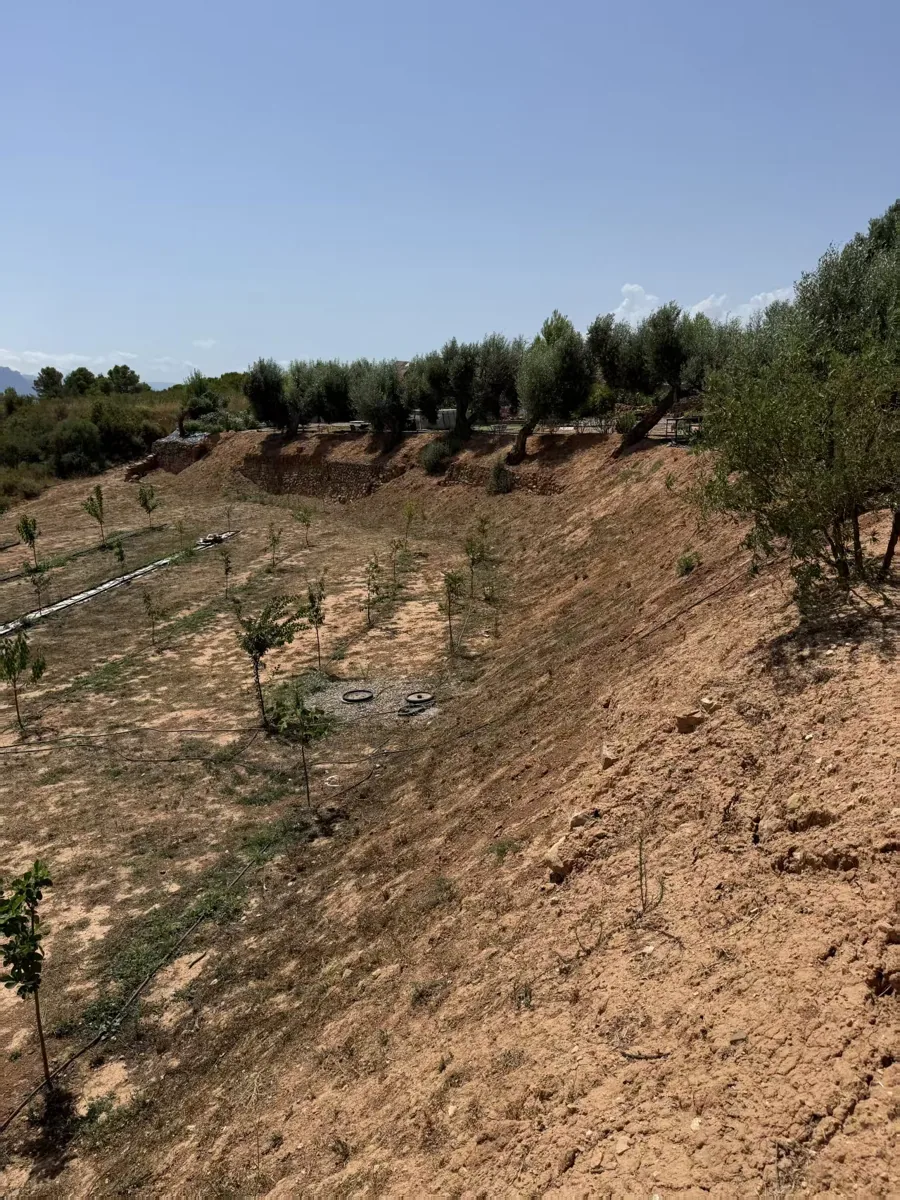
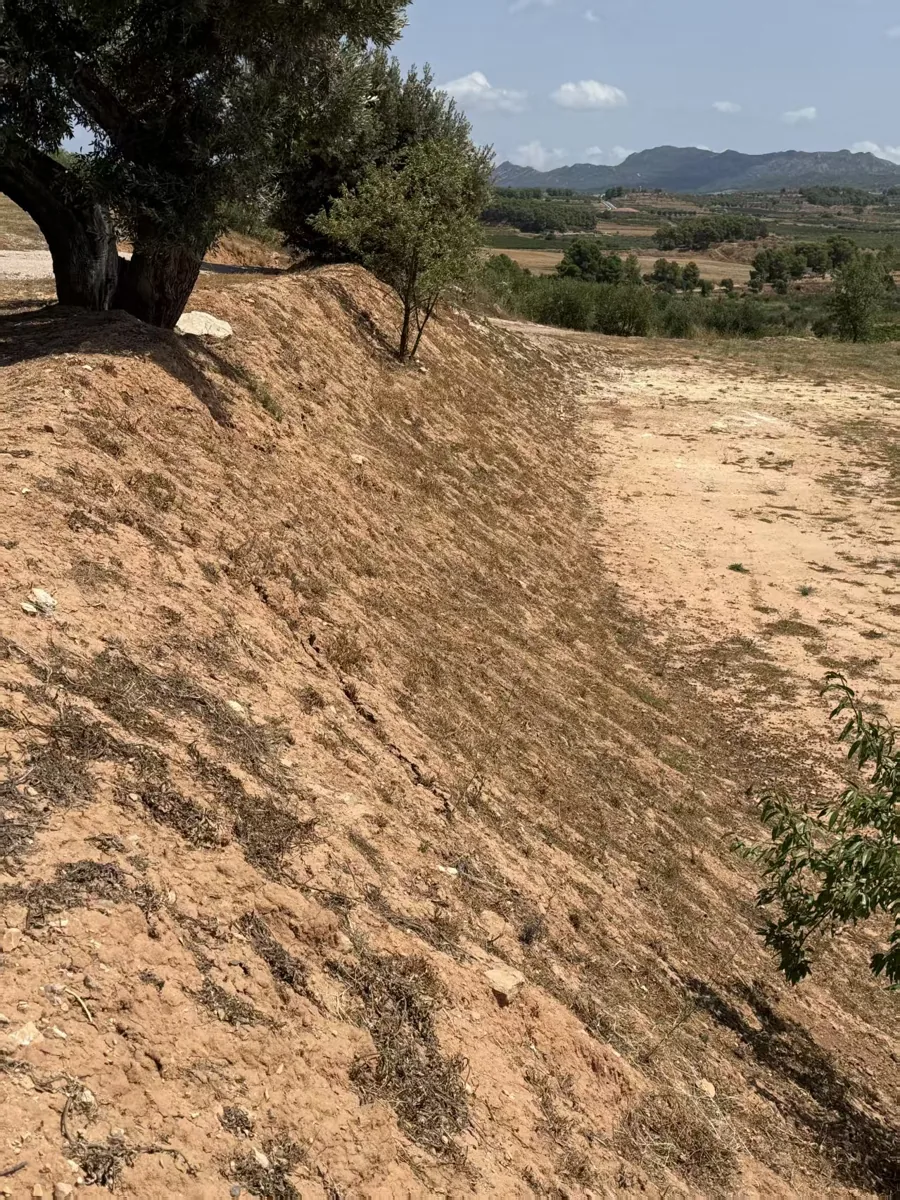
A customer in Spain sent us photos of an olive orchard with a long, steep bank. The customer said the sloping area was about 150 metres long. The soil looked dry and loose, and some parts were uneven with small stones.
This is a real customer enquiry and site assessment. It is not a report of a completed purchase or a machine already working at the site.
The site in Spain
The photos show mature olive trees above and around a clear earth bank. The slope drops into a lower open area. There is little green grass at the time of the photos, but seasonal grass and weeds still need regular control.
The ground is not a smooth lawn. It is dry, dusty and loose. There are also changes in level, exposed soil and some stones. These details can affect grip and steering.
The customer described the bank as about 150 metres long. A photo cannot confirm that distance or the exact angle, so both should be measured on site before the final machine choice.
Why a normal mower may be difficult here
A ride-on mower puts the driver on the slope with the machine. A walk-behind mower can also be hard to hold and guide on loose soil. Both jobs become more tiring when the bank is long.
The biggest questions are simple:
- Can the machine keep enough grip on the dry surface?
- Can it cross uneven areas without hitting stones or roots?
- Can the operator see the mower and the route clearly?
- Is there enough flat space to enter, turn and leave the slope?
Remote control changes where the operator stands. It can help the operator stay away from the machine and avoid riding on the bank. It does not remove risk, so the work area and travel plan still need to be checked.
Why we looked at the ME1000D-48
For this enquiry, we recommended the MERI ME1000D-48 as the main model to review.
The reason was not one headline slope number. The site combines a long bank, loose soil, uneven ground and professional vegetation work. That made the tracked diesel 48V platform more relevant than a basic lawn mower.
The current MERI product information lists a diesel engine, a 48V electronic control system, a 1000 mm cutting width and 40 flails. These are useful points for a larger professional site.
The 1000 mm cutting width can cover more ground than a small garden mower, but the full machine is wider than its cutting deck. Access gates, tracks, loading ramps and turning areas must be measured before ordering.
Why tracks matter on loose and uneven soil
Tracks spread the machine’s contact over a wider area than small wheels. This is one reason tracked mowers are often considered for rough or uneven land.
That does not mean tracks can grip every surface. Very dry soil can slide. Loose stones can move under the machine. A sharp edge or hidden hole can also change the way the mower sits.
For this Spanish orchard, the buyer should check the firmest route and avoid planning turns on the steepest part. Ground conditions should be reviewed again after heavy rain or during very dry weather.
Why the 48V system entered the comparison
The ME1000D-48 uses a 48V electronic control system for the drive platform. For a site where grip and controlled movement are important, this is a sensible configuration to compare.
But voltage alone does not prove that a mower suits a slope. The real decision must include the measured angle, travel direction, soil condition, machine weight, vegetation load and space for turning.
We would not say that 48V means the mower will definitely work. A better answer is that the 48V tracked model fits the type of job, but the exact site still needs to be checked.
Diesel power for regular professional work
The ME1000D-48 uses a diesel engine. This can suit buyers who expect repeated vegetation work and already have a plan for fuel, service and spare parts.
The cutting system uses flails. Flails are relevant when the job includes grass and mixed soft vegetation rather than only a neat lawn finish. The photos do not show heavy woody brush, so this article does not claim that the mower can shred branches.
The customer should send photos when the vegetation is at its heaviest. A dry summer photo may not show the full spring workload.
What still needs to be measured
Photos are a good start, but they are not enough for a final recommendation. Before ordering, the customer should provide:
- The normal slope angle and the steepest short section.
- Whether the mower will travel up and down or across the bank.
- The narrowest gate, path and access point.
- The flat space available for turning and loading.
- The type and height of the heaviest seasonal vegetation.
- Locations of stones, roots, irrigation pipes, drops and soft soil.
A measured site plan or a short video can make the recommendation much more useful.
A simple work plan for this orchard
Start by walking the site without the mower. Mark loose stones, holes, irrigation lines and sharp edges. Choose a clear operator position with a full view of the machine.
Plan the first pass on a lower-risk section. Do not begin at the steepest point. Keep people and animals outside the work area, and never stand directly below the mower.
Use the operating limits and instructions for the exact machine. Stop if the tracks begin to slide, the ground breaks away, visibility is poor or the mower cannot turn safely.
These steps are more useful than relying on one maximum slope figure.
What this real enquiry teaches buyers
This Spanish olive orchard is different from a flat orchard with narrow rows. Here, the main problem is the bank itself: loose soil, uneven ground, traction and operator position.
The ME1000D-48 became the main model to review because it combines a tracked platform, diesel power, a 48V control system and a 1000 mm flail cutting deck. Final suitability still depends on measured site conditions.
For a wider selection overview, read the MERI remote control slope mower guide or compare the current mower range.
Frequently asked questions
Can photos show the exact slope angle?
No. Photos show the general shape and ground condition, but the working angle should be measured on site.
Why use a tracked mower in an olive orchard?
Tracks are useful to compare where the ground is uneven or loose. Final grip still depends on soil, stones, moisture, travel direction and the exact machine.
Does remote control make slope mowing completely safe?
No. It lets the operator work from a separate position, but the site still needs an exclusion zone, clear visibility and a safe travel plan.
Why was the ME1000D-48 recommended for review?
The site needs a professional tracked platform for a long, uneven bank. The model also has diesel power, a 48V control system and a 1000 mm flail cutting deck.
Can the mower cut branches?
This case does not make that claim. The vegetation type and any woody material must be checked against the current model documents before work.
Send us your slope measurements
If you manage an orchard on sloping land, send MERI your photos, measurements and vegetation details. We can help compare the right model with the real ground in mind.