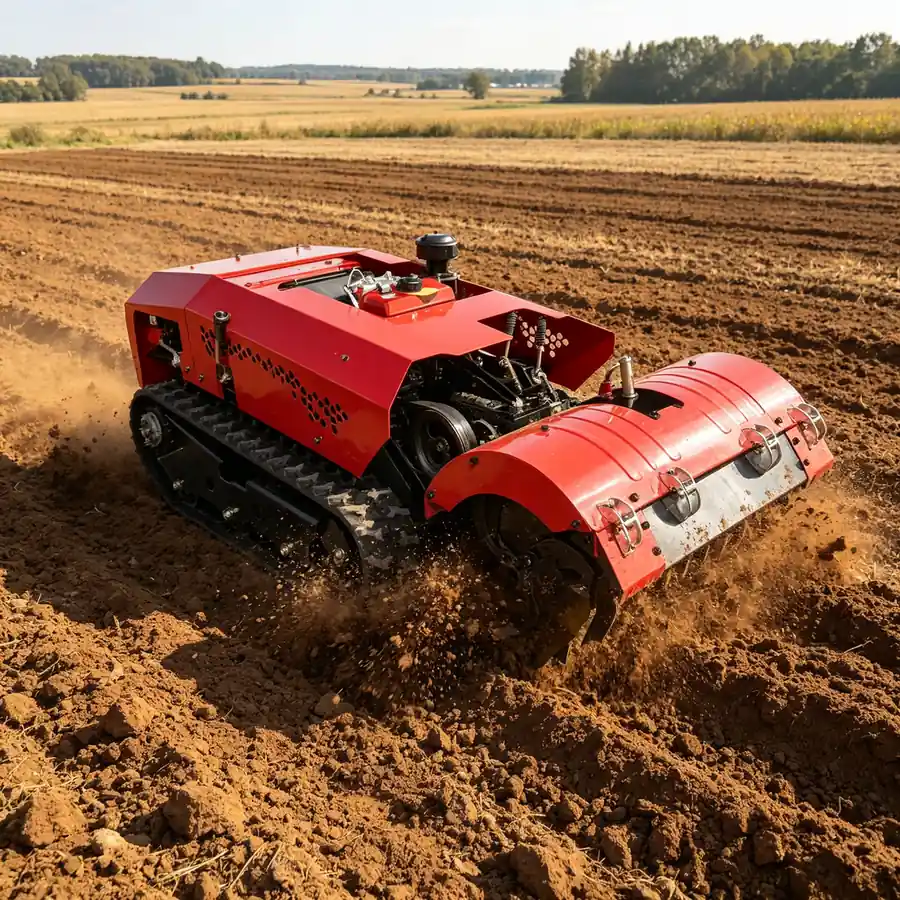
Rotary tillage can help prepare an orchard floor or a replanting block, but the right working depth is never a number to guess. Tree roots, irrigation lines, soil moisture, and the purpose of the pass all dictate your operating limits. Before choosing a remote crawler rotary tiller, map the work area and define where soil should be loosened—and where roots or infrastructure must stay undisturbed.
Quick answer: There is no universal safe depth around established orchard trees. Set the pass from the job objective and verified site conditions, use the shallowest effective setting near sensitive zones, and stop if roots or buried lines are exposed. A machine’s maximum capability is not a recommended depth for every orchard.
Start with the job—not the machine setting
First, define what the pass must accomplish. Preparing an open replanting block, incorporating surface residue, and cultivating a narrow alley between established trees are fundamentally different jobs. Penn State Extension notes that orchard site preparation depends on soil structure, tree design, equipment size, and worker access; it also stresses that planning mistakes can be difficult to reverse. Treat working depth as an intentional, site-specific operating decision rather than a machine headline.
Walk the block before deploying the tiller. Record tree-row spacing, trunk locations, visible surface roots, irrigation tubing, drainage features, headlands, and turning clearances. Identify young plantings separately: their root systems and clearance requirements differ significantly from mature trees. If the orchard has documented root distribution records or prior trenching maps, use them to establish clear no-till or shallow-work zones.
Use a depth-planning sequence
Depth decisions by orchard situation
| Work area | Planning priority | Practical decision |
|---|---|---|
| Open block before planting | Soil profile and replanting plan | Use soil test and agronomic recommendations to define the target; verify the implement can perform it. |
| Between established rows | Tree roots, trunk clearance and irrigation | Keep the pass within the mapped work strip; avoid assuming the visible bare strip is root-free. |
| Under the canopy | Root flare, shallow roots and obstacles | Use an alternate vegetation-control method if the safe tillage zone cannot be established. |
| Uneven or rocky ground | Depth consistency and impact risk | Reduce the scope, inspect more often and follow the machine maker’s limits. |
Match the attachment to the whole operating plan
A remote crawler platform keeps the operator at a safe standoff distance during work, while a rotary tiller handles soil preparation. However, equipment selection should always begin with row spacing, turning clearance, transport logistics, implement requirements, and seasonal working windows. Request verified specifications from the supplier—including exact working width, operational depth range, machine weight, power requirements, and compatible configurations for the specific unit quoted. Do not infer these details from another model or from a photograph.
For MERI’s multi-function crawler options, compare the ME-RT Series and ME-RT PRO against your site plan. Send row dimensions, planting age, soil description, irrigation layout, and intended tillage outcome with your inquiry so the attachment setup can be verified against your actual job requirements.
Orchard tiller depth checklist
- Have you defined the purpose and target area of each pass?
- Are tree rows, root-sensitive zones, irrigation lines, and utilities marked?
- Have you verified depth and working-width information for the exact configuration?
- Did a short test pass produce the intended finish without exposing roots or lines?
- Is the result recorded so the next block can be set consistently?
Frequently asked questions
What is the right rotary tiller depth in an orchard?
There is no single depth for every orchard. The target depends on the job, crop and root zone, soil condition and implement specifications. Set the depth from a site assessment and agronomic guidance.
Can I till close to established tree trunks?
Only if you can define a safe working strip for that tree and implement. Surface appearance does not prove that roots are absent. Mark trunk clearance and stop if roots become exposed.
Should I use maximum tiller depth for replanting?
Not automatically. Maximum machine capability is not a universal agronomic recommendation. Use soil-test and site-specific advice, then confirm the selected attachment can achieve the planned job.
What should I send when requesting a tiller recommendation?
Provide row spacing, crop and tree age, soil type and moisture, irrigation layout, slope, target work depth and photos of the site. These details support a configuration review; they do not replace a field assessment.
External reference: Penn State Extension, Beginning Grower: Planning and Planting an Orchard. Site-specific agronomic and machine-manufacturer guidance takes precedence.
Need a mower recommendation for your terrain or project?
Get a Quote