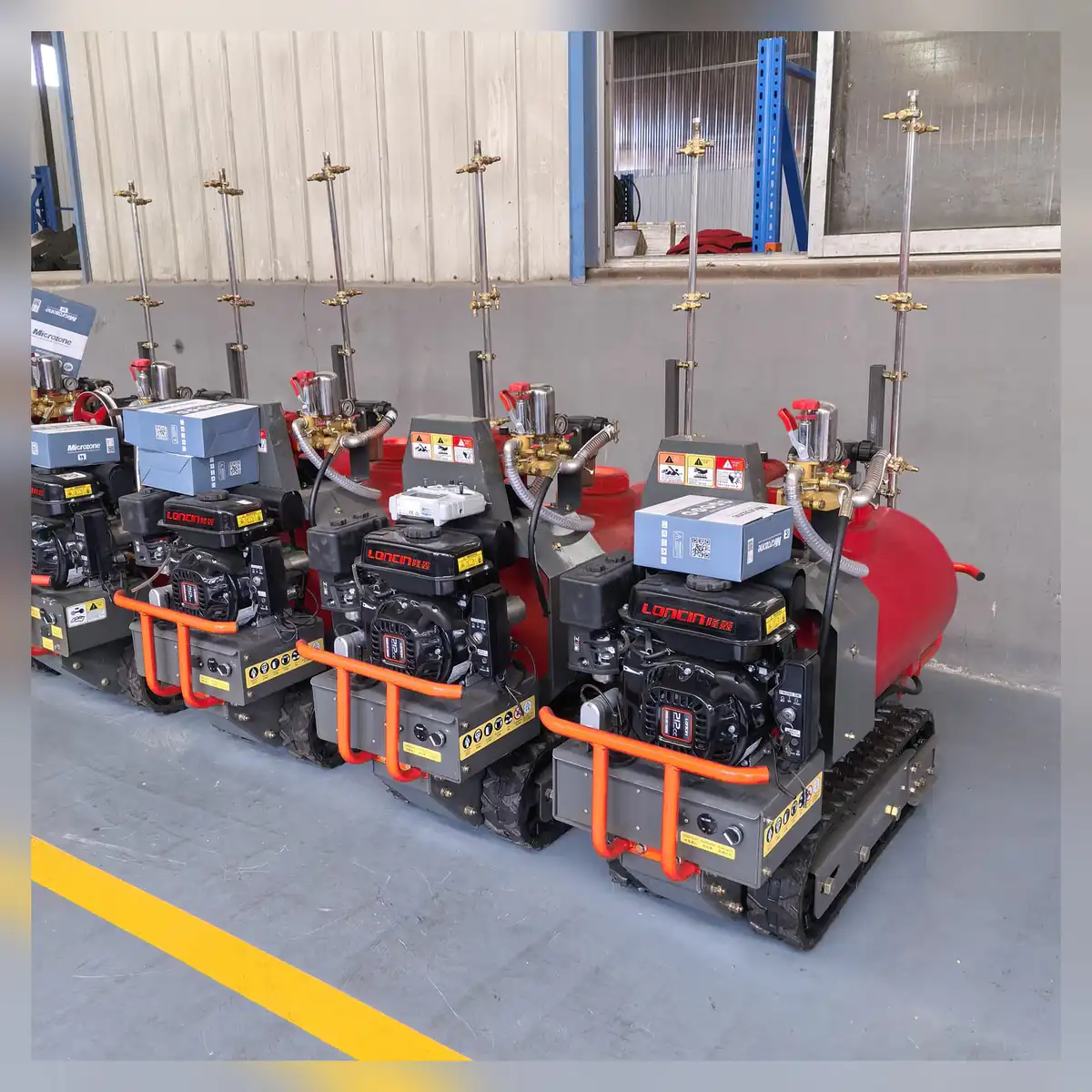
A larger tank can reduce refill frequency, but capacity grows together with the platform that must pass through the farm. The correct remote sprayer is therefore the largest configuration that still clears the narrowest row, gate, headland, transport route and crop envelope with a safe margin—not simply the largest tank in the catalogue.
Direct recommendation
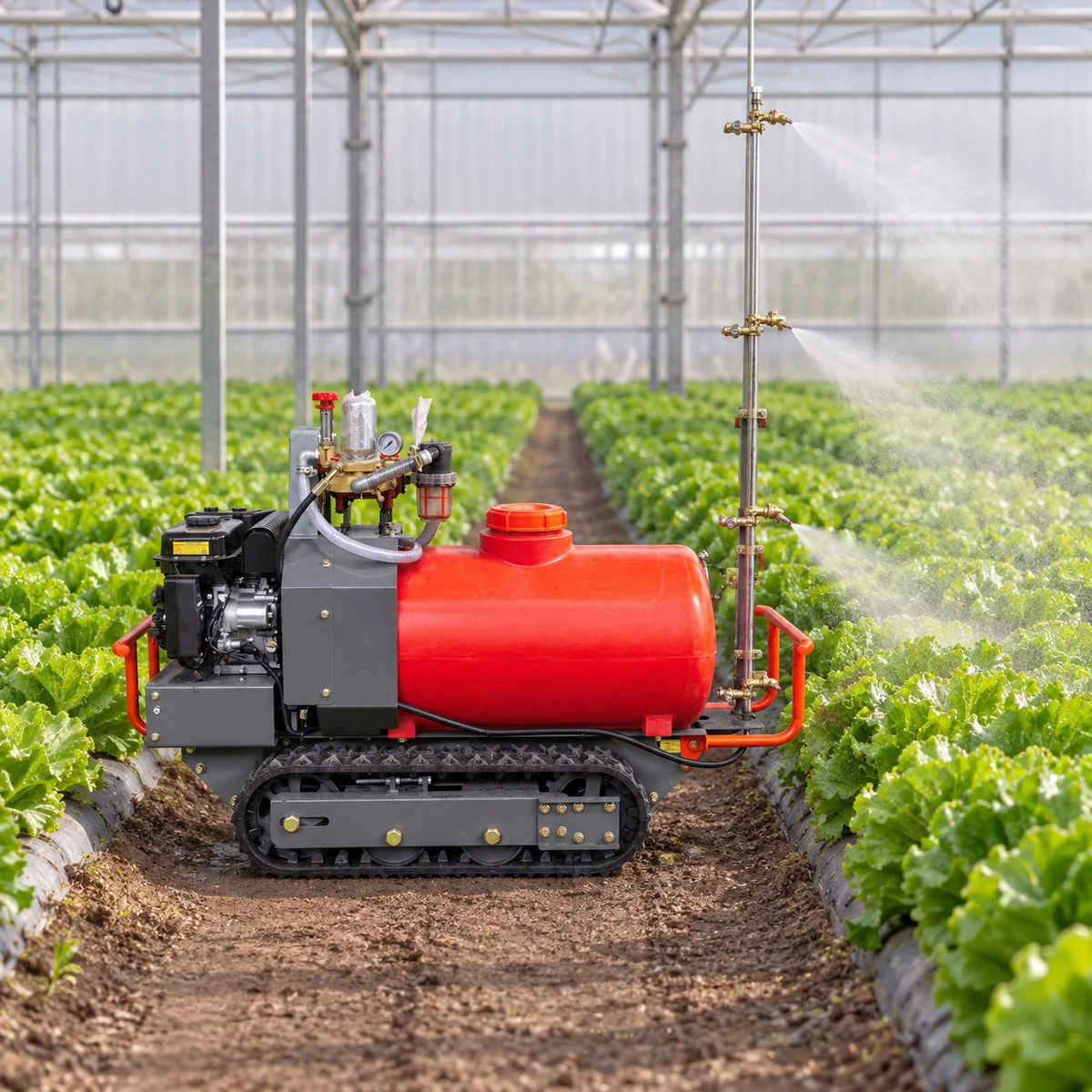
Measure the narrowest usable passage first. Compare that dimension with the verified chassis widths: 400, 520, 700, 900, 960, 980 and 1100 mm across the RCS100–RCS800 range. Then choose capacity using crop demand and refill logistics. Chassis width is a selection filter, not the final operating clearance.
Verified planning reference
| Model | Tank | Chassis width | Travel speed |
|---|---|---|---|
| ME-RCS100 | 100 L | 400 mm | 80 m/min |
| ME-RCS120 | 120 L | 520 mm | 80 m/min |
| ME-RCS200 | 200 L | 700 mm | 80 m/min |
| ME-RCS300 | 300 L | 900 mm | 60–80 m/min |
| ME-RCS400 | 400 L | 960 mm | 60–80 m/min |
| ME-RCS500 | 500 L | 980 mm | 60–80 m/min |
| ME-RCS800 | 800 L | 1100 mm | 100–133 m/min |
Measure the passage at the limiting height
Do not record only the distance between trunks or greenhouse posts. Measure foliage, trellis wires, irrigation hardware, raised beds, wheel ruts and the height where the sprayer body, tank, boom or fan will pass. Repeat the measurement at representative narrow points and record the minimum.
Add a practical clearance allowance
The listed chassis width describes the undercarriage. The complete configured machine may have components or working equipment outside that dimension. Uneven ground, track steering, crop growth and operator correction also consume clearance. Request the final overall dimensions for the boom or airblast configuration and establish the site margin from those drawings.
Capacity cannot repair an access mismatch
An 800 L tank may reduce trips but the RCS800 chassis is 1100 mm wide. If a route cannot accept the configured machine, the nominal capacity has no value. A smaller model can produce a more reliable day when it moves through every block without crop contact, rerouting or manual recovery.
Check turning and headland geometry
Measure usable headland length and width, surface, slope and obstacles. A machine that fits a straight row may still lack room for the return turn. Mark where the boom or airblast assembly will travel during steering and keep people, crop structures and water infrastructure outside that envelope.
Connect access to refill planning
After width removes unsuitable models, compare tank capacity with calibrated application volume, work-block size, refill distance and mixing time. These inputs show whether compact access or fewer refill cycles carries more value for the operation. Do not invent hectares-per-hour output from tank size.
Build a configuration-envelope drawing
Place the chassis width, overall body width, boom or fan envelope, height and turning path on one drawing. Add the measured crop corridor at the same scale and mark fixed objects. This reveals whether the limiting point is the track, tank, spray hardware or steering movement.
Keep the drawing with the quotation revision. If boom width, fan, chassis or crop layout changes, update the comparison rather than relying on the earlier clearance decision. A dimension without its component name can create a false fit.
Information to record before selection
- Representative measurements, photographs and the method used.
- Task, target result, ground, access, turns and transport route.
- Daily work window, refill or energy plan and service capability.
- Exact model, working equipment, destination and current documents.
Related MERI resources
Buyer FAQ
Does the largest published number identify the best model?
No. The complete route, task, configuration and operating conditions control suitability.
Can observed field performance replace the TDS?
No. Record observations with their conditions and keep them separate from published ratings.
What does MERI need to review a shortlist?
Send measurements, site media, workload, access, infrastructure, destination and preferred configuration.
Review the measured site and configuration
Send the actual inputs so MERI can identify the relevant model and documents.
Need a agricultural sprayer recommendation for your terrain or project?
Get a Quote