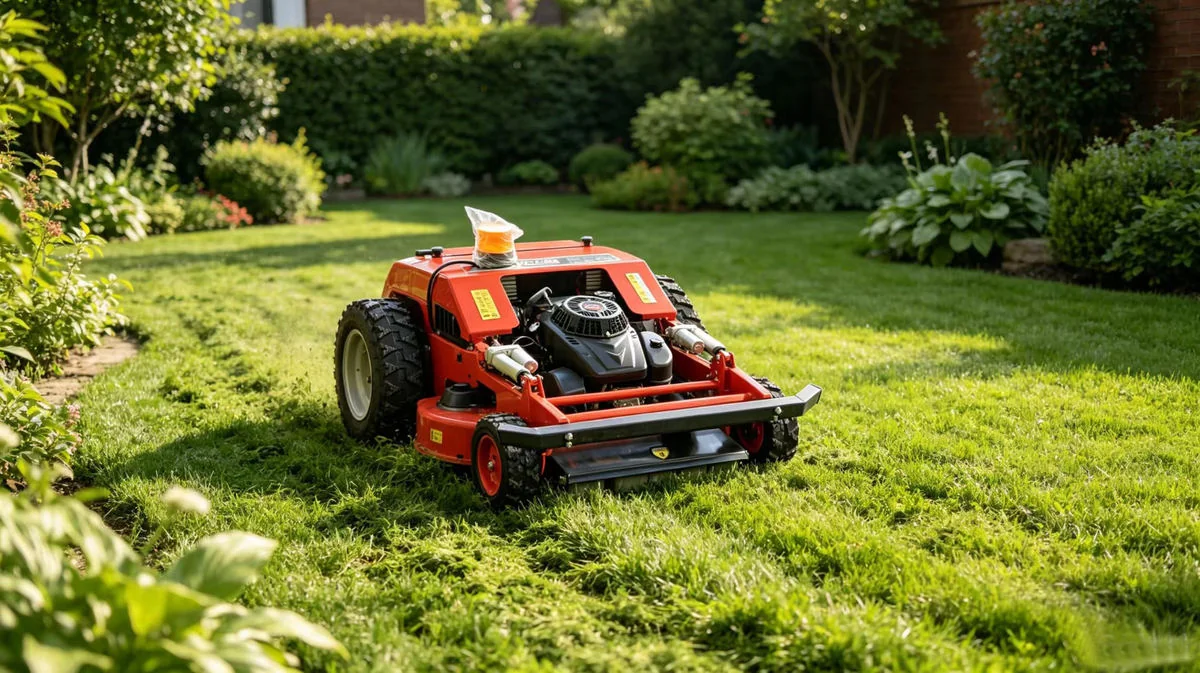
Commercial grounds maintenance is being reshaped by labor availability, safety expectations, larger distributed sites, and the need for predictable operating costs. Remote control lawn mowers are receiving more attention because they allow one operator to control a purpose-built machine while remaining away from the cutting deck and difficult terrain.
For procurement teams, the decision is broader than replacing a person with a machine. It involves matching equipment to the work, planning service and spare parts, verifying documentation, and understanding the full delivered cost.
Labor pressure is changing equipment specifications
Manual brush cutting and walk-behind mowing can require several workers across large orchards, solar farms, roadsides, and embankments. Recruiting and retaining people for repetitive work on heat, slopes, or remote sites can be difficult. A remote control mower can concentrate the task around a trained operator and a defined maintenance process.
Buyers should calculate labor using their own wage rates, utilization, transport time, supervision, and seasonal workload. Headline productivity figures are useful for initial screening, but a site trial or realistic work-cycle estimate provides a stronger business case.
Safety is becoming part of the purchasing calculation
Separating the operator from the machine can reduce direct exposure to rollover, cutting, vibration, and unstable footing. However, remote operation introduces its own requirements: visibility, exclusion zones, emergency controls, site inspection, operator training, and reliable maintenance.
Procurement documents should request the operating manual, emergency-stop design, relevant test information, guarding details, maintenance schedule, and training materials. Safety should be evaluated as a system rather than a single product claim.
Buyers are comparing total cost of ownership
The machine price is only one component. Freight, import charges, commissioning, fuel or charging, wear parts, routine servicing, operator time, downtime, and resale value affect the real cost. A lower initial quote can become more expensive if model-specific parts are difficult to identify or slow to ship.
Ask suppliers to quote a recommended initial spare-parts package and identify which filters, belts, fasteners, lubricants, and service items can be sourced locally. Confirm how technical questions and warranty claims are handled after delivery.
Product selection is becoming more site-specific
Procurement teams increasingly need more than one generic mower specification. Orchard rows prioritize access and maneuverability. Solar farms require clearance around panel structures. Embankments emphasize traction and operator position. Maintained turf requires a different cutting finish from brush clearance.
A useful request for quotation includes the maximum measured slope, total area, vegetation type, required cutting height, narrowest access point, daily operating hours, preferred power source, and transport constraints. This information allows the supplier to recommend a model instead of simply offering the largest machine.
Documentation and certification require verification
CE, EPA, and ISO references should be checked against the exact product, engine, manufacturer, and destination requirements. A logo on a brochure is not a substitute for the underlying document. Importers should review certificates, declarations, labels, manuals, and engine information before shipment.
The relevant requirements vary by market and equipment configuration. Buyers should obtain advice from their customs, legal, or compliance professionals when necessary. MERI’s certificate verification guide provides a practical starting checklist.
Dealer and distributor support is a long-term decision
Distributors need more than a container of machines. Product training, parts identification, service diagrams, sales materials, warranty procedures, and territory planning influence whether a product line can be supported profitably. Factory communication should be tested before a large order, not after the first service issue.
Review the guidance on building a local mower service network and after-sales spare-parts planning when evaluating a supplier relationship.
A practical procurement checklist
- Define the terrain, vegetation, access, and expected work cycle.
- Compare total delivered and operating cost, not only unit price.
- Verify certification and documentation for the destination market.
- Specify spare parts, training, warranty, and technical support.
- Confirm production lead time, inspection, packing, and shipping terms.
- Start with a controlled evaluation before scaling a fleet or dealer order.
Explore the MERI commercial remote control mower range, review the factory audit checklist, or send MERI your procurement requirements for a model and supply proposal.