
Short answer: On busy roads, traffic management can cost as much as the mowing. Faster work inside each closure, fewer people near the live lane and grouping sites on one closure all reduce that cost. Remote mowers help by cutting steep banks quickly while the operator stays back.
What it costs
- Crew and vehicles for the closure.
- Signs, cones and barriers.
- Night or off-peak premiums.
- Delay to the mowing crew.
How to reduce it
| Action | Effect |
|---|---|
| Work faster in each closure | Fewer closure hours |
| Group sites on one closure | Fewer setups |
| Cut steep banks with remote machines | Less time near traffic |
| Plan with other works | Share closures |
Remote mowers
A remote tracked mower works the bank while the operator stands back. MERI tracked mowers are rated to 45°.
Planning
Survey routes, list banks by size and access, and estimate time per bank with the mowing time calculator.
Shared closures
Coordinate with drainage, signage and barrier crews to share the same closure.
Safety
Never reduce traffic management below the required standard; aim to shorten time, not cut corners.
Records
Record closure hours and work done to show savings.
Example route plan
- List every bank on the route with length and slope.
- Group banks that share a closure.
- Assign boom, remote mower and hand crews to each group.
- Estimate hours per closure and book them together.
Worked example: what a closure really costs
Count the cost of a closure in crew hours and vehicle hours, not just the hire fee. A typical closure needs a traffic management crew, signs, a protection vehicle, set-up and removal time, and often night-time rates. If the mowing itself takes two hours but set-up and removal take two more, half the closure time is spent on traffic management.
| Item | How to estimate |
|---|---|
| Traffic management crew | Crew size × closure hours |
| Protection vehicle | Vehicle hours |
| Set-up and removal | Timed on previous jobs |
| Night or weekend rates | From the TM contract |
| Mowing crew waiting time | Crew hours before and after work |
Use your own rates and past closure records.
Reducing the number of closures
- List all vegetation work on a route for the year.
- Group work by location so one closure covers mowing, litter picking and drain clearing.
- Choose machines that finish the area within one closure.
- Use remote mowers where the operator can stand behind the barrier.
- Agree with the road authority where work can be done from the verge without a closure.
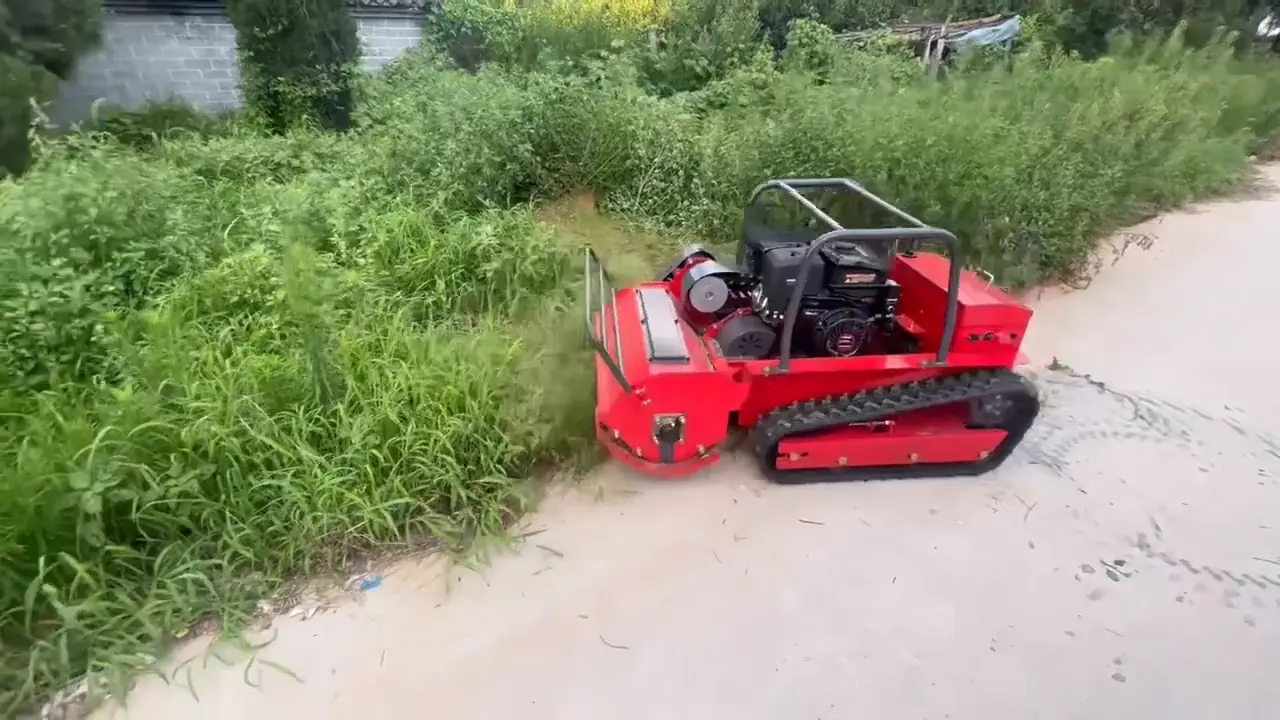
Why remote mowers can shorten closures
A remote tracked mower works the bank while the operator stays on the hard shoulder or verge behind the barrier. That can reduce the extent of the closure needed, depending on the road authority’s rules. MERI tracked mowers are rated to 45°, have a standard remote range of 800 m with an optional R1 up to 1,000 m, and stop if the signal is lost. The operator should still keep the machine in view.
Common mistakes
- Comparing machines on mowing speed only, ignoring closure time.
- Booking closures before checking the machine fits through access points.
- No shared calendar with other teams who need the same closure.
- No record of actual closure times, so estimates never improve.
Worked example: grouping a route
A contractor has 14 bank sites on one road, each needing a short lane closure. Booked separately, that is 14 set-ups and removals. Grouped into three longer closures by location, the set-up and removal time falls to three, and the remote mower moves along the hard shoulder from one bank to the next inside the closure. The same closures are offered to the drainage and litter teams, who share the cost. The mowing time stays the same; most of the saving comes from traffic management time.
What to send the traffic management provider
A clear request gets a better plan and fewer changes on the day.
- Route map with each site, its length and the side of the road.
- Expected work time at each site, based on your own records.
- Machine size, transport vehicle and where it will unload.
- Whether the operator can work from behind the barrier or off the carriageway.
- Dates, shift times and any time limits from the road authority.
Related MERI pages
Frequently asked questions
Why is traffic management expensive?
Crews, vehicles, equipment and off-peak premiums.
How can it be reduced?
Faster work, grouped sites and shared closures.
How do remote mowers help?
They cut banks quickly with the operator away from traffic.
Can standards be lowered?
No; reduce time, not safety.
Send us your site details
Tell us the job, area, slope and country. MERI replies within 24 hours.
Need a mower recommendation for your terrain or project?
Get a Quote