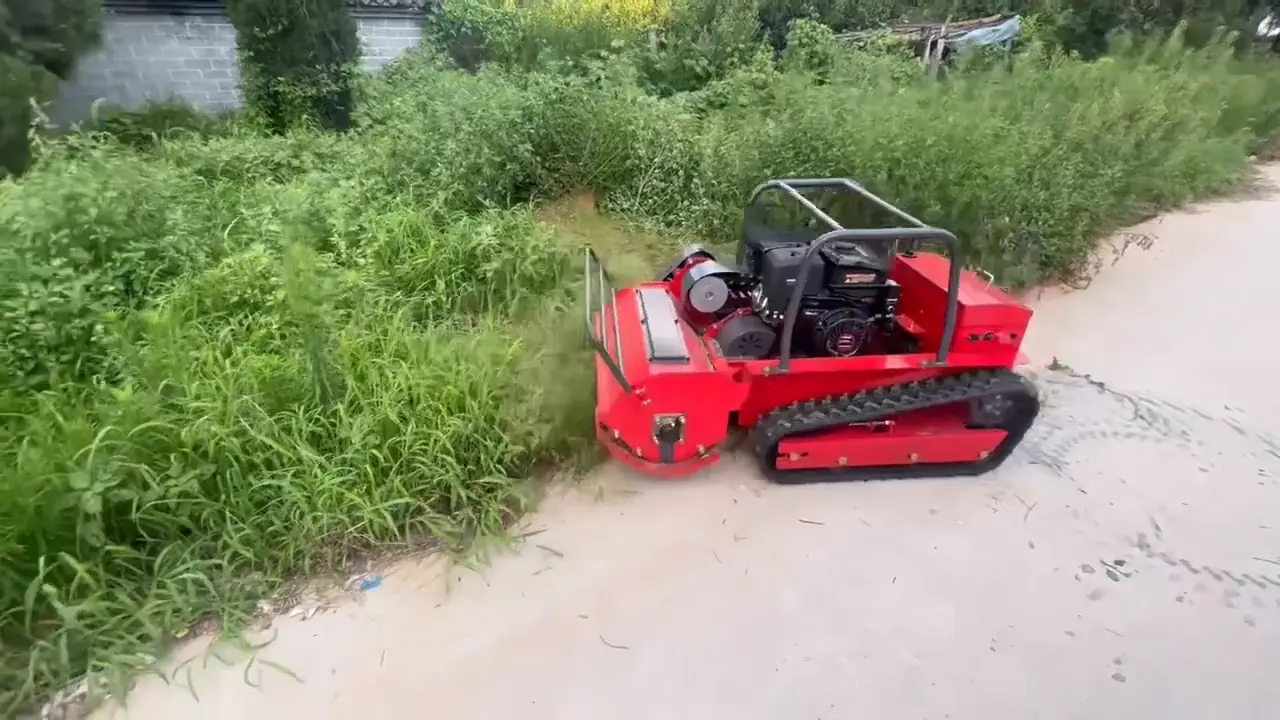
Short answer: Posts slow verge mowing more than open grass does. Mow the open bank with a remote mower, keep a set distance from each post, and trim the ring around it by hand or with a small trimmer. Keeping signs and delineators visible is the goal, so plan cuts before the growing peak and check visibility from the driver’s side.
Why posts eat the hours
Highway maintenance guides stress that signs, marker posts and delineators must stay visible to drivers. On flat verges a tractor flail can work close. On steep banks behind barriers or above ditches, crews often strim every post by hand. On a long route, that is hundreds of stops.
The aim is not to cut closer with the machine. It is to shrink the hand work to a small ring around each post.
A three-part method
| Part | Tool | Detail |
|---|---|---|
| Open bank | Remote flail mower | Normal height, up-and-down passes |
| Approach to each post | Remote mower, slow | Stop at an agreed distance |
| Ring around the post | Hand trimmer | Small, quick finish |
| Sign face check | Visual from the road side | Confirm the sign can be read |
General method. Follow the road authority’s traffic management and work rules.
Machine control near posts
A tracked remote mower can be stopped and turned precisely, which helps on posts set into steep banks. MERI tracked models are rated to 45°. The operator walks a safe position on the verge or behind the barrier, keeping the machine in clear view. Standard remote range is 800 m; the machine stops if the signal is lost.
Flail models cut 800–1,200 mm wide. On verges with many posts, a narrower deck often saves time because it can get closer to each post without hitting it.

Before the route
- Get the route list of signs and marker posts.
- Check traffic management needs for each section.
- Note posts that lean or are already damaged.
- Look for buried cables at sign bases.
- Plan the order so the crew moves in one direction.
Visibility checks
After each section, look back at the signs from where a driver would see them. A sign half-hidden by a tall weed behind it is still a problem. Note any post that needs repair or a sign that needs cleaning. A record of visibility checks helps the client show the route is being maintained.
Working out the time per post
On the first round, time how long the ring trim takes at a sample of posts. Multiply by the number of posts on the route and add it to the open-bank mowing time. This gives a realistic estimate and shows how much a narrower deck or a better approach saves. Many crews find the post count, not the verge area, decides the length of the day.
Share the numbers with the client. It explains why verges with many posts cost more per metre than open ones.
Common mistakes
- Hitting posts by trying to cut right up to them with the deck.
- Leaving tall weeds behind a sign face, so it is still hard to read.
- Skipping the visibility check from the road side.
- Not reporting damaged or leaning posts found during the cut.
Timing
Plan the first cut before the main growth peak so posts never get buried. A second cut around posts in mid-season keeps signs clear until the late cut. On slow-growing verges, one main cut plus a post-ring trim may be enough.
A worked example
A highway contractor takes on a route of steep road banks with many marker posts and signs. On the first round, the team times the ring trim at ten sample posts and finds an average figure per post. Multiplied across the route, the posts add a clear block of hours to the open-bank mowing time. The contractor shows that figure in the next quote. On the bank, the remote mower stops at an agreed distance from each post, and a strimmer operator follows to trim the rings. A visibility check from the road side at the end of each section finds two signs hidden by tall growth behind them.
Related MERI pages
- Guardrail mowing and open strips
- Roundabout mowing
- Median strip mowing
- Remote mowers for highway embankments
- Slope ratings by model
Frequently asked questions
Can a remote mower cut right up to a sign post?
It can get close, but leave a small ring around the post to trim by hand. That avoids damage to the post and the deck.
Why are delineators and marker posts a priority?
Drivers need to see them. Keep growth below and behind them, and check visibility from the road.
Is a narrow deck better on verges with many posts?
Often yes. MERI flail models range from 800 to 1,200 mm wide; a narrower deck can work closer to posts.
How often should posts be cleared?
Usually before the growth peak and again mid-season, with the main verge cuts. Adjust to local growth.
Send us your site details
Tell us the job, area, slope and country. MERI replies within 24 hours.
Need a mower recommendation for your terrain or project?
Get a Quote