
Planning Vineyard Ground-Cover Maintenance
This article is the operations guide in our vineyard series. It focuses on vegetation planning, terrace access, worker positioning, and ongoing ground-cover maintenance. If you are comparing machine configurations before purchase, use the separate vineyard slope mower selection guide.
Vineyards on sloped terrain produce some of the world’s finest wines, but maintaining the ground between rows on a 25-degree incline is one of agriculture’s most demanding tasks. A remote control mower for vineyard slopes eliminates the need to ride equipment on dangerous hillsides, letting vineyard managers control vegetation safely from a distance. Whether your vineyard uses narrow terraces, contoured rows, or steep hillside plantings, this equipment protects both workers and vines while keeping maintenance costs predictable.
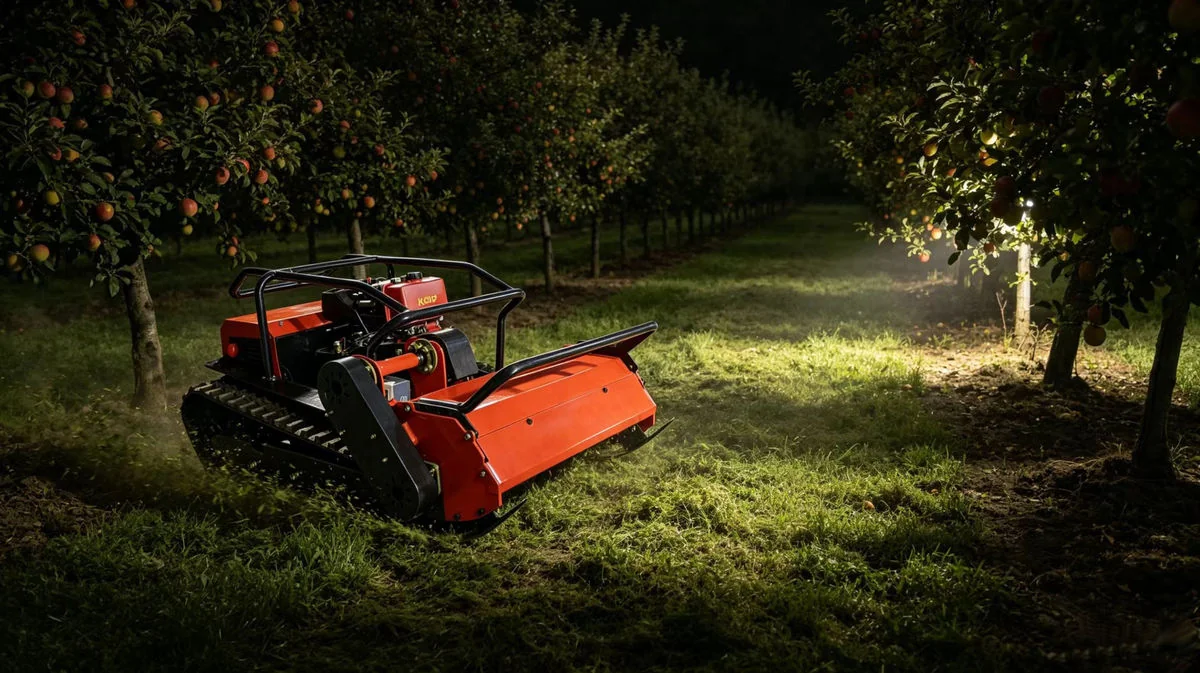
The Challenge of Vineyard Slope Maintenance
Sloped vineyards face a combination of hazards that flat-ground equipment cannot handle. Tractors risk rollover on wet grass. Walk-behind mowers expose workers to slip injuries and fatigue. Herbicide use is increasingly restricted in wine-growing regions, and manual scything is too slow for commercial operations. Meanwhile, ground cover between vine rows must be managed — not eliminated — to control erosion, retain moisture, and support beneficial insect populations. This specialized equipment provides the precision cutting that vineyard floors require without the safety risks of conventional machinery.
Cover crops in vineyards serve multiple purposes: they prevent soil erosion on slopes, fix nitrogen in poor soils, and harbor predatory insects that control vine pests. A mowing strategy that cuts these plants to a controlled height — rather than eliminating them — is essential for sustainable viticulture. Tracked remote control mowers allow vineyard managers to adjust cutting height precisely, preserving the beneficial aspects of cover crops while preventing them from competing with vines for water and nutrients.
Why Remote Control Mowers Excel on Vineyard Terraces
Terraced vineyards, common in regions like Piedmont, Douro, and parts of China’s northwest wine country, present narrow rows with stone or earth retaining walls. A remote control slope mower with rubber tracks grips the terrace surface without scuffing it, and its compact width — typically under 80 cm — fits between vine rows planted on 1.5-meter spacing. The operator stands on stable ground above or beside the machine, controlling speed and direction while monitoring the cutting path. This separation of operator and machine is the single most important safety improvement for steep viticulture sites.
Choosing the Right Mower for Your Vineyard
Vineyard conditions vary by soil type, row width, slope angle, and cover crop species. Consider these factors when selecting equipment:
Row width compatibility: Measure your narrowest row spacing and add 15 cm clearance on each side. Most remote control mowers are 60 to 75 cm wide, suitable for standard vineyard layouts.
Cutting mechanism: Flail heads are ideal for vineyards because they shred cover crop material finely, reducing clumping that can harbor vine pests. Rotary blades work for lighter grass but may throw debris toward vines.
Power system: MERI gasoline and diesel mowers use a lead-acid battery with an engine-driven generator. While the engine operates, it continuously supplies electrical power to the drive and control system, supporting long working days without a separate lithium charging cycle.
Slope rating: Confirm the manufacturer’s rated slope angle. Vineyard terraces commonly range from 15 to 30 degrees, but some sites exceed 35 degrees. Choose a model rated above your steepest section.
Safety on Steep Vineyard Slopes
Slope safety in vineyard operations is not optional — it is a legal and moral obligation. Remote control mowers reduce rollover risk by removing the operator from the machine, but additional precautions remain essential. Always mow across slopes rather than up and down when possible, as cross-slope travel reduces the chance of sliding. Never operate on saturated soil — even tracked machines can lose traction on mud. Follow the slope mowing safety guidelines established for remote control equipment, and train every operator before solo use. Keep a clear escape path in case the machine needs to be stopped quickly on an incline.
ROI: Cost Savings for Vineyard Operators
MERI internal customer feedback indicates that many commercial users recover the equipment cost in around 12 months, while a practical planning range is 12 to 24 months. Actual payback depends on local labor cost, mowing frequency, terrain, utilization and the selected model.
Current MERI product pages list 5,000 m²/hour for the ME800, ME1000 and ME1200 families. This is a product-page reference, not a guaranteed vineyard result. Row width, headland turning space, slope, vegetation density and operator method all affect daily output, so confirm the applicable model value again when requesting a quotation.
FAQ: Remote Control Mowers for Vineyard Operations
Will a tracked mower damage vine roots or terrace walls?
Rubber tracks distribute weight more evenly than wheeled equipment, reducing soil compaction. At proper operating speeds, they do not damage stone terrace edges. Avoid sharp turns near walls.
Can it handle thick cover crops like clover and vetch?
Yes, especially with a flail cutting head. For very dense cover crops, make two passes — one high to knock down tall growth, one lower to finish-cut.
How narrow can the rows be?
Most models are 60 to 75 cm wide. If your rows are narrower than 75 cm, confirm the specific model dimensions before ordering, as deck width varies.
Is it suitable for organic vineyards?
Absolutely. Remote control mowing is a mechanical method that aligns with organic certification standards, replacing both herbicides and gas-powered trimmers.