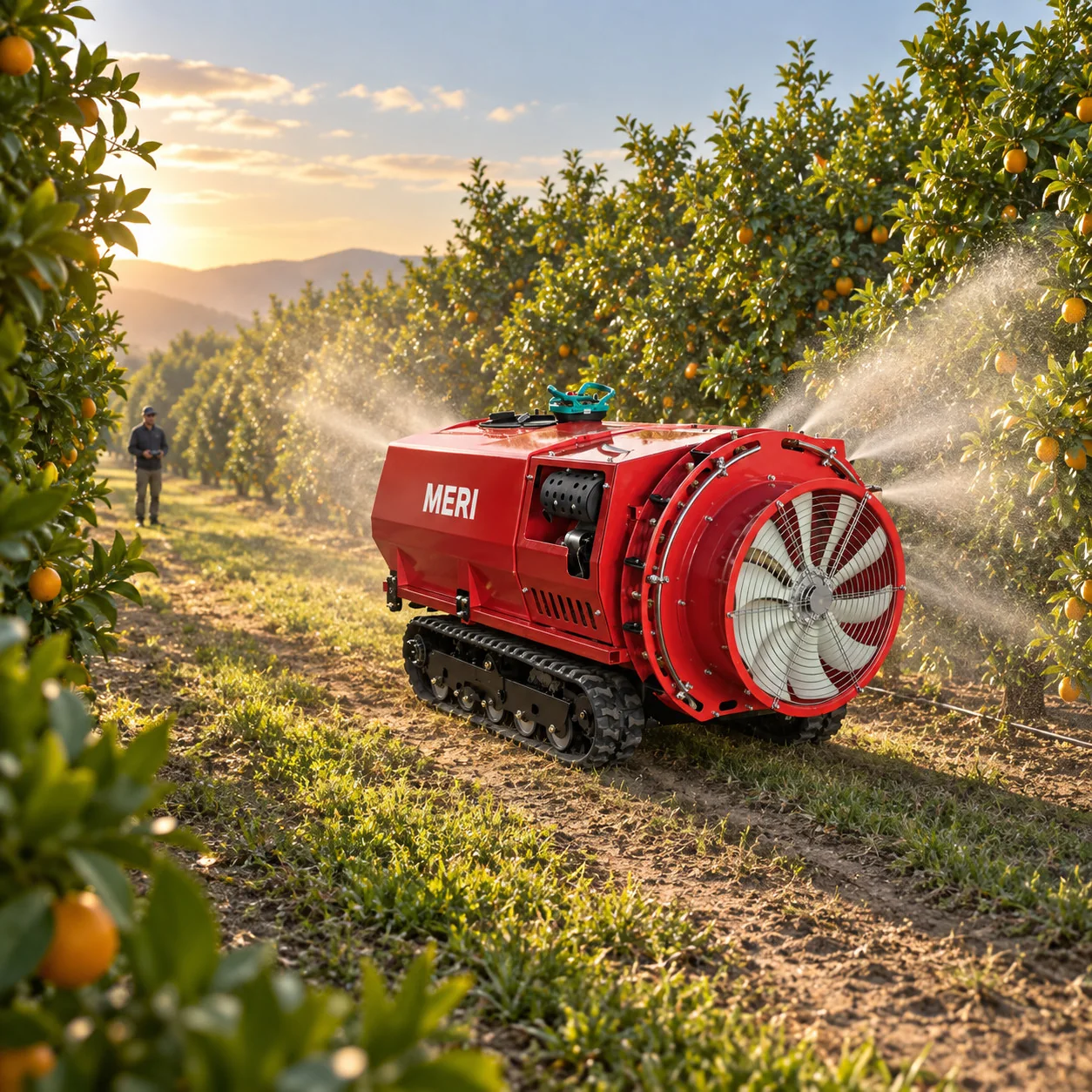
A high canopy is a three-dimensional target. Vertical reach alone does not establish coverage: canopy depth, density, gaps, row spacing, nozzle orientation, airflow, speed and weather all affect deposition. Equipment selection must begin with a canopy profile and an approved calibration method.
Fast planning answer
Use airblast configuration -A, then select fan, nozzle zones and platform capacity for the measured canopy and route. Treat published reach as a configuration reference, not a guaranteed deposition result.
Inputs to measure before quotation
Measure height, depth and density at several locations, including the upper and inner canopy. Record row width, lower branches, headland, slope, wind exposure and refill distance. Define which canopy zones are treatment targets and how deposition will be checked.
Shortlist the configuration
| Option | Capacity or use | Verified dimension | Planning role |
|---|---|---|---|
| ME-RCS200 | 200 L | 700 mm | Compact high-canopy work where access limits capacity |
| ME-RCS300 | 300 L | 900 mm | Balanced cycle and passage in wider alleys |
| ME-RCS400 | 400 L | 960 mm | Longer cycle and dense canopy planning |
| ME-RCS500 | 500 L | 980 mm | Higher capacity after ground and transport review |
| ME-RCS800 | 800 L | 1100 mm | Large-site platform with published airblast reach up to 13 m |
Published RCS models use a 200 m remote-control range. Range supports operator positioning; it is not permission to lose line of sight or work outside the controlled area. Final pump, fan or boom, nozzle, engine and plumbing configuration is confirmed for the order.
Divide the canopy into vertical zones
Map lower, middle and upper target zones rather than aiming one undifferentiated spray cloud at the tree. Nozzle orientation and output can then be reviewed against actual foliage, with unused positions shut or adjusted through the approved calibration process. The purpose is to match the crop, not to maximize liquid or airflow.
Verify deposition instead of assuming penetration
Use the orchard’s accepted method—such as water-sensitive cards or another approved check—to examine outer and inner foliage at representative heights. Adjust only within label and agronomic requirements. Record weather, speed and settings so the result can be reproduced. A website image, fan diameter or reach value cannot replace this field verification.
Match tank cycle to canopy verification time
Dense high trees may require more checks and adjustments than a uniform young block. Include time for deposition checks, nozzle inspection and weather changes when estimating the useful cycle. A larger tank does not improve the result if calibration must be revisited mid-block. Procurement should compare verified treated-row length per calibrated setup rather than using tank volume as the only productivity measure.
Operating workflow
- Profile canopy zones and identify representative test rows.
- Confirm product label, application volume and weather limits.
- Set fan, nozzles and speed using the approved calibration process.
- Check deposition at lower, middle, upper and interior positions.
- Record settings and repeat verification when canopy or weather changes.
Limits and safety boundaries
The RCS800 reach reference does not guarantee coverage at 13 m. Effective treatment must be verified for the crop, configuration, speed and conditions.
Remote operation does not remove pesticide training, protective equipment, drift control, exclusion zones, re-entry requirements, inspection or emergency planning.
Related MERI resources
- Compare the MERI RCS series
- Read the agricultural sprayer selection guide
- Download the RCS series TDS
- Review MERI equipment videos
Buyer FAQ
Does remote control make pesticide application safe by itself?
No. It changes operator position but does not replace the label, training, PPE, drift controls, exclusion, re-entry or emergency procedures.
Should the largest available tank be selected?
No. Balance the liquid cycle with chassis clearance, ground, turning, transport, refill route and the approved application volume.
What should accompany a quotation request?
Send crop and target dimensions, route and terrain, gate and row width, application volume, refill logistics, daily work target and destination requirements.
Match the sprayer to the measured work
Send the crop, route, configuration and work-cycle inputs. MERI will compare suitable RCS platforms using verified model data.
Need a agricultural sprayer recommendation for your terrain or project?
Get a Quote