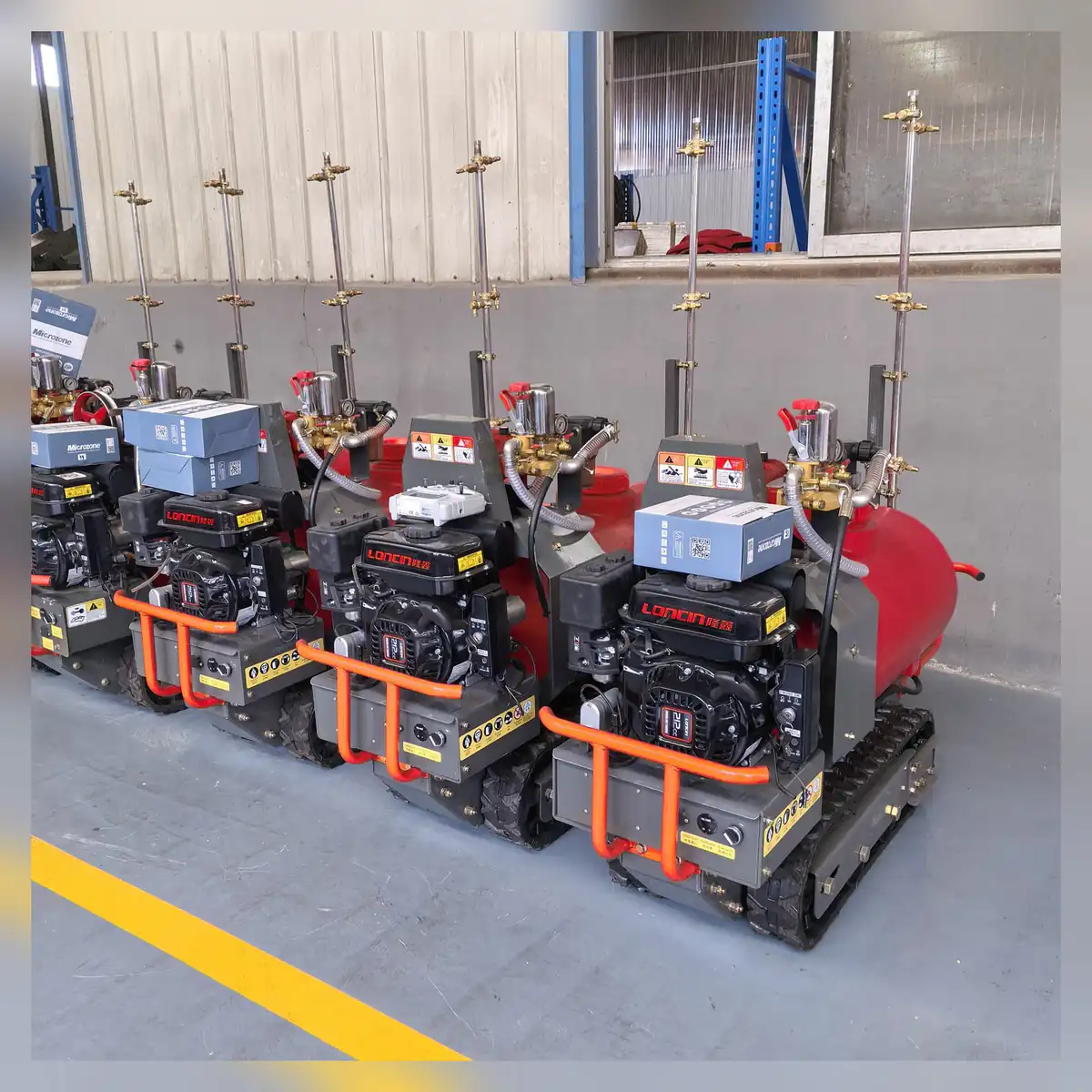
Choosing a remote control agricultural sprayer starts with the crop and the space between the rows—not with tank capacity alone. A machine that fits an open orchard may be too wide for vegetable beds, while a compact boom sprayer may not deliver the canopy penetration an orchard needs.
The right choice depends on five practical factors: crop type, row spacing, turning room, canopy structure, and refill access. This guide shows how to match those conditions to the MERI ME-RCS remote control agricultural sprayer range.
Remote Sprayer Selection Summary
- Narrow vegetable rows: begin with the compact 100 L ME-RCS100-B, then match boom height, width, and nozzle count to the crop.
- Orchards and vineyards: choose an airblast (-A) configuration to move spray into raised and denser canopies.
- Many orchards below roughly 100 mu: use 120–400 L as a practical starting range, then refine it around access and refill distance.
- Larger sites and longer cycles: consider 500 or 800 L only when row width, turning room, ground, and transport can support the larger platform.
- Every ME-RCS model: the current range lists a 200 m remote-control range.
Start With the Crop, Then Follow the Decision Path
Identify the spray target
Low, even vegetable beds point toward a boom. Raised, layered orchard foliage points toward airblast.
Measure the tightest space
Use the narrowest clear row, gate, branch clearance, and headland—not the average width.
Plan the refill cycle
Balance tank capacity against access, liquid demand, refill distance, and the time available for each spray cycle.
Boom vs Airblast: Make This Choice First
Boom configuration (-B)
Best starting point for: vegetables, seedlings, greenhouses, nurseries, and other low, relatively even crops.
The boom distributes spray horizontally across the bed or row. In narrow vegetable layouts, the compact ME-RCS100 is usually the first model to evaluate because larger equipment may simply not fit.
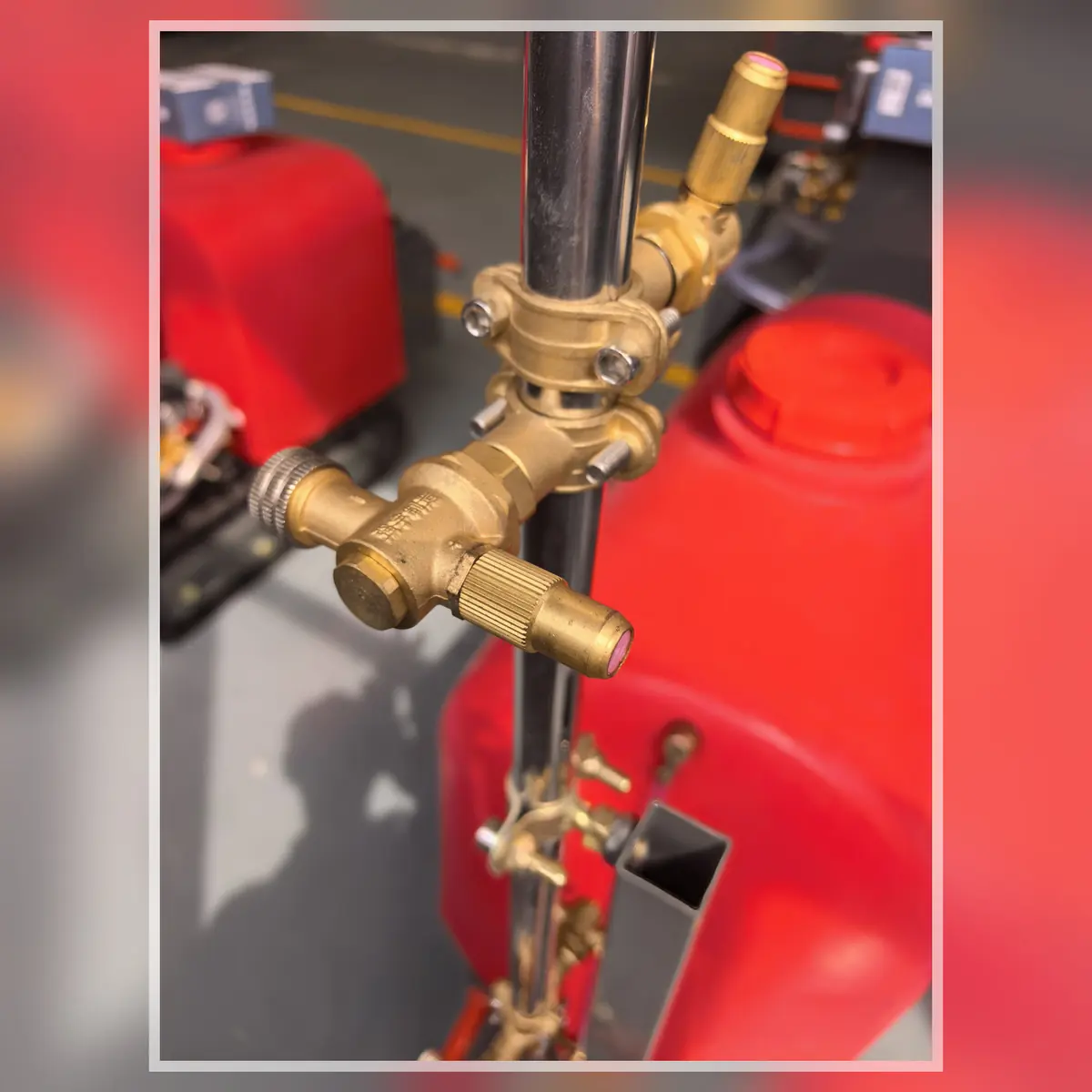
Custom options: boom height, boom width, and nozzle quantity can be matched to the planting layout.
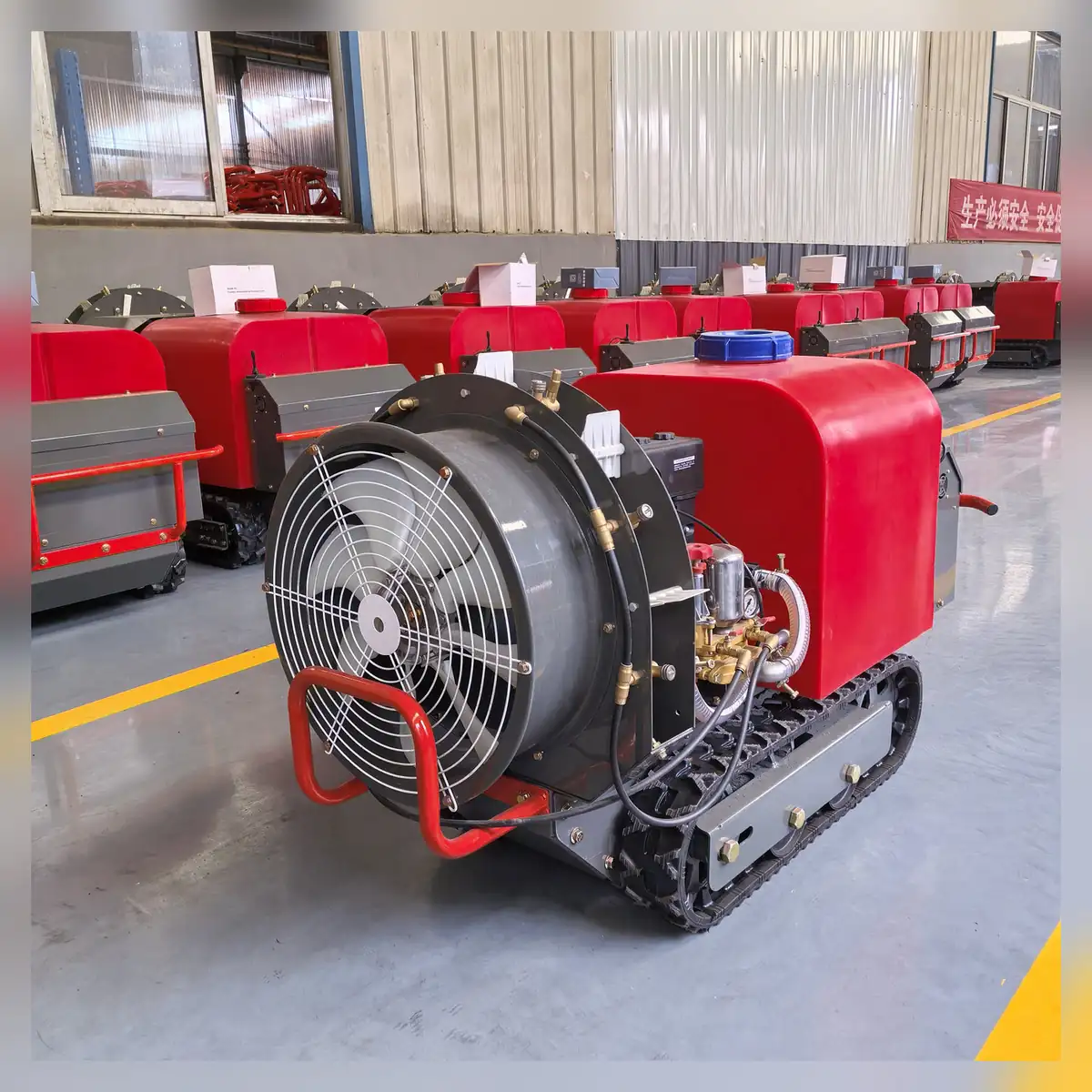
Airblast configuration (-A)
Best starting point for: orchards, vineyards, and crops with raised or denser foliage.
A fan carries droplets into the canopy, which makes airblast more suitable than a low horizontal boom for tree rows.
Define before selection: canopy height and density, row width, branch clearance, and turning space.
Measure the Row Before Selecting the Model
Nominal tank capacity tells only part of the story. Overall machine width and turning space determine whether the sprayer can actually work in the field. Measure the narrowest usable gap and allow clearance for plants, irrigation lines, posts, low branches, and steering corrections.
| Model | Tank capacity | Chassis width | Practical starting point |
|---|---|---|---|
| ME-RCS100 | 100 L | 400 mm | Narrow vegetable rows |
| ME-RCS120 | 120 L | 520 mm | Narrow access and short cycles |
| ME-RCS200 | 200 L | 700 mm | Compact-capacity balance |
| ME-RCS300 | 300 L | 900 mm | Mid-range balance |
| ME-RCS400 | 400 L | 960 mm | Wider rows and longer cycles |
| ME-RCS500 | 500 L | 980 mm | Larger sites where access permits |
| ME-RCS800 | 800 L | 1100 mm | Longer cycles on suitable sites |
A machine that fits between rows may still lack room to turn. Check the aisle end, loading route, transport width, and the softest ground the machine must cross.
Match Tank Size to the Refill Cycle
For narrow vegetable production, the 100 L ME-RCS100 is the practical first model to evaluate. It prioritizes access where wider equipment cannot enter.
For orchards below roughly 100 mu, MERI commonly begins the selection discussion within the 120–400 L range. Treat that as a practical starting band rather than an automatic area guarantee:
120 L
Choose this direction when access is tight, spray cycles are shorter, and refilling is easy.
200–300 L
A useful middle ground between compact dimensions and fewer refill stops.
400 L
Stronger fit for wider rows, longer working periods, inconvenient refill points, or larger and denser canopies.
For larger sites or longer planned spray cycles, the 500 L and 800 L models provide additional capacity. Bigger only creates value when the row width, ground condition, turning room, transport method, and refill plan support it.
Check Weight, Speed, and Access as One System
Tank capacity should never be evaluated alone. The ME-RCS range spans from a 150 kg ME-RCS100 to heavier mid-size platforms such as the 420 kg ME-RCS400 and 465 kg ME-RCS500. Travel speed is listed at 80 m/min for the 100, 120, and 200 L models; 60–80 m/min for the 300, 400, and 500 L models; and 100–133 m/min for the 800 L model.
These figures help compare platforms, but they do not predict hectares or mu sprayed per hour. Real productivity changes with spray volume, nozzle setup, crop density, turning frequency, refill time, terrain, and operating speed.
Specify the Sprayer Around the Crop
Standard specifications are a starting point. MERI supports customization of boom height, boom width, nozzle quantity, chassis width, and engine model.
Pre-Purchase Checklist
- Crop and growth stage: describe what will be sprayed and how the target changes through the season.
- Narrowest clear row: include irrigation lines, posts, branches, gates, and steering clearance.
- Canopy structure: for orchards, provide height, density, and the area that must receive coverage.
- Terrain and surface: note slope, soft ground, ruts, stones, and turning conditions.
- Liquid and refill plan: define desired volume, refill location, and acceptable cycle length.
- Transport and access: confirm gate width, loading method, vehicle limits, and headland space.
- Configuration: state boom or airblast and any required boom, chassis, nozzle, or engine customization.
- Local operating rules: check the requirements that apply to spraying equipment and chemical use.
Frequently Asked Questions
Which remote control sprayer is the best starting point for narrow vegetable rows?
The 100 L ME-RCS100-B is the practical first model to evaluate because its 400 mm chassis is the narrowest in the current range. Final boom dimensions and nozzle layout should be matched to the crop.
Should an orchard use a boom or an airblast sprayer?
Airblast is the correct starting point for orchards and vineyards because the fan moves droplets into raised and denser foliage. Confirm canopy height, density, row width, and branch clearance before selecting capacity.
Is 120–400 L suitable for every orchard below 100 mu?
No single tank range guarantees suitability by area alone. The 120–400 L range is a practical starting point for many orchards below roughly 100 mu, then access, canopy, refill distance, and cycle length refine the decision.
When should a buyer consider the 500 L or 800 L models?
Consider them when the site needs longer spray cycles and can support the wider, larger platform. Row width, turning space, ground condition, transport, and refill planning all need to work together.
Choose the Sprayer That Fits the Field
Send MERI your crop type, narrowest row spacing, canopy dimensions, terrain, refill plan, and preferred configuration. The clearer the site brief, the faster the model and customization discussion becomes.
Need a agricultural sprayer recommendation for your terrain or project?
Get a Quote