
Short answer: On conservation grassland, mowing is usually part of a written management plan. Follow the contract and the local office’s guidance for timing and how much area to mow, keep cutting heights that protect cover, avoid the nesting season where the plan says so, and keep clear records. A remote mower helps on wet or steep parts.
Why mowing is part of the plan
Conservation grassland, such as land enrolled in the US Conservation Reserve Program (CRP), needs management to stay healthy. Without it, woody plants move in and the grass cover ages. Mowing, alongside other methods, keeps the cover in good condition.
Each contract has its own rules. The landowner and the local office set them. A contractor’s job is to deliver the work to that plan.
Before you quote
- Ask the landowner for the management plan and any mowing dates or limits.
- Confirm which areas are to be mowed and which left.
- Ask about cutting height and how much area per year.
- Note wet areas, slopes and wildlife features.
Timing
Many plans restrict mowing during the main nesting season for ground-nesting birds. Do not assume dates; take them from the plan or the local office. Where mowing is allowed, plan the work for dry conditions so the field is not rutted.
Cutting height and pattern
| Goal | Practice |
|---|---|
| Keep cover for wildlife | Higher cut, as set by the plan |
| Control woody invasion | Mow areas with saplings; consider repeat passes |
| Leave refuges | Mow in strips or blocks, leaving uncut areas |
| Protect wet areas | Skip or mow only in dry periods |
MERI flail models adjust from 30 to 300 mm, so the plan’s height can usually be matched.
Steep and wet ground
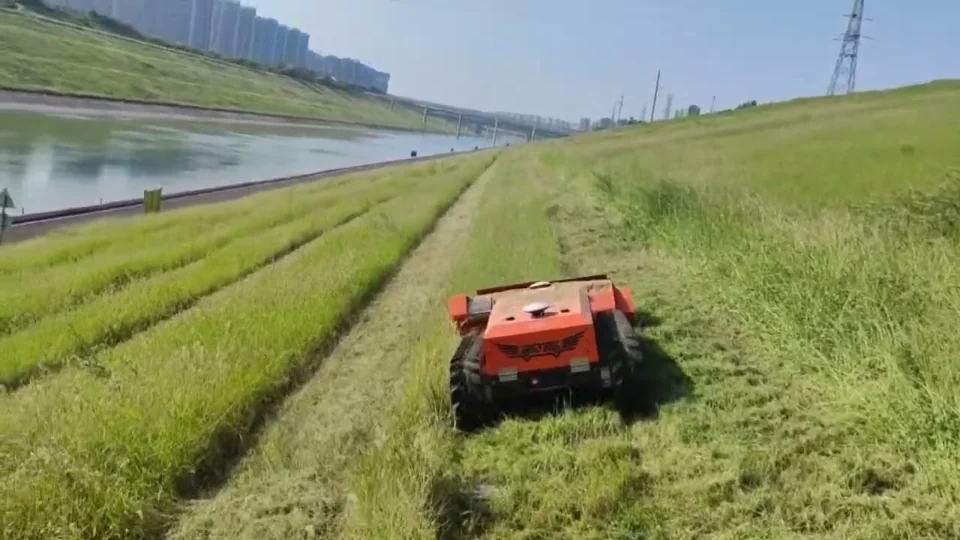
Conservation fields often include the steep and wet ground that was hardest to farm. Tractors struggle there. A remote tracked mower can work these areas while the operator stays on firm ground. MERI tracked remote mowers are rated to 45°, but wet soil is a reason to work well below that.
Records
- Date, area and field map of what was mowed.
- Cutting height and machine used.
- Weather and ground conditions.
- Photos before and after.
Give a copy to the landowner. Many contracts require proof that management was done, and good records make that easy.
For contractors
Conservation contracts can be steady annual work. Build a simple template for each farm and keep it up to date. Clients value contractors who know the plan and do not need reminding of the rules.
A worked example
A landowner has a conservation field with a wet hollow and a steep bank. The plan allows mowing of part of the field outside the nesting period, in blocks, with refuges left uncut. The contractor maps the blocks, mows the flat ground with a tractor and uses a remote mower on the bank. The wet hollow is skipped because the ground is soft. The landowner receives a short report with the map, dates, heights and photos.
A visit record that works
| Date | Block | Cut height | Ground | Notes |
|---|---|---|---|---|
| Day of visit | Block number from the map | As set by the plan | Dry / soft / wet | Refuges left, saplings found, photos taken |
One row per block per visit. Keep the map and the record together.
A record in this form is quick to fill in on site and easy for the landowner to pass on when proof of management is needed.
Spotting woody invasion early
On every visit, note where saplings are coming in, and mark them on the field map. Small saplings are quick to mow. If they are left for a few years, the field may need a mulcher instead. Showing the landowner the map each year helps them plan the next step with their adviser.
Cleaning between farms
Seed and plant fragments travel in tracks and decks. Clean the machine before moving between fields, so unwanted plants are not carried into conservation grassland.
Common mistakes
- Assuming last year’s dates apply this year.
- Mowing the whole field when the plan asks for blocks.
- Rutting wet ground with heavy machines.
Related MERI pages
- Remote mowers for nature reserves and meadows
- Mowing in ground-nesting bird season
- Remote mowers for farms and pasture
- Cutting height by model
- Remote control slope mowers
Frequently asked questions
Who sets the mowing rules on CRP land?
The contract and the local office set them. The contractor follows the plan the landowner provides.
Can I mow during nesting season?
Only if the plan allows it. Many plans restrict mowing during the main nesting period.
What cutting height should I use?
The height set in the management plan. MERI flail models adjust from 30 to 300 mm.
Why keep records of conservation mowing?
Many contracts require proof that management was done. Records also help plan next year’s work.
Send us your site details
Tell us the job, area, slope and country. MERI replies within 24 hours.
Need a mower recommendation for your terrain or project?
Get a Quote