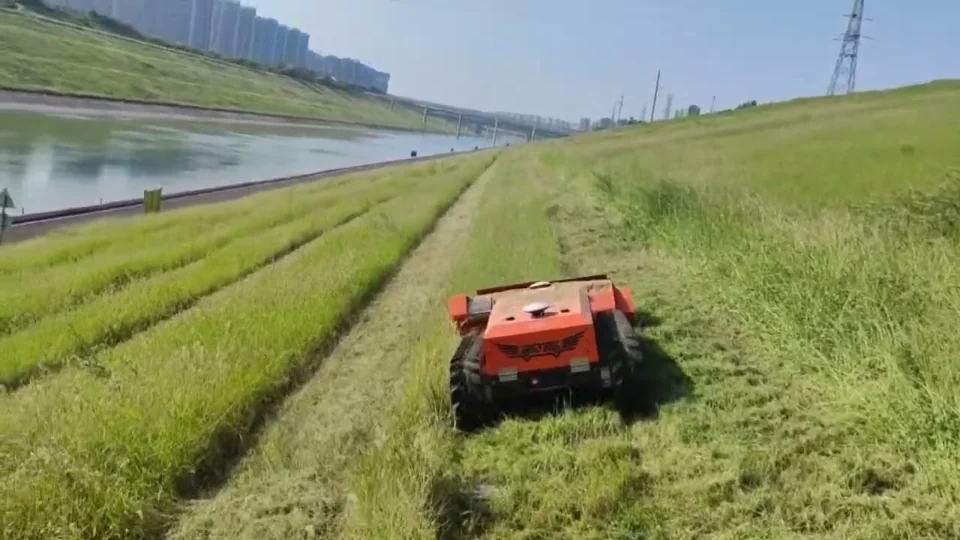
Short answer: A grassed waterway carries runoff across a field without cutting a gully. It only works if the grass stays thick and the channel stays smooth. Mow it a few times a year at a moderate height, avoid wet ground, never use it as a track, and fix small ruts or sediment early. A light tracked remote mower reduces the risk of rutting.
Why waterways fail
Extension services in the Midwest and conservation agencies return to grassed waterways often. The common failures are simple: ruts from machinery, thin grass, sediment build-up and woody growth. Each one concentrates water into a narrow line, and a gully starts.
Mowing is part of keeping the grass dense and the channel smooth.
A simple maintenance plan
| Task | When | Why |
|---|---|---|
| Mow | A few times a year in the growing season | Keeps grass dense and stops woody growth |
| Inspect | After big storms | Find ruts, gullies and sediment early |
| Repair | As soon as found | Small fixes stop large gullies |
| Remove sediment | When it builds up | Keeps the channel shape |
| Control weeds | As needed | Weeds leave bare ground |
General plan. Your conservation adviser may set specific rules.
Mowing height and timing
Mow at a moderate height so the grass stays thick and slows the water. Very short grass offers less protection; very tall grass can lodge and trap sediment. MERI flail models have a 30–300 mm cutting height range, so the deck can be set to the height your adviser suggests.
Mow when the channel is dry. A waterway that is soft after rain will rut, and a rut in the bottom becomes the start of a gully. Many farms mow after the main nesting period and again before winter.
Why weight and tracks matter
Tractors crossing or driving along a waterway in wet weather cause most of the damage. A compact tracked remote mower is lighter and spreads its weight. The operator walks on the field edge while the machine works the channel, so there is no need to drive heavy equipment down the centre.
48 V MERI models use two 1,000 W travel motors, and the tracks give grip on the side slopes of the channel.

Crossing points
Machinery has to cross waterways during field work. Pick firm crossing points, keep them the same every year and avoid turning in the channel. Lift tillage tools before crossing. Spraying across a waterway can kill the grass; turn off the boom when crossing unless your plan says otherwise.
Checklist after a storm
- Walk the full length of the waterway.
- Look for ruts, small gullies and bare patches.
- Check the outlet for scour.
- Note sediment fans at the inlet.
- Plan repairs before the next heavy rain.
Woody growth and weeds
Willow, cottonwood and other trees seed into waterways if mowing stops for a few years. Their roots and trunks divert flow and start gullies. Regular mowing keeps them out. Where saplings are already established, cut them while small; larger stems may need a mulcher and a repair plan for the channel.
Noxious or invasive weeds in the waterway should be handled as your local adviser recommends; mowing before seed set at least limits their spread.
Seeding and repairs
Small bare patches can be reseeded after repair. Rake, sow and firm, and avoid mowing until the new grass has rooted. A short repair done early keeps the waterway working through the next storm season.
A worked example
A farm has a long grassed waterway across a sloping field. In past years, the tractor crossed it at different points, and two shallow gullies started. The farmer now uses one firm crossing point, marked with posts. A compact tracked remote mower cuts the waterway a few times each growing season, always when the channel is dry. After each big storm, the farmer walks the length and repairs small bare patches early. The gullies have been filled and reseeded.
Common mistakes
- Using the waterway as a field road.
- Mowing when the channel is wet.
- Mowing too short and thinning the grass.
- Leaving woody growth to establish in the channel.
Related MERI pages
- Mowing drainage channels without rutting
- Cutting height by model
- Remote mower for farms and pasture
- Stopping erosion on steep banks: mowing height
- ME1000-48 remote flail mower
Frequently asked questions
How often should a grassed waterway be mown?
A few times a year in the growing season, when the channel is dry. Your adviser may set a specific plan.
What height should a waterway be mown at?
A moderate height that keeps the grass thick. MERI flail models adjust from 30 to 300 mm.
Why do waterways get gullies?
Usually from ruts, thin grass or sediment that concentrates water into one line.
Can a remote mower help protect a waterway?
Yes. A compact tracked machine is lighter than a tractor and the operator walks on the field edge.
Send us your site details
Tell us the job, area, slope and country. MERI replies within 24 hours.
Need a mower recommendation for your terrain or project?
Get a Quote