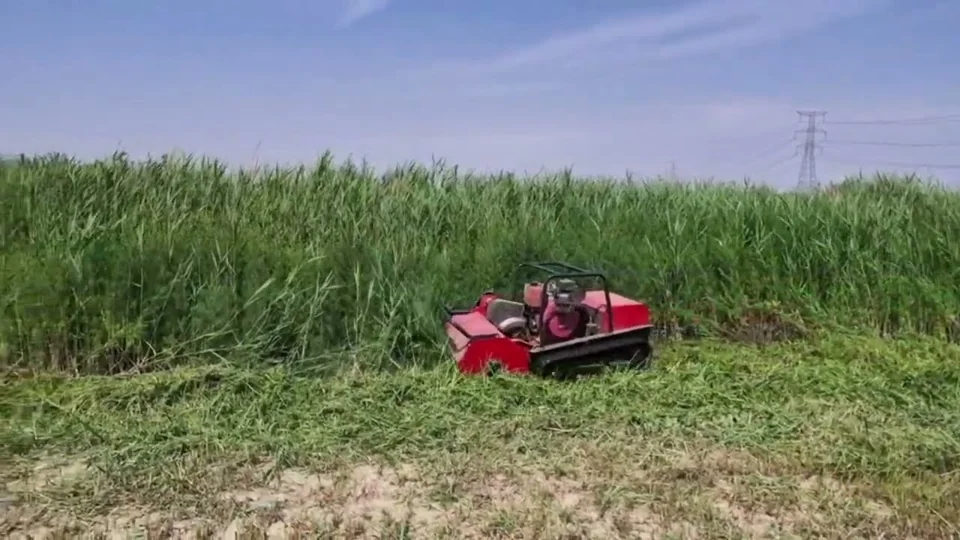
Short answer: Mowing will not wipe out johnsongrass on its own. It does two useful things. It stops new seed if you cut before the heads open. And repeated cuts drain the underground rhizomes over time. Inside the hay field, the normal hay cut does much of the work. The weak spots are field edges, ditch banks and fence lines. That is where a tracked remote mower such as the MERI ME1000-48 or ME1200-48 can keep the stand from spreading back into the field.
Johnsongrass is a tall, fast perennial grass. It spreads by seed and by thick rhizomes under the soil. In hay fields it lowers quality and can carry feeding risks. This guide is for hay growers, farm managers and the dealers who supply them. It looks at where mowing fits, and which machines suit the hard-to-reach parts of the farm.
How johnsongrass spreads
Johnsongrass moves in two ways. Seed heads drop seed that can stay alive in the soil for years. Rhizomes grow sideways and send up new shoots. Cutting a rhizome with a disc or tiller can even start new plants from each piece.
That is why timing matters more than anything else. A cut before seed heads open stops the seed side. A cut every time the regrowth gets tall makes the plant use stored energy. Over a season or two, the stand gets weaker.
Where mowing fits in a control plan
Most farms use more than one method. Mowing, grazing, crop rotation and herbicide all have a place. Your local extension service can tell you what works and what is allowed in your area. This article only covers the mowing side.
- Inside the field: time the hay cuts so johnsongrass does not head out between them.
- Field edges and corners: cut on the same schedule as the field, not once a year.
- Ditch banks and fence lines: these often hold the seed source. Keep them cut short.
- After the last hay cut: watch regrowth and cut again before it heads.
Why the edges are the problem
Tractors and hay mowers do the field well. They struggle on the steep ditch bank, the narrow strip by the fence and the wet corner. Those strips are often left until late summer. By then, the johnsongrass has headed and dropped seed back into the field.
A remote mower lets one person cut those strips safely. The operator stands at a distance while the tracked machine works on the bank. Selected MERI models are rated for slopes up to 45° in suitable conditions. Keep people at least 15 m away from the working machine, as the MERI manual requires.
MERI flail models for hay farms
| Model | Cutting width | Cutter | Cutting height | Overall size (L × W × H) | Net weight | Engine |
|---|---|---|---|---|---|---|
| ME800-24 | 800 mm | Flail, 30 blades | 30–300 mm | 1650 × 950 × 920 mm | 355 kg | Loncin 459 gasoline, 18 hp |
| ME1000-48 | 1,000 mm | Flail, 40 blades | 30–300 mm | 1750 × 1150 × 920 mm | 424 kg | Loncin 459 gasoline, 18 hp |
| ME1200-48 | 1,200 mm | Flail, 48 blades | 30–300 mm | 1750 × 1350 × 920 mm | 445 kg | Loncin 459 gasoline, 18 hp |
Source: MERI technical data sheets. All models listed travel at 0–5 km/h on rubber tracks.
All three cut from 30 to 300 mm. For johnsongrass, start high on the first pass if the growth is tall, then cut lower on the next. The ME1200-48 covers the most ground per pass on wide banks. The ME800-24 is the narrowest, at 950 mm overall, for tight fence lines. Full data is on the ME1200-48 page. Our cutting width comparison helps you size the machine to your strips.

A practical cutting routine
- Map where johnsongrass grows on edges, banks and around gates.
- Cut those strips when the field is cut, before seed heads open.
- Clean the mower before moving to a clean field, so you do not carry seed or rhizome pieces.
- Check regrowth every few weeks and cut again before it heads.
- Keep notes on each strip so you can see if the stand is getting weaker.
Standard remote range is up to 800 m, and the optional R1 upgrade reaches up to 1,000 m. Keep the machine in sight on banks. If the remote signal is lost, the machine stops. Johnsongrass is a common problem on farms in the southern United States. Our USA buying guide covers local buying questions. For more on farm use, see remote mowers for farms and pasture and our guide to pasture topping on steep fields.
What to send MERI
- Total length of field edges, ditch banks and fence lines you cut.
- The steepest bank slopes.
- Height of the growth when you usually cut.
- Ground conditions: wet, stony or firm.
- Your country, and whether you buy for your own farm or for resale.
Frequently asked questions
Does mowing kill johnsongrass?
Mowing alone rarely kills an established stand. Repeated cuts before seed heads form stop new seed and slowly drain the rhizomes. Most farms combine mowing with other methods advised locally.
When should johnsongrass be cut?
Cut before the seed heads open. After that, each plant can drop a large amount of seed. Keep cutting regrowth before it heads again.
Is johnsongrass regrowth safe to feed?
Stressed johnsongrass, for example after frost or drought, can build up prussic acid and nitrate. Ask your local extension adviser before grazing or feeding it.
Where does a remote mower help most?
On field edges, ditch banks, fence lines and steep corners. These are the places where johnsongrass often hides and where a tractor cannot cut safely.
Mowing hay field edges and banks?
Send your field size, bank slopes and the height of the growth you cut. We will suggest a MERI model and quote it for your market.
Need a mower recommendation for your terrain or project?
Get a Quote