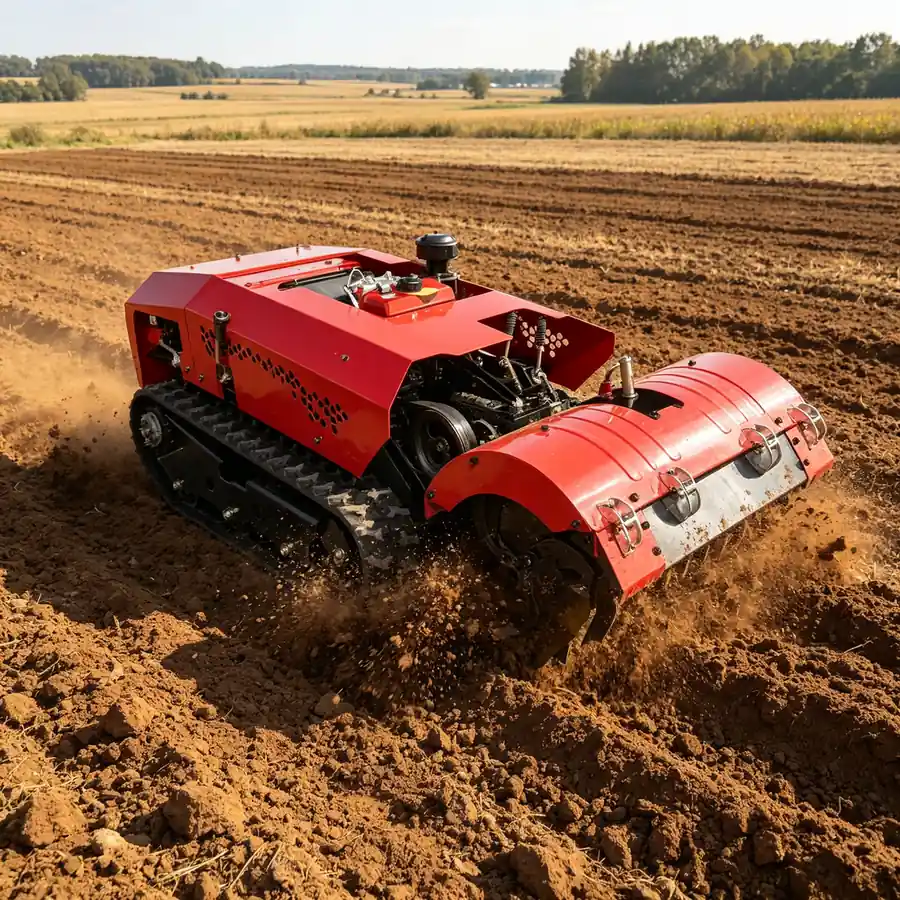
Short answer: The ME-RT suits vineyards that till or weed the inter-row and need small drainage ditches, especially on slopes where a tractor is risky. The product page lists an 800 mm working width, 130–250 mm tilling depth, 750 mm width, 45° slope rating and a KOOP 195 diesel engine. Diesel models are not supplied to the US market.
Why some vineyards till the inter-row
Many vineyards keep a cover crop between rows. Others till some or all rows to reduce competition for water, to work in compost or to break up compaction. Some alternate: one row tilled, the next one grassed.
On flat sites a tractor with a rotary tiller does this well. On steep or terraced blocks, tractors are unsafe or cannot fit. A remote tracked tiller lets the operator walk the headland while the machine works the row.
ME-RT product page figures
| Item | Product page figure |
|---|---|
| Engine | KOOP 195 single-cylinder diesel, 15 hp |
| Working width | 800 mm |
| Control system | 24 V |
| Travel power | 24 V 800 W × 2 |
| Max slope | Up to 45° |
| Remote range | Up to 800 m |
| Travel speed | Up to 5 km/h |
| Fuel tank | 5.5 L |
| Weight | 390 kg, excluding tools |
| Dimensions (L×W×H) | 1800×750×700 mm |
| Rotary tilling depth | 130–250 mm (by configuration) |
| Included work | Rotary tillage, weeding, ditching, backfilling |
Data from the live MERI product page. Confirm the order configuration with MERI before you buy.
Row fit
The ME-RT is 750 mm wide overall, with an 800 mm working width. Measure the clear width between trellis posts and the lowest wires, and between vine trunks. Many vineyard rows have space, but posts and anchors at row ends need care when turning.
Diesel models are not supplied to the US market. US buyers should look at the gasoline versions.
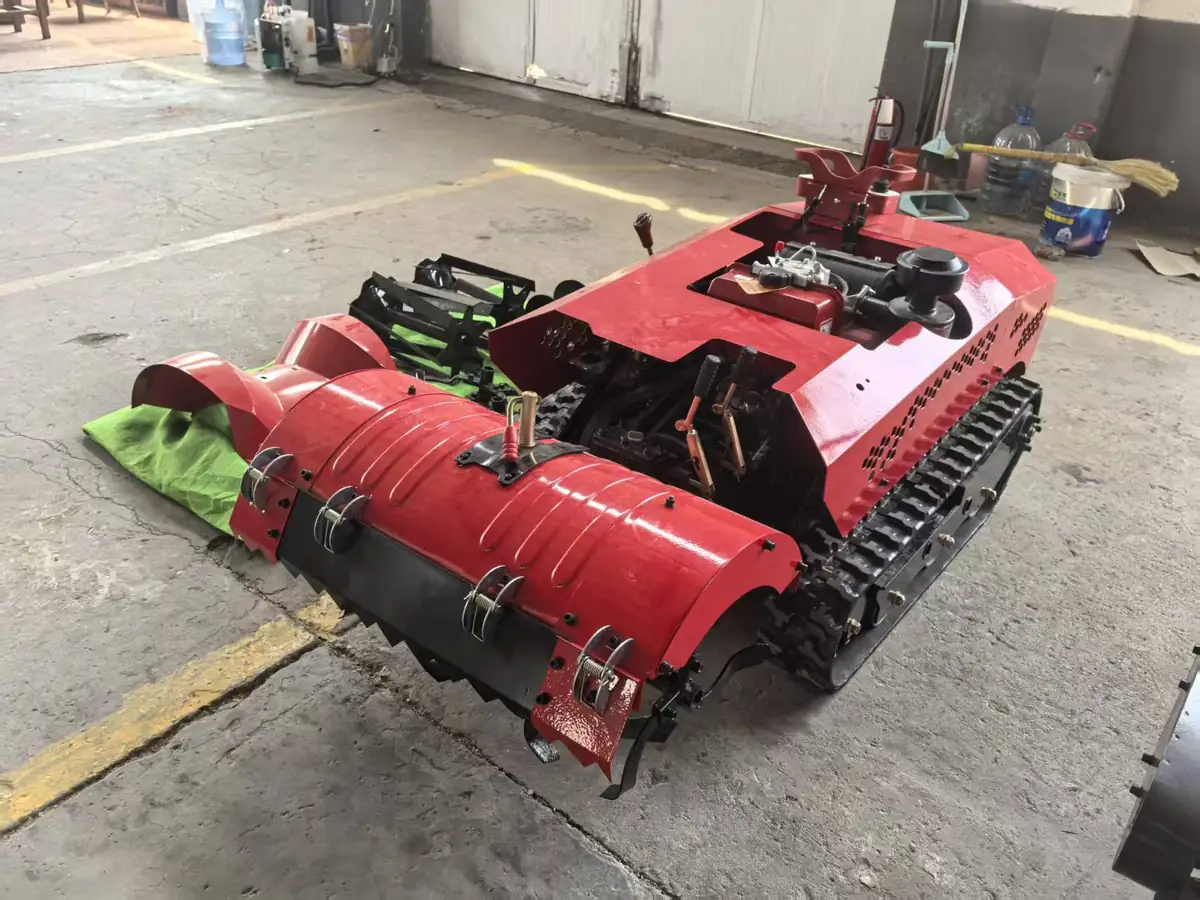
Setting depth near vine roots
The product page lists 130–250 mm tilling depth by configuration. In established vineyards, shallow work is usually enough to control weeds and incorporate compost. Deeper work cuts more vine roots. Agree the depth with your viticulturist, and test one row before doing a block.
Seasonal jobs
| Season | Typical ME-RT job |
|---|---|
| Late winter | Work in compost or manure in tilled rows |
| Spring | Shallow tilling to control early weeds |
| Summer | Spot weeding where cover crops compete in dry years |
| Autumn | Small ditches to move water off the block |
Starting points only. Your soil, climate and vineyard plan set the timing.
Slopes and soil
The product page lists a maximum slope of up to 45°. On steep vineyard slopes, work across the slope where row layout allows and keep travel slow. Tilled soil on slopes can erode in heavy rain; many growers till alternate rows or leave a grassed strip to hold the soil. Do not till when the soil is wet: tracks and blades will smear and compact it.
Before the first row
- Walk the block and mark broken posts, anchors and loose wire.
- Check drip lines and lift them clear or mark them.
- Set depth on a test strip and check the result.
- Plan headland turns so the machine does not hit end posts.
- Keep people out of the row while the tiller is working.
Working around irrigation and posts
Drip lines are often hung on the lowest wire or laid on the ground under the vines. Keep the tiller in the centre of the row and leave an untouched strip under the vines. At row ends, the anchor wires run out at an angle and are easy to catch. Mark them with tape or paint before the first round, and turn on the headland with a wide arc.
A worked example
- A 4 ha block has rows 2.2 m apart: about 18,000 m of row.
- If you till alternate rows, that is about 9,000 m per round.
- Tilling speed in vineyard soil is far below the 5 km/h top travel speed on the product page, and headland turns add time.
- Time the first ten rows and scale up. That gives a fair estimate for the block and tells you whether one machine can keep up in a wet spring.
- Record soil condition for each round so you know which weeks are workable.
What to send MERI before ordering
- Row width, post spacing and the height of the lowest wire.
- The steepest slope in the block.
- Soil type and stone content.
- Which rows you till and how often.
- Your country, so MERI can confirm the diesel model is offered there.
MERI can then confirm whether the ME-RT or the ME-RT PRO suits the vineyard, and which tools to add for mowing or ditching.
Related MERI pages
- ME-RT series rotary tiller
- Remote tillers for vineyards
- Rotary tiller fit checklist for narrow vineyard rows
- Tiller setup near drip irrigation
- Tilling orchard cover crop residue
- ME-RT tiller FAQ
Frequently asked questions
Can the ME-RT work on steep vineyard slopes?
The product page lists a maximum slope of up to 45°. Wet or loose soil lowers the safe angle.
How wide are the rows it needs?
The machine is 750 mm wide with an 800 mm working width. Measure the clear space between posts and trunks.
Is the ME-RT gasoline or diesel?
The product page lists a KOOP 195 diesel engine. Diesel models are not supplied to the US market.
What remote range does it have?
The product page lists up to 800 m. In a vineyard, stay where you can see the machine and the row end.
Send us your site details
Tell us the job, area, slope and country. MERI replies within 24 hours.
Need a mower recommendation for your terrain or project?
Get a Quote