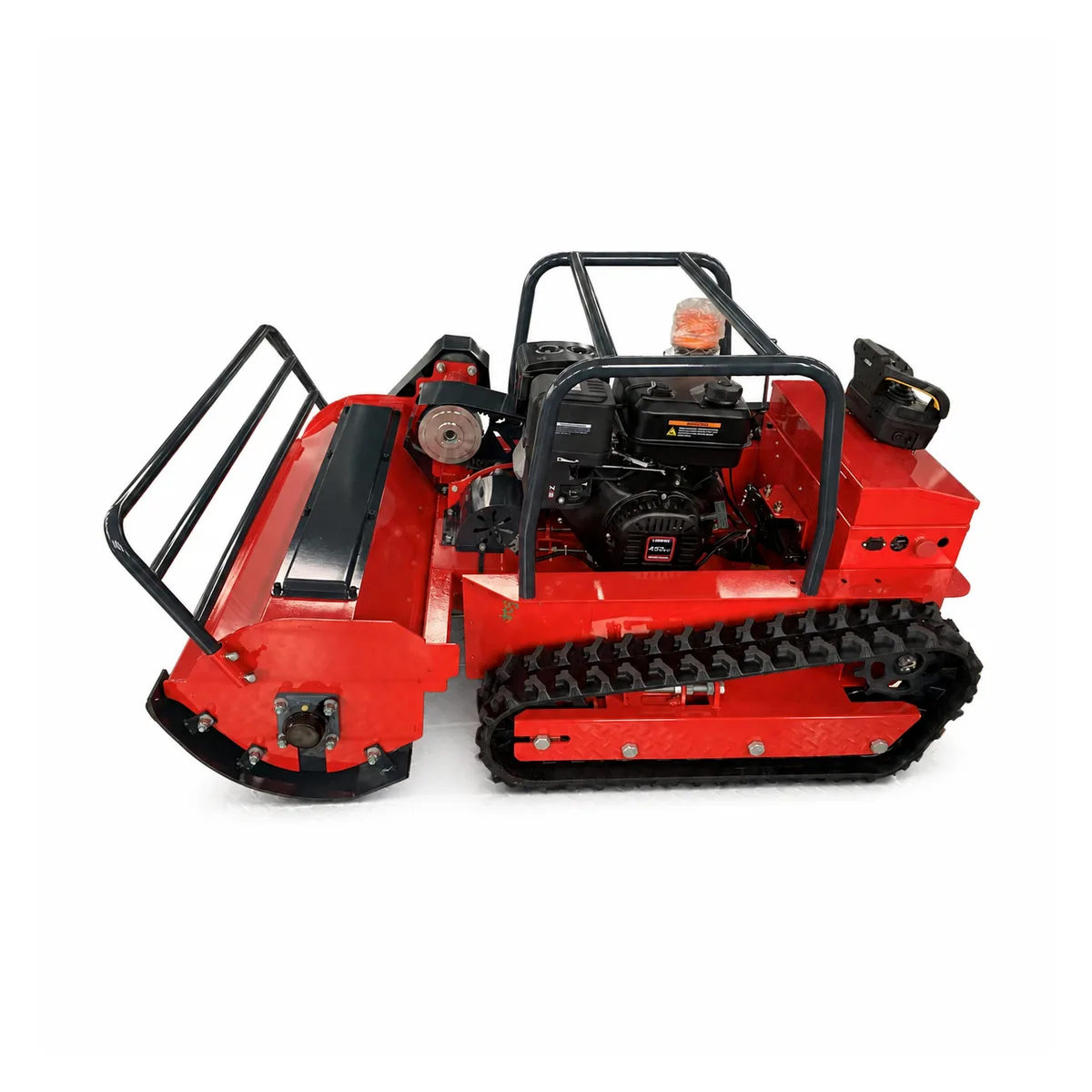
Short answer: The ME800-48 suits the steep banks, terrace edges and boundary slopes of a cemetery, where a ride-on is unsafe and strimming takes hours. Its 800 mm flail deck, 30–300 mm cutting height and 45° slope rating cover rough grass on banks. Keep it away from close headstone rows; finish those by hand or with a smaller mower.
Where the ME800-48 fits on a cemetery site
Most cemeteries mix two very different kinds of ground. The burial sections are flat or gently sloped, with headstones close together. Around them are the hard parts: embankments by the road, terraces cut into a hillside, drainage slopes and the wild boundary strip by the wall or fence.
The ME800-48 is a tracked flail mower driven by remote control. It is meant for the second kind of ground. The operator stands on the path at the top or bottom of the bank and steers the machine across the slope. Nobody walks the bank with a strimmer and nobody sits on a ride-on near a drop.
It is not a tool for tight headstone rows. At 950 mm overall width, it needs a clear lane. Use it on the open banks and let the hand team finish the memorials.
Key figures from the product page
| Item | Product page figure |
|---|---|
| Engine | LONCIN 459 gasoline, 18 HP |
| Cutting width | 800 mm |
| Control system | 48 V |
| Electric power | 2,000 W |
| Blades | 30 (flail) |
| Cutting height | 30–300 mm (adjustable) |
| Max slope | 45° |
| Remote range | 800 m |
| Travel speed | 0–5 km/h |
| Fuel tank | 5.5 L |
| Weight | 402 kg |
| Dimensions (L×W×H) | 1750×950×920 mm |
| Listed working efficiency | 4,000 m²/hour |
Data from the live MERI product page. Confirm the order configuration with MERI before you buy.
Why a flail deck on cemetery banks
Cemetery banks are often cut only a few times a year. Grass grows long, brambles creep in from the boundary and leaves collect in autumn. A flail deck handles this better than a flat blade. The swinging blades chop the material small and drop it, so there is less to rake off the bank.
The 30–300 mm height range lets you set a higher cut on the first visit after a long gap and a lower cut on regular visits. A higher first cut also reduces the chance of hitting hidden kerbs, old markers and stones in the grass.

Plan a visit in five steps
- Walk the bank first. Look for loose stones, old markers, wire, broken vases and wasp nests. Flag anything you cannot move.
- Mark the no-go zones. Keep the machine away from graves at the top or foot of the bank and from soft ground after rain.
- Set the cut. Start high on long grass. Drop the height on later passes if the ground is clean.
- Work across the slope. Keep travel slow on the steepest part. Overlap passes a little so no strips are left.
- Finish by hand. Strim around posts, benches and memorials that the deck cannot reach safely.
Respect for visitors and services
A cemetery is not an ordinary grass contract. Agree mowing windows with the site manager so the machine is not running near a funeral or a visit. The remote control helps here: the operator can stop the machine at once and keep a calm distance from people. Stop work if anyone walks onto the bank and do not restart until they leave.
Flail decks throw less than open rotary decks, but small stones can still move. Keep the public out of the work area and park the machine with the deck lowered when you take a break.
A worked example
Take a hillside cemetery with three grass terraces, each about 600 m long and 4 m deep, and a boundary bank of about 2,500 m². That is roughly 9,700 m² of bank work. The product page lists 4,000 m² per hour for the ME800-48 on open ground. Banks, turns and hand finishing are slower, so use your own logged rate. If your crew logs half the listed figure, the banks take about five hours of machine time plus strimming. Record the real time on the first visit and use it to quote the rest of the season.
ME800-48 or a different MERI model?
If the cemetery has wider open slopes, the ME1000-48 or ME1200-48 cover more ground per pass but need wider access. If the banks are narrow and the grass is kept short, a flat-blade T-Series model can be easier around obstacles. Compare the ME800-48 with its 24 V sister model before you choose; the 48 V version adds electric drive power for steep, heavy work.
Related MERI pages
- ME800-48 remote flail mower
- Remote mowers for cemeteries
- ME800-24 vs ME800-48
- Slope ratings by model
- Cutting height by model
- Slope mowing risk assessment template
Frequently asked questions
Can the ME800-48 mow between headstones?
Only where rows are wide and clear. The machine is 950 mm wide overall. Close headstone rows are better finished by hand or with a smaller mower.
What slope is the ME800-48 rated for?
The product page lists a maximum slope of 45°. Ground condition matters: wet grass, loose soil and holes reduce safe working angles.
Does the flail deck leave clippings to rake?
Flail blades chop grass small and drop it. On long grass you may still want to clear heavy clumps from paths and graves after the cut.
How far can the operator stand from the machine?
The product page lists a remote range of 800 m. On a cemetery bank, stay close enough to see the machine, the ground and any visitors clearly.
Send us your site details
Tell us the job, area, slope and country. MERI replies within 24 hours.
Need a mower recommendation for your terrain or project?
Get a Quote