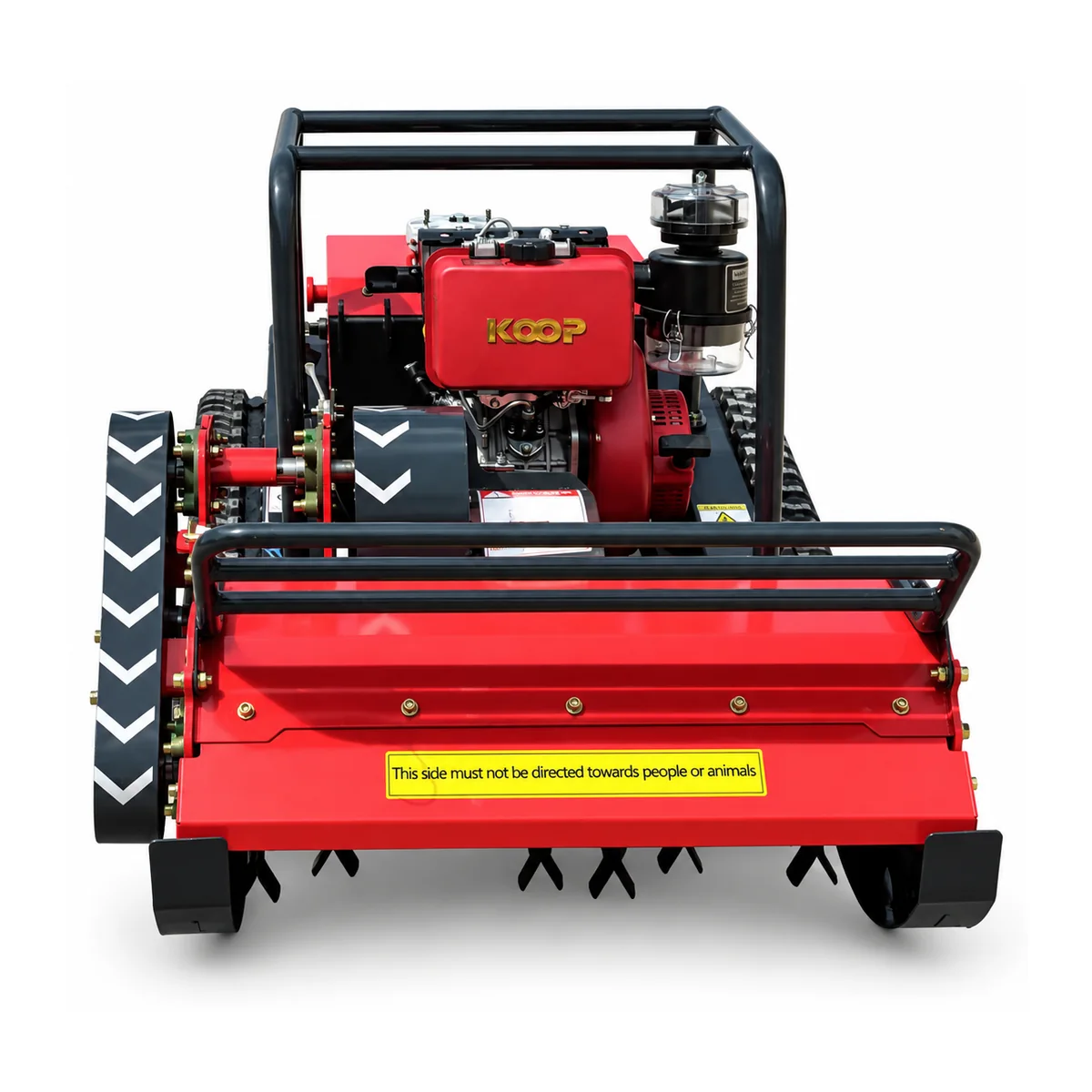
Short answer: New forestry plantations need grass and weeds controlled between the rows for the first few years so young trees are not smothered. The ME800D-48 has an 800 mm flail deck, 30–300 mm cutting height, 45° slope rating and a KOOP 192 diesel engine on its product page. It suits planted rows on slopes. Diesel models are not supplied to the US market.
Why young plantations need weeding
Young trees compete with grass, bracken and brambles for light, water and nutrients. Without weed control in the first years, many trees die or grow slowly. Forestry teams use herbicide, hand cutting or tractor mowers. Hand cutting is slow and costly. Tractors cannot work on steep or rough planting sites.
A remote tracked flail mower can cut between rows on slopes, while the operator walks the ride or the top of the block.
ME800D-48 product page figures
| Item | Product page figure |
|---|---|
| Engine | KOOP 192 diesel, 12 HP |
| Cutting width | 800 mm |
| Control system | 48 V |
| Electric power | 2,000 W |
| Blades | 30 (flail) |
| Cutting height | 30–300 mm (adjustable) |
| Max slope | 45° |
| Remote range | 800 m |
| Travel speed | 0–5 km/h |
| Fuel tank | 5.5 L |
| Weight | 402 kg |
| Dimensions (L×W×H) | 1750×950×920 mm |
| Listed working efficiency | 4,000 m²/hour |
Data from the live MERI product page. Confirm the order configuration with MERI before you buy. Diesel models are not supplied to the US market. US buyers should look at the gasoline versions.
Why the ME800D-48
The 800 mm deck fits between rows on most planting layouts. The 950 mm width keeps the machine clear of young trees with a margin. Diesel suits forestry crews who run diesel vehicles and work far from fuel stations.

Row checks
- Measure row spacing and the clear gap between tree guards or shelters.
- Mark rows where trees are close or where rows wander.
- Note stumps, brash and stones left from the previous crop.
- Check drains and ditches crossing the block.
Planting sites on old forest ground often have stumps and brash. Raise the deck on the first visit and walk the block to mark hazards.
Season timing
| Time | Aim |
|---|---|
| Late spring | First cut as grass starts competing |
| Mid summer | Main cut to keep light reaching the trees |
| Late summer | Cut bracken and brambles before they smother |
| Winter | Usually no cutting; check guards and drains |
Follow local nesting season rules for vegetation work.
Protecting the trees
The aim is to help the young trees, not damage them. Keep a margin from each row, avoid hitting tree shelters, and finish close to trees by hand where needed. The remote control lets the operator steer precisely from a good viewpoint. Drive slowly near the trees and stop if a shelter catches.
A worked example
A 20 ha new native woodland on a hillside has rows 2.5 m apart. Hand cutting took a crew three weeks per round. With the ME800D-48 cutting between rows and a small crew finishing around trees, each round takes about a week. The forester logs time per compartment and plans two rounds per year for the first three years.
What to send MERI before ordering
- Planting layout: row spacing and tree shelter type.
- Slope angles and ground conditions on the site.
- Photos of the vegetation at peak growth.
- Access routes and gate widths to the compartments.
MERI can then confirm the ME800D-48 fits the rows, or suggest a different width. For woody scrub, ask about the ME-RFM forestry mulchers.
Common mistakes
- Cutting too close to rows and knocking shelters.
- Skipping the stump and brash walk on new sites.
- Cutting in the nesting season against local rules.
- Leaving bracken until it has already smothered the trees.
A short compartment sheet with row spacing, hazards and the cut dates keeps each round on track.
Daily machine checks
- Flail blades and bolts: none missing, bent or loose.
- Rotor: free of wrapped wire, string and grass.
- Tracks: tension set and stones removed.
- Remote control: charged, stop function tested.
- Fuel and oil checked away from the work area.
Five minutes of checks at the start of the day prevent most stoppages in the field.
Related MERI pages
- ME800D-48 diesel flail mower
- Remote forestry mulchers for forest understory
- ME800-24 vs ME800-48
- Slope ratings by model
- Cutting height by model
- Slope mowing risk assessment template
Frequently asked questions
Is the ME800D-48 sold in the US?
No. Diesel models are not supplied to the US market. The gasoline ME800-48 is the US option.
Will it fit between young tree rows?
The product page lists 950 mm overall width. Measure your row gap and keep a margin from trees and shelters.
Can it cut bracken and brambles?
Yes, the flail deck handles grass, bracken and brambles. Woody scrub needs a forestry mulcher.
What slope can it handle?
The product page lists 45°. Brash and stumps on planting sites reduce the safe angle.
Send us your site details
Tell us the job, area, slope and country. MERI replies within 24 hours.
Need a mower recommendation for your terrain or project?
Get a Quote