
Short answer: A mist blower, or airblast sprayer, uses a fan to carry fine droplets into the tree canopy. Coverage depends on droplet size, air volume, travel speed and how well the outlets are aimed at the canopy. Test with water-sensitive paper before the season and adjust for each block.
How the air does the work
Nozzles break the liquid into droplets; the fan air carries them into the canopy and moves the leaves so both sides get covered. Too little air leaves the canopy centre dry. Too much blows spray through and past the trees.
Droplet size
| Droplets | Coverage | Drift risk |
|---|---|---|
| Fine | Very good on leaves | Higher |
| Medium | Good | Moderate |
| Coarse | Lower on dense canopy | Lower |
Follow the product label for the required droplet class.
Pressure and nozzle choice set the droplet size. Check the label and local rules for each product.
Speed and aiming
- Keep a steady speed; uneven speed means uneven dose.
- Aim outlets at the canopy, not over the top or into the ground.
- Turn off outlets facing gaps or the end of the row.
- Check with water-sensitive paper at the top, middle and inside of trees.
Remote tracked airblast sprayers
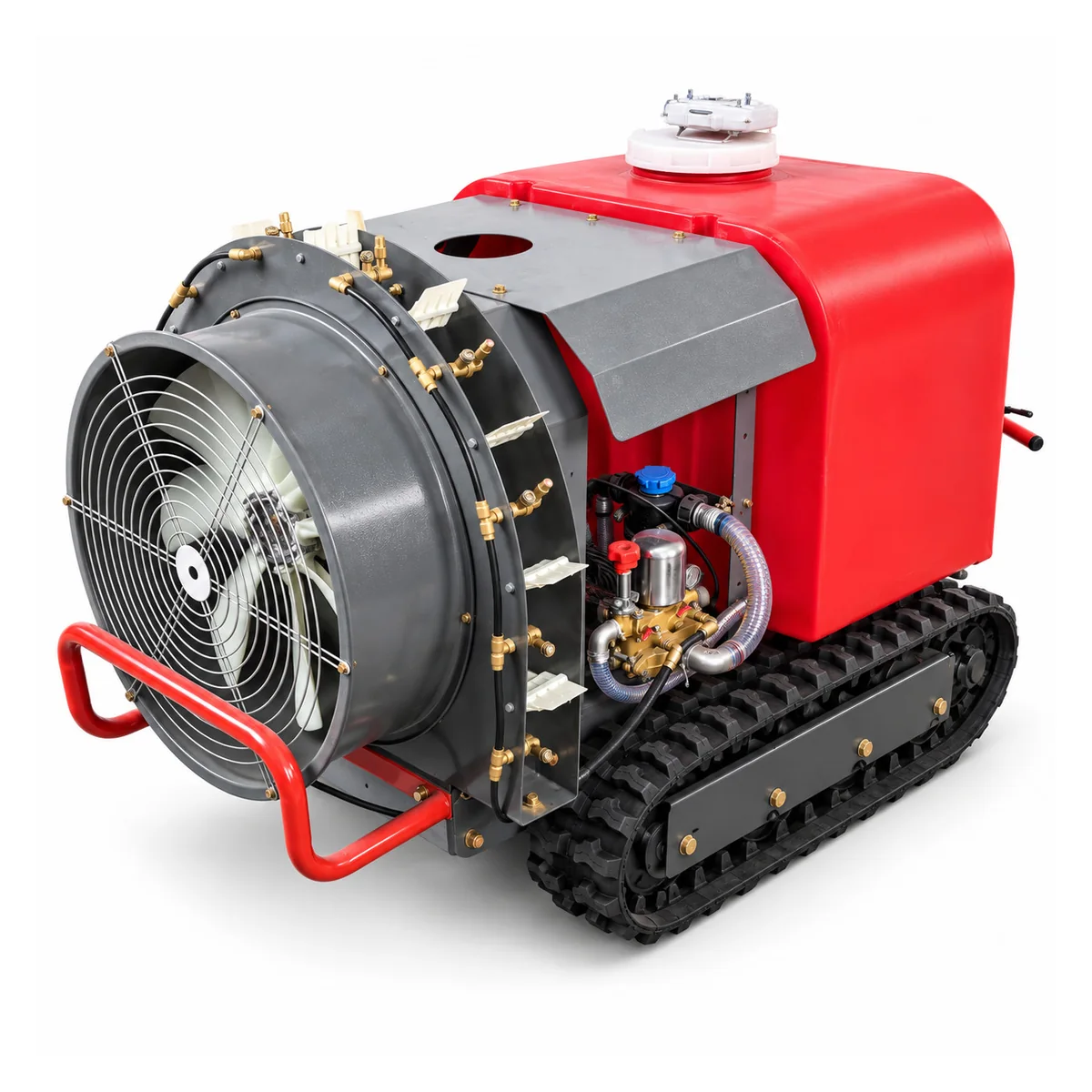
MERI ME-RCS sprayers come in airblast (-A) and boom (-B) versions with tanks from 100 L to 800 L. Airblast reach is up to 13 m on the ME-RCS800 depending on configuration (TDS, indicative). The operator stays out of the spray cloud with the remote, but still needs the protective equipment the label requires.
Calibration before the season
- Fill with clean water and run at working pressure.
- Measure output from each nozzle into a jug for one minute.
- Replace nozzles that are more than about 10% off the average.
- Check the fan, guards and hoses for damage.
Calibrating each year keeps the dose right and shows worn nozzles before they waste product. See the pumps and nozzles guide for MERI sprayer components.
Weather and drift
Spray in calm conditions within the wind limits on the label. Avoid hot, dry afternoons when fine droplets evaporate. Turn off outlets at row ends and near sensitive areas such as water, homes and neighbouring crops.
Checking coverage
Use water-sensitive paper at the top, middle and inside of the canopy. Adjust air and outlets until coverage is even.
Operator exposure
Mist blowers produce fine droplets that drift. Remote operation keeps the operator out of the cloud; follow the label PPE.
Step-by-step: setting up for a new block
- Measure tree height, canopy width and row spacing.
- Close outlets that would spray above the tallest tree or below the lowest branches.
- Set the travel speed you can hold steadily on that ground.
- Calculate output per hectare from nozzle flow, speed and row spacing, then check it against the label rate.
- Spray one row with water and water-sensitive paper at the top, middle and inside of the canopy.
- Adjust outlets, air and speed, then test again.
- Write the settings down for that block.
Worked example: travel speed and output
| Change | Effect on dose per hectare |
|---|---|
| Travel 20% faster, same nozzles | About 17% less liquid per hectare |
| Travel 20% slower, same nozzles | About 25% more liquid per hectare |
| Close the top two outlets | Less liquid per hectare; recheck coverage |
| Wider row spacing, same speed | Less liquid per hectare |
Dose changes in proportion to time spent over each metre of row. Always check the label rate.
This is why steady speed matters. A tracked remote sprayer holds speed well on slopes and soft ground, but the operator still sets the pace.
Seasonal notes
Early in the season, canopies are thin, so less air and fewer outlets are needed. As leaves fill out, air volume and coverage checks matter more. Late in the season, dense canopies need careful aiming at the inside of the tree. Recheck the setup at each stage rather than using one setting all year.
The video shows a remote control orchard sprayer working in a fruit farm.
Common mistakes
- Using one air setting for every block and every growth stage.
- Spraying the tops of small trees with outlets meant for tall ones.
- Changing speed on slopes without adjusting the setup.
- Skipping the water-sensitive paper check after a nozzle change.
Each of these wastes product or leaves part of the canopy short of cover, which often leads to an extra pass.
Related MERI pages
Frequently asked questions
Is a mist blower the same as an airblast sprayer?
Yes. Both use fan air to carry droplets into the canopy.
How do I check coverage?
Place water-sensitive paper at the top, middle and inside of trees and spray with water.
What tank sizes does MERI offer?
From 100 L (ME-RCS100) to 800 L (ME-RCS800).
Does remote operation remove the need for PPE?
No. Follow the label for protective equipment.
Send us your site details
Tell us the job, area, slope and country. MERI replies within 24 hours.
Need a agricultural sprayer recommendation for your terrain or project?
Get a Quote