
Short answer: Without herbicide, orchards split the floor into alleys and tree strips. Alleys are mowed; tree strips are managed by tillage, mulch or careful mowing. Remote mowers and tillers do much of the work on slopes and in tight rows.
Two zones
| Zone | Methods | Machine |
|---|---|---|
| Alley | Mowing, cover crops | ME800–ME1200 or T-Series |
| Tree strip | Tillage, mulch, hand weeding | ME-RT tiller or hand tools |
General approach.
Alley mowing
Mow before weeds set seed. T-Series mowers (500 mm tall) pass under low branches; flail mowers handle tall growth and prunings.
Tree strip tillage
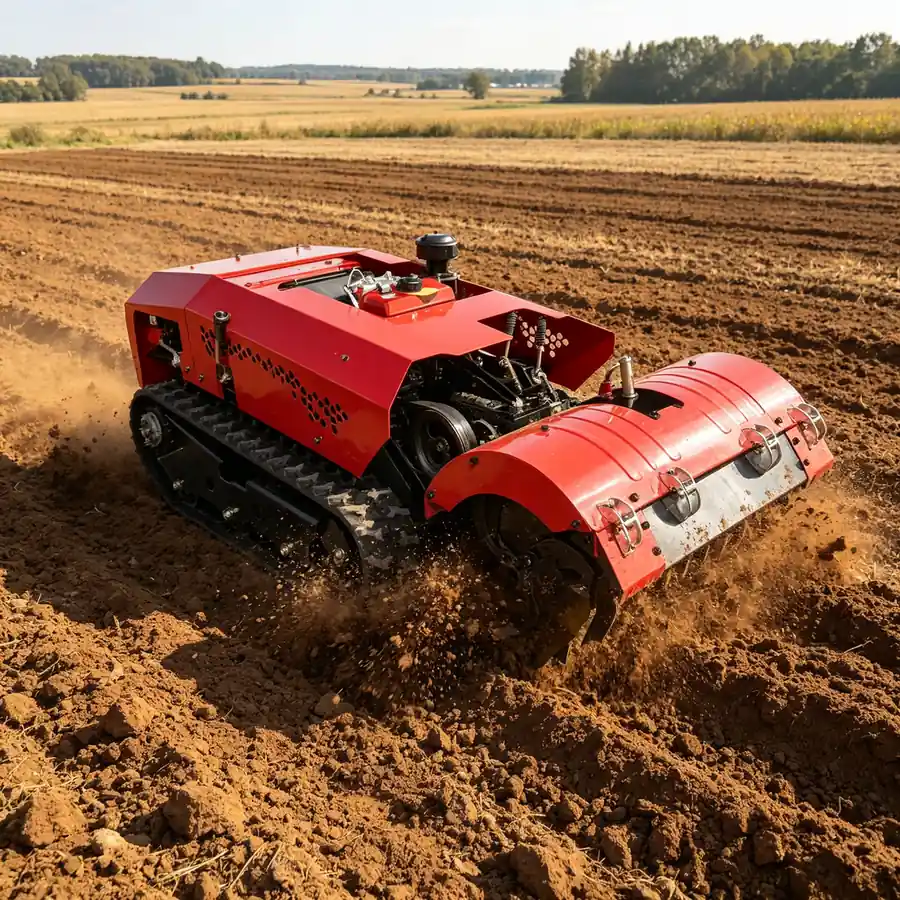
Shallow tillage between trees controls weeds without chemicals. The ME-RT Series tills 800 mm wide and 130–250 mm deep; keep depth shallow near roots and stay clear of trunks and drip lines.
Mulches and cover crops
- Mulch under trees suppresses weeds and holds moisture.
- Cover crops in alleys compete with weeds.
- Mow cover crops at the right stage for your goal.
Planning the season
Map blocks by slope and row width, plan mowing and tillage rounds, and record weed pressure. Expect more passes than with herbicide, and plan crews and machines for it.
Planning by tree age
| Tree age | Focus |
|---|---|
| Young | Clean strip, protect trunks |
| Bearing | Balance cover and competition |
| Mature | Alley mowing, less tillage |
Records
Organic and residue-free programmes often require records of every operation.
What a season looks like
| Period | Alleys | Tree strip | Records |
|---|---|---|---|
| Early spring | First cut before weeds seed | Shallow tillage or fresh mulch | Weed pressure by block |
| Late spring | Regular mowing | Second tillage pass | Dates, depth, machine |
| Summer | Mow to reduce water competition | Spot hand weeding | Dry blocks noted |
| Autumn | Cut prunings and cover | Last light tillage or mulch top-up | Season summary |
The number of passes depends on rain and weed type. Set aside crew time for the tree strip as well as the alleys.
Tillage depth near trees
Tree roots sit near the surface in the strip. The ME-RT Series tills 800 mm wide and 130–250 mm deep, but in an established orchard you will usually work at the shallow end and stay well clear of trunks.
- Test the depth on one row and dig to see where roots are.
- Set the depth shallower close to young trees.
- Do not till wet soil; it smears and forms a crust.
- Leave a hand-weeded ring around each trunk.
Worked example: passes per hectare
An orchard with rows 4 m apart has about 25 rows per 100 m of width. Each row has one tree strip and one alley. If the tiller covers the strip in one 800 mm pass and a 1,000 mm mower covers a 2.5 m alley in three passes, each row needs four passes per round.
Over 25 rows of 100 m, that is about 10 km of travel per round. Use your measured speeds in the time calculator to turn that into hours, and multiply by the rounds you expect in a season.
Booking time for the busy weeks
Mechanical weed control depends on timing, so plan crew time for the weeks when weeds grow fastest. A missed tillage pass in late spring lets weeds set seed in the tree strip, and that seed comes back for years.
Book machines and operators for those weeks first, and fit other jobs around them.
Common mistakes
- Letting weeds in the strip go to seed, which adds to next year’s seed bank.
- Tilling too deep near trees and cutting roots.
- Mowing cover crops at the wrong stage for the goal you set.
- Not keeping records, which some organic schemes require.
Choosing the first blocks
Do not switch the whole orchard at once. Start with two or three blocks that are easy to reach and have average weed pressure. Run the alley and strip plan for a full season, record the passes and hours, and compare weed cover and tree growth with blocks still on the old programme. The figures from those first blocks tell you how much machine time and crew time the full switch will need, and which blocks will be hardest.
Related MERI pages
Frequently asked questions
How can orchards control weeds without herbicide?
Mow alleys and manage tree strips with tillage, mulch or careful mowing.
What tills between trees?
A compact tiller such as the ME-RT, 800 mm wide.
Does non-chemical control take more passes?
Usually yes; plan crews and machines for it.
Which mower fits under low branches?
The T-Series, 500 mm tall.
Send us your site details
Tell us the job, area, slope and country. MERI replies within 24 hours.
Need a mower recommendation for your terrain or project?
Get a Quote