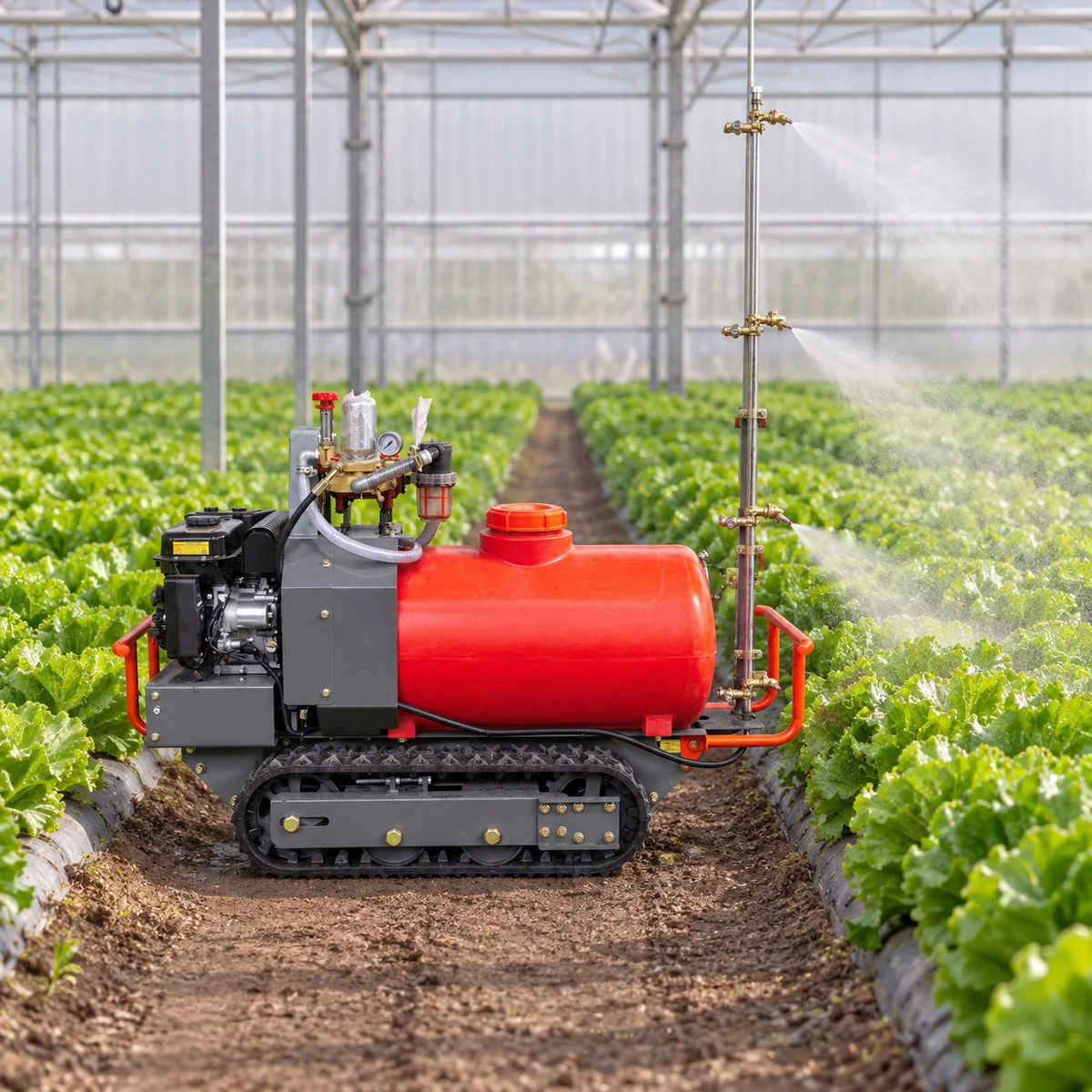
Greenhouses impose hard dimensional limits: doors, benches, beds, pipes and crop growth can all reduce the usable aisle. Ventilation and worker separation add operating constraints. A tracked remote boom sprayer therefore starts with a clearance survey and an approved chemical-handling plan before tank size or options are discussed.
Fast selection answer
The compact ME-RCS100 boom platform is the first comparison where greenhouse access is the controlling factor. Larger capacities should be considered only after their chassis width, turning space, floor loading and cleaning route are verified.
Measure the complete working route
Measure every door, threshold, aisle and turning pocket along the complete route. Include crop growth into the aisle, suspended pipes, irrigation lines, floor drains and gradients. Record ventilation controls, occupied periods, wash-down location, boom height and the required nozzle arrangement.
Model shortlist for planning
| Model | Tank | Chassis width | Planning role |
|---|---|---|---|
| ME-RCS100 | 100 L | 400 mm | First comparison for narrow greenhouse access |
| ME-RCS120 | 120 L | 520 mm | Additional capacity where doors and turns allow |
| ME-RCS200 | 200 L | 700 mm | Wider commercial aisles after route review |
| ME-RCS300 | 300 L | 900 mm | Large structures with verified floor and turning capacity |
All currently published RCS models use a 200 m remote-control range. Model coding uses Boom -B for this application. Final engine, pump, fan or boom, nozzle and plumbing specifications are confirmed for the order.
Tank size is a work-cycle decision
Calculate tank demand from the approved application volume and the area or row length treated between refills. Then test that capacity against the narrowest passage, turning space, ground, transport and refill route. A smaller machine can be the better commercial choice when it reduces access conflicts or can refill quickly.
Crop and spray inputs
Crop stage, target structure, approved rate, nozzle plan, airflow or boom requirements, weather and sensitive boundaries.
Machine and site inputs
Chassis clearance, headland, ground, route, liquid cycle, transport, cleaning point and destination requirements.
Operating workflow
- Confirm the label permits the greenhouse crop and establish ventilation, re-entry and emergency procedures.
- Walk the complete route and mark doors, drains, pipes, workers and sensitive production zones.
- Set and calibrate boom height, nozzles, pressure and speed for the bed or bench arrangement.
- Control access and maintain sight of the sprayer throughout each aisle pass.
- Handle remaining liquid and clean the equipment only at the approved location.
Limits and safety boundaries
A remote controller does not make an enclosed-space application safe by itself. Ventilation, exposure control, re-entry time, spill response and the product label remain decisive. Confirm all dimensions with the crop at its treatment-stage size.
Remote operation changes the operator position; it does not remove pesticide training, protective equipment, drift control, exclusion zones, re-entry rules, machine inspection or emergency planning.
Greenhouse-specific question: the real clearance envelope
The usable aisle is the smallest moving envelope along the entire path. Door frames, heating pipes, bench corners, crop trolleys and leaves can reduce it below the building drawing. Measure width at track level, tank level and boom level, then add working clearance rather than specifying a machine exactly equal to the opening. Check thresholds and drains that can change machine pitch as it passes through a doorway.
Turning should be demonstrated on the tightest end bay with the crop at treatment-stage size. If the machine cannot reverse or turn without entering a bench, the work plan may require one-way aisles or a compact configuration. Confirm whether the boom stays deployed, folds or needs a custom height. These layout decisions should be settled before tank capacity is increased.
Ventilation, occupancy and wash-down
An enclosed structure needs a documented sequence for ventilation shutdown or operation, worker evacuation, application, re-entry and cleaning. Remote control does not authorize the operator to remain in an exposure zone. Identify where the operator can keep sight of the machine without blocking doors and where emergency access remains available. Remaining liquid and wash water must follow the farm’s approved procedure; floor drains are not automatically an acceptable disposal route.
Related MERI resources
- Compare MERI remote agricultural sprayers
- Read the complete sprayer selection guide
- Download the RCS series TDS
- Review MERI equipment videos
Buyer FAQ
Does tank capacity determine the correct model?
No. Capacity must be balanced with access, turning, ground, transport, crop structure, approved application rate and refill logistics.
Can the spray system be finalized from website dimensions?
No. The website supports shortlisting. MERI must confirm the final pump, fan or boom, nozzle and engine configuration against the buyer’s crop and site data.
What should be sent with an enquiry?
Send crop and canopy or bed dimensions, row and gate width, headland, terrain, approved application volume, refill distance, daily work target and destination.
Configure the sprayer around the crop and route
Send the measured site and spray-plan inputs. MERI will compare suitable RCS platforms without assuming that the largest tank is automatically best.
Need a agricultural sprayer recommendation for your terrain or project?
Get a Quote