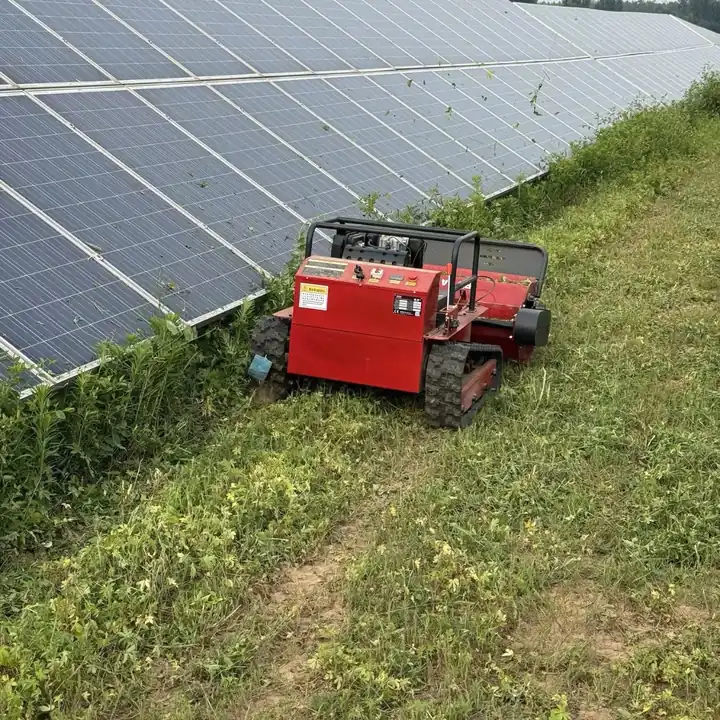
Short answer: On most solar farms, the biggest mowing cost is labour. In our worked example, one MERI ME1000D-48 cuts as much grass in a day as 5–6 workers with brushcutters. Running cost per hectare falls by about 75% with one operator per machine. The electric ME-RFM1000-E cuts it by about 70% and needs no fuel on site. With optional navigation, one operator can supervise 2–5 machines, and the cut rises to roughly 85–92%. Use the calculator below with your own numbers to see your yearly saving and payback.
Solar O&M teams mow the same rows many times a year. Grass under the panels must stay below the lowest panel edge. If it grows too tall, it shades the modules and adds fire risk. Most sites still do this work with brushcutter crews, sometimes with a tractor on the open roads.
This guide compares three ways to do the job: a manual crew, the diesel MERI ME1000D-48 remote mower and the electric MERI ME-RFM1000-E remote mulcher. Every number is shown, so you can check it or replace it with your own.
The three options side by side
| Item | Manual crew | ME1000D-48 (diesel) | ME-RFM1000-E (electric) |
|---|---|---|---|
| Power | Brushcutters | KOOP 195 diesel, 15 hp, 48 V electric drive | 30 kWh LiFePO4 battery, 9,000 W cutter motor |
| Cutting width | Hand tool | 1,000 mm flail, 40 blades | 1,000 mm, 24 alloy blades |
| Cutting height | By hand | 30–300 mm | 0–400 mm lift range |
| Machine height | – | 920 mm | 640 mm |
| Work rate | About 0.55 ha per worker per day (example) | 5,000 m²/h listed | About 3,333 m²/h (5 mu), MERI field average |
| Slope | Slow and tiring | 45° maximum | 35° maximum operating angle |
| Run time | One shift | Continuous on fuel | About 6 h of steady work per 30 kWh charge (field average); charge about 6 or 12 h |
| Navigation | – | Optional; one operator for 2–5 machines | Optional; one operator for 2–5 machines |
Where the machine figures come from
Machine figures come from the ME1000D-48 product page and the ME-RFM1000-E product page and data sheets.
The ME-RFM1000-E work rate and working hours are MERI field averages from real contract work: about 5 mu (3,333 m²) an hour, for about 6 hours on one 30 kWh charge. That is about 30 mu, or 2 ha, a day. Crew output is an example. It changes a lot with grass height, panel height and heat.

A worked example: one working day
These are example inputs. A worker cuts 0.55 ha a day and earns $28. The diesel machine works 6 hours and uses 1.5 litres of fuel an hour at $1.05 a litre. The electric machine works 6 hours on one 30 kWh charge at $0.08 per kWh, about the 0.55 yuan average power price in China. Each machine has one operator on $28 a day.
| Per working day | Manual crew (1 worker) | ME1000D-48 | ME-RFM1000-E |
|---|---|---|---|
| Area cut | 0.55 ha | 3.0 ha | 2.0 ha |
| Running cost | $28 wage | $9.45 fuel + $28 operator | $2.40 power + $28 operator |
| Cost per hectare | $50.9 | $12.5 | $15.2 |
| Cost cut vs manual | – | About 75% | About 70% |
| Matches the output of | 1 worker | About 5.5 workers | About 3.6 workers |
| Saving per machine-day | – | About $115 | About $71 |
Scale that up to a 100 ha site cut 6 times a year, or 600 ha of mowing. A manual crew needs about 1,091 worker-days, or about $30,545 a year. The ME1000D-48 needs about 200 machine-days and $7,490. The ME-RFM1000-E needs about 300 machine-days and $9,120. Neither figure includes depreciation or service.
What navigation changes
Without navigation, plan one operator per machine. With the optional navigation package, one operator can supervise 2–5 machines. Fuel and power stay the same, but the wage is shared.
| Machines per operator | ME1000D-48 | ME-RFM1000-E |
|---|---|---|
| 1 (no navigation) | $12.5/ha, −75% | $15.2/ha, −70% |
| 2 | $7.8/ha, −85% | $8.2/ha, −84% |
| 3 | $6.3/ha, −88% | $5.9/ha, −88% |
| 5 | $5.0/ha, −90% | $4.0/ha, −92% |
Navigation adds to the purchase price, so it changes payback, not daily running cost. The video shows manual mowing next to the electric ME-RFM1000-E on a solar farm.
MERI video: manual vs electric mowing.
Example from China: electric vs a typical fuel brush mower
Many contractors in China weigh the ME-RFM1000-E against ordinary fuel brush mowers from other makers. Here is how they do the sums, in yuan. The electric figures are MERI field averages. The fuel figures are typical of what contractors tell us about common fuel units, not MERI diesel models.
| To cut 30 mu (2 ha) | ME-RFM1000-E (electric) | Typical fuel brush mower |
|---|---|---|
| Real work rate | About 5 mu (3,333 m²) an hour | About 1.5–2 mu an hour, often a third of the rated figure |
| Working time | About 6 hours, one working day | About 15–20 hours, two to three days |
| Energy | One 30 kWh charge | Fuel for 15–20 hours |
| Energy cost | About 17–18 yuan, at an average 0.55 yuan per kWh | About 200 yuan |
In some regions of China, contract rates for river banks, reservoir dams, eucalyptus and pine plantations and solar bases are about 50–80 yuan per mu. On 30 mu, that is 1,500–2,400 yuan of work. With the electric machine, the power bill is under 20 yuan of it. With a slow fuel unit, the same job ties up an operator for two to three days and burns about 200 yuan of fuel, so much of the margin goes on wages and fuel.
These are Chinese prices. Fuel, power and wages differ by country, so put your own figures into the calculator below.
Less routine service on the electric unit
The ME-RFM1000-E has no engine. That removes the usual engine service items:
- No engine oil or oil filter to change.
- No air filter, spark plug or ignition coil to clean or replace.
- No carburettor or fuel system to clean, drain or store.
Fewer parts also means fewer things for hired operators to get wrong. You still check the blades, tracks and bearings, and you follow the charging instructions for the battery.
Work out your own numbers
Change any figure below, then press the button. Use your crew’s real output, your local wages and your local fuel and power prices. Leave the number of machines blank and the calculator works out how many you need. It assumes the MERI machines take over all the mowing, including any share done by tractor now.
Current method
–running cost per year–
ME1000D-48
–saving per year–
ME-RFM1000-E
–saving per year–
Full results
| Per year | Current method | ME1000D-48 | ME-RFM1000-E |
|---|---|---|---|
| Running cost | – | – | – |
| Cost per hectare cut | – | – | – |
| Cost cut | – | – | – |
| Machines / operators | – | – | – |
| Working days for one full cut | – | – | – |
| One machine matches | – | – | – |
| Total investment | – | – | – |
| Payback | – | – | – |
Results are planning estimates. Running cost covers wages, fuel or power, tractor costs and the service figure you enter. It does not include depreciation or finance. Check the numbers with a timed trial on your site and your MERI quote.
How to read your result
- Cost cut: how much lower your yearly running cost is with the machines.
- One machine matches: how many workers it takes to cut what one machine cuts in a day. MERI’s general reference for slope and orchard work is 8–10 workers, as listed in our FAQ. Solar rows vary, so use your own crew figure.
- Payback: total investment (machines plus navigation, if ticked) divided by your monthly saving.
- Working days for one full cut: if this is longer than the gap between your rounds, you need more machines. See fleet sizing for large sites.
The weakest number in any comparison is the crew’s output. Time your crew on a marked area before you trust it. Our guide to timing a brushcutter crew shows how.
Fit checks for solar sites
- Panel height: the ME1000D-48 is 920 mm high and the ME-RFM1000-E is 640 mm. Measure the lowest panel edge along the whole row. For very low arrays, see remote mowers for low-clearance solar farms.
- Grass type: the flail deck suits tall grass. The mulcher suits woody regrowth and heavy weeds.
- Stones: plan the cutting direction so debris is thrown away from the modules.
- Fuel or power: diesel runs all day on fuel. Electric needs a charging plan, but no fuel is stored on site.
- USA: MERI does not recommend its diesel models for the USA. US sites should look at the electric unit.
What to send MERI
- Site area and number of cuts per year.
- Lowest panel edge height and row spacing.
- Grass type and height before each cut.
- Current crew size and any tractor use.
- Slope and ground conditions, with photos of a typical row.
Frequently asked questions
How many workers does one remote mower replace on a solar farm?
It depends on your crew’s output. In our example, one ME1000D-48 matches about 5–6 workers. MERI’s general reference for slope and orchard work is 8–10 workers. Put your own crew figure into the calculator.
How fast does a remote mower pay back?
Divide the machine price, plus navigation if you add it, by your monthly saving. The calculator does this when you enter the prices from your MERI quote.
Can one operator run several machines?
Without navigation, plan one operator per machine. With the optional navigation package, one operator can supervise 2–5 machines. Tick the navigation box in the calculator to see the effect.
Diesel or electric for a solar farm?
In our example, diesel gives more output per day and runs all day on fuel. Electric needs no fuel on site and is lower, at 640 mm, but needs charging time.
Get a solar mowing plan for your site
Send MERI your site area, panel height and current crew. We will suggest machines, navigation and fleet size, and send the TDS for your quote.
Need a mower recommendation for your terrain or project?
Get a Quote