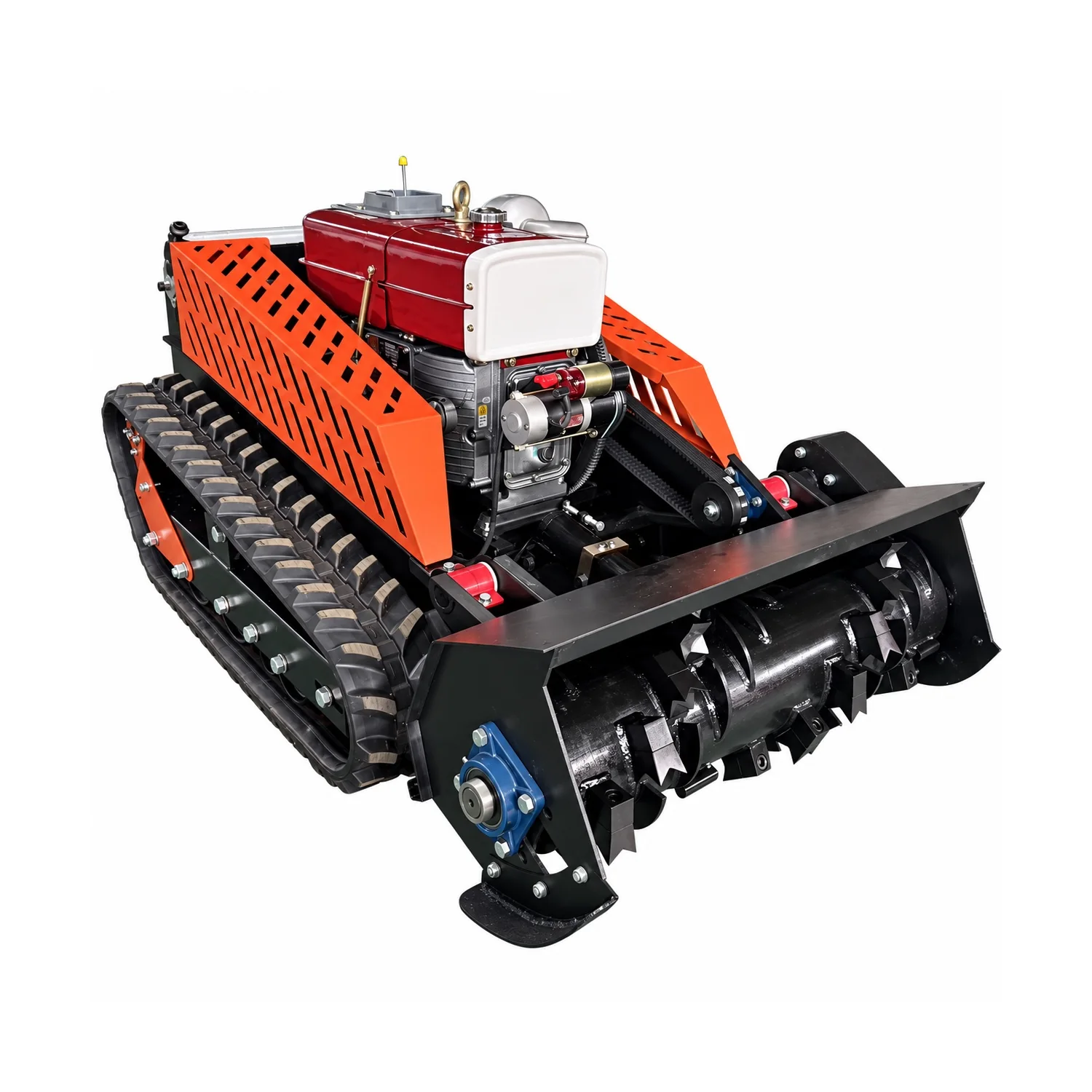
Short answer: An excavator mulcher reaches from stable ground into ditches, over fences and up to overhanging limbs, but needs room for the excavator and a level place to stand. A remote tracked mulcher works on the slope itself, fits tighter access and keeps the operator away. For long corridors with mixed ground, a combination often works best.
Reach versus presence
The key difference is where the cutting head can go. An excavator mulcher works at the end of an arm, so it can reach down a ditch bank or over a fence from a track or road. A remote tracked mulcher has to drive onto the ground it clears, but it can go where an excavator cannot stand.
Side-by-side
| Factor | Excavator mulcher | Remote tracked mulcher |
|---|---|---|
| Where it works | From a stable base, by reach | On the slope or ground itself |
| Steep banks | Reaches from the top or bottom | Drives on them; ME-RFM1000-D rated to 45° |
| Overhanging limbs | Can reach high | Works at ground level |
| Tight access | Needs space for the machine and swing | Compact; 1,000 mm working width |
| Transport | Heavy machine and low loader | Smaller trailer |
| Operator | In the cab | Away from the machine with a transmitter |
Excavator capability depends on the machine and head; check with their makers.
Where the excavator is the better tool
- Ditches and drains beside a road, cleared from the road.
- Fence lines and boundaries where only one side is accessible.
- Overhanging limbs and side growth above ground level.
- Sites where the excavator is already working on drainage or earthworks.
Where the remote mulcher is the better tool
Long, steep banks with no stable top or bottom for an excavator, wooded slopes between trees, power line corridors with soft ground, and narrow rights-of-way where an excavator cannot swing. The ME-RFM1000-D is a 25 hp diesel rated to 45°; it clears trees and branches up to 30 cm under suitable conditions.

Corridor work: plan by section
Right-of-way jobs are rarely uniform. Walk the corridor and split it into sections by ground type: flat open stretches, steep banks, wet ground, road-side ditches. Assign each section to the tool that suits it. A short excavator section for a roadside ditch can sit beside a long remote-mulcher section on a steep cutting.
Ground damage and soil
An excavator standing on soft ground can rut it badly, and the swing can scuff the surface. A lighter tracked remote machine spreads its weight but still marks wet ground. On sensitive sites, plan work for dry periods and keep routes consistent.
Cost and output
Excavator day rates are usually higher, but on suitable sections the reach and head size can mean fast output. A remote mulcher has a smaller head and steadier output, and it keeps working where an excavator would stop. Compare output per section, not per day.
A worked example
A utility corridor runs 4 km across mixed ground. The first kilometre follows a road with a deep ditch; the excavator clears it from the road shoulder. The next two kilometres climb a wooded hillside where no excavator can stand, and the remote mulcher clears the line while the operator walks the track above. The last section is flat pasture edge, shared between both machines to finish on time. Planning by section kept both machines busy and avoided putting a heavy machine on the steep, wet slope.
Questions for the quote
- How many metres of the corridor can an excavator reach from a stable base?
- How many metres are steep bank without a stable base?
- What are the access widths at gates and between trees?
- Is there overhead growth that needs reach?
Transport and set-up
An excavator usually needs a large transporter and a level space to unload and set up. A compact remote mulcher travels on a smaller trailer and can unload in a lay-by or a field gate. On jobs with many short sections, this difference in daily set-up time adds up. List the number of sections and moves in the quote for each option.
Related MERI pages
- Remote control forestry mulchers
- ME-RFM1000-D diesel mulcher
- ME-RFM forestry mulcher FAQ
- Excavator flail vs remote mower
- Transmission right-of-way clearing
- Slope ratings by model
Frequently asked questions
When is an excavator mulcher better than a remote mulcher?
When the work can be reached from a stable base: roadside ditches, one-sided fence lines and overhanging limbs.
When is a remote tracked mulcher better?
On long steep banks, wooded slopes and narrow corridors where an excavator cannot stand or swing.
What slope is the ME-RFM1000-D rated for?
45°, with trees and branches up to 30 cm under suitable conditions.
Can both be used on one corridor?
Yes. Split the corridor into sections and use each machine where it suits the ground.
Send us your site details
Tell us the job, area, slope and country. MERI replies within 24 hours.
Need a mower recommendation for your terrain or project?
Get a Quote