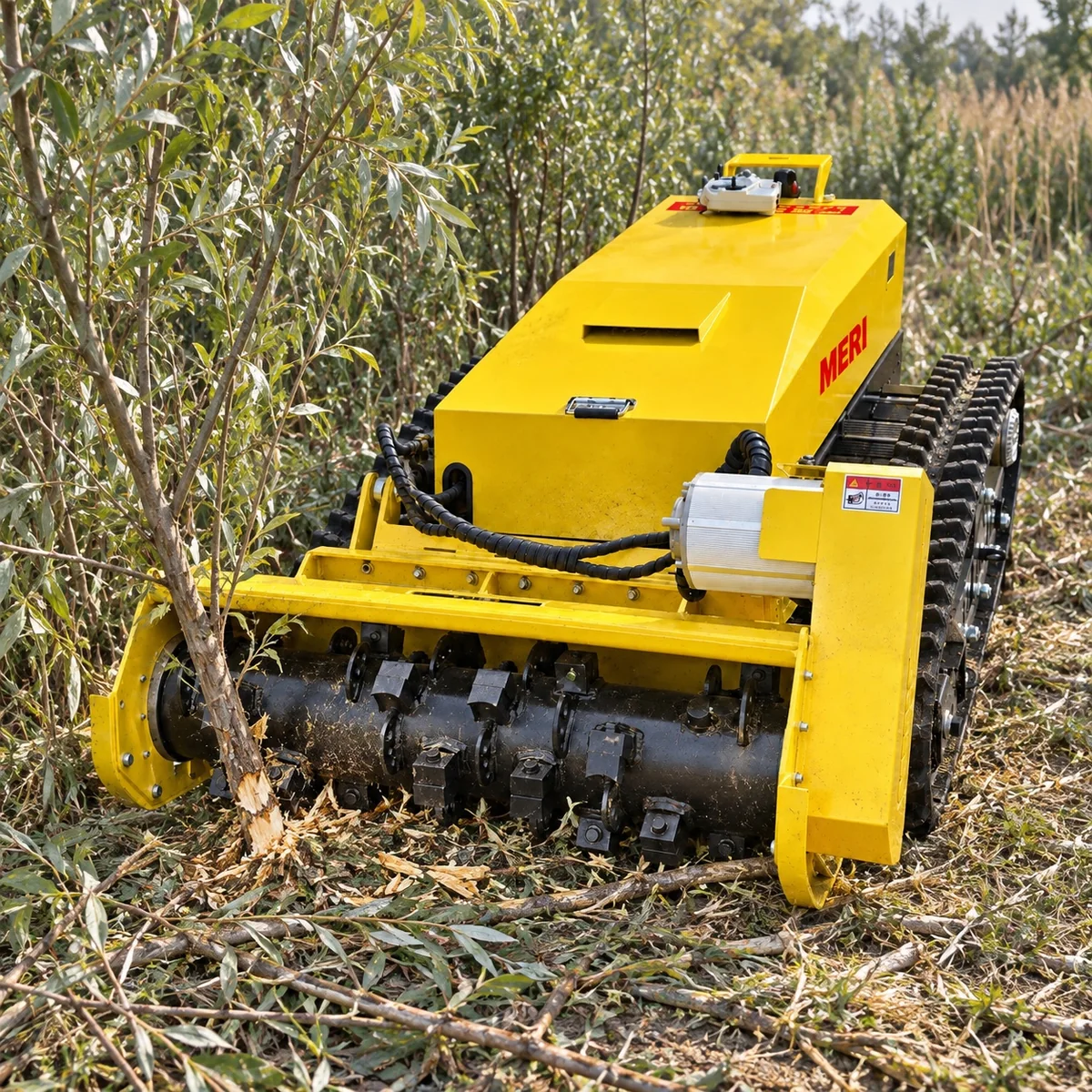
Short answer: Japanese barberry forms low, spiny thickets under woodland canopy. It is painful to clear by hand, and dense stands are often linked to more ticks. A remote mulcher or heavy flail mower can cut the shrubs low while the operator stays out of the brush. Mark trees to keep, work at low height and plan follow-up cuts for resprouts.
Why it is a problem
Barberry is a low, dense shrub with many spines. Under woodland canopy, it can carpet the ground and crowd out native plants. Its dense, humid cover is often associated with higher tick numbers, which is a concern for crews and land users.
Hand clearing means kneeling in spiny brush, often in tick habitat. That is slow and unpleasant.
Mulcher or flail
| Stand | Machine choice |
|---|---|
| Low, dense barberry under trees | Heavy flail mower or mulcher |
| Barberry mixed with saplings | Forestry mulcher |
| Scattered shrubs in open ground | Flail mower |
| Barberry around kept trees | Mulcher with care and a margin |
MERI flail models cut 30–300 mm high. The ME-RFM1000 series handles stems up to 30 cm under suitable conditions.

Working under canopy
- Mark trees to keep on all sides.
- Leave a margin around trunks and surface roots.
- Keep the cutting head low but out of rocks and roots.
- Keep the machine in view between trunks.
- Work in strips so no patches are missed.
Crew protection
Ask crews to wear long sleeves, gloves and tick-safe clothing, and to check for ticks after work. A remote machine means the operator does not walk through the thicket while it runs. Follow the client’s health and safety plan.
Regrowth from the crown
Barberry regrows from its root crown after cutting. The first-season shoots are soft and less spiny, which makes them easier to cut with a flail or a light mulcher pass. Repeat cuts weaken the plants over time. The client decides whether to add any other treatment.
Follow-up
Barberry resprouts from the root crown. Cut regrowth in the next season while it is soft. Walk the woodland edges each year for new plants, because birds spread the seed.
Quoting
Time a sample area under canopy, where manoeuvring between trees slows output. List follow-up visits separately.
A worked example
A woodland owner wants barberry cleared from the understory of a walking area. The crew marks trees to keep and the path line. A heavy flail mower takes the open patches; the remote mulcher handles barberry mixed with saplings near the trunks. Crews wear tick-safe clothing and check for ticks at the end of each day. A follow-up cut is booked for the next growing season, when the resprouts are soft.
Recognising it on the site walk
- Small, rounded leaves in clusters along the stems.
- Single sharp spines at the leaf clusters.
- Small red berries that hang on the stems into winter.
- Leaves that come out early in spring, before most of the woodland.
That early leaf-out is useful. A walk in early spring shows the barberry as green patches on an otherwise bare woodland floor, which makes mapping quick.
Keeping paths open after clearing
Where clearing opens a walking path, plan a path-edge cut each year. Regrowth near paths is the first thing walkers notice, and the spines catch clothing. A flail mower pass along both edges keeps the path clear and lets you check for new plants at the same time.
Machine access under canopy
Check the gaps between trunks before bringing the machine in. Where the gap is narrower than the machine with a safe margin, mark that patch for a smaller machine or hand work. Plan a route in and out that avoids roots on the surface, and keep the turning points in the open areas. Note the route on the map so the follow-up visit uses the same line.
Common mistakes
- Working under canopy without marking kept trees.
- Cutting so low that roots and rocks are hit.
- Skipping tick checks for the crew.
Related MERI pages
- ME-RFM forestry mulcher FAQ
- ME-RFM1000-E electric mulcher
- Buckthorn and honeysuckle understory mulching
- Mowing for tick habitat reduction
- Chinese privet mulching
Frequently asked questions
Can a mulcher remove Japanese barberry?
It can cut the shrubs low. The root crown often resprouts, so plan follow-up cuts.
Is barberry linked to ticks?
Dense barberry is often associated with higher tick numbers. Crews should take tick precautions.
Should I use a flail mower or a mulcher?
A flail suits low, open stands. A mulcher suits stands mixed with saplings.
How do I protect trees under canopy?
Mark them on all sides and keep a working margin around trunks and roots.
Send us your site details
Tell us the job, area, slope and country. MERI replies within 24 hours.
Need a forestry mulcher recommendation for your terrain or project?
Get a Quote