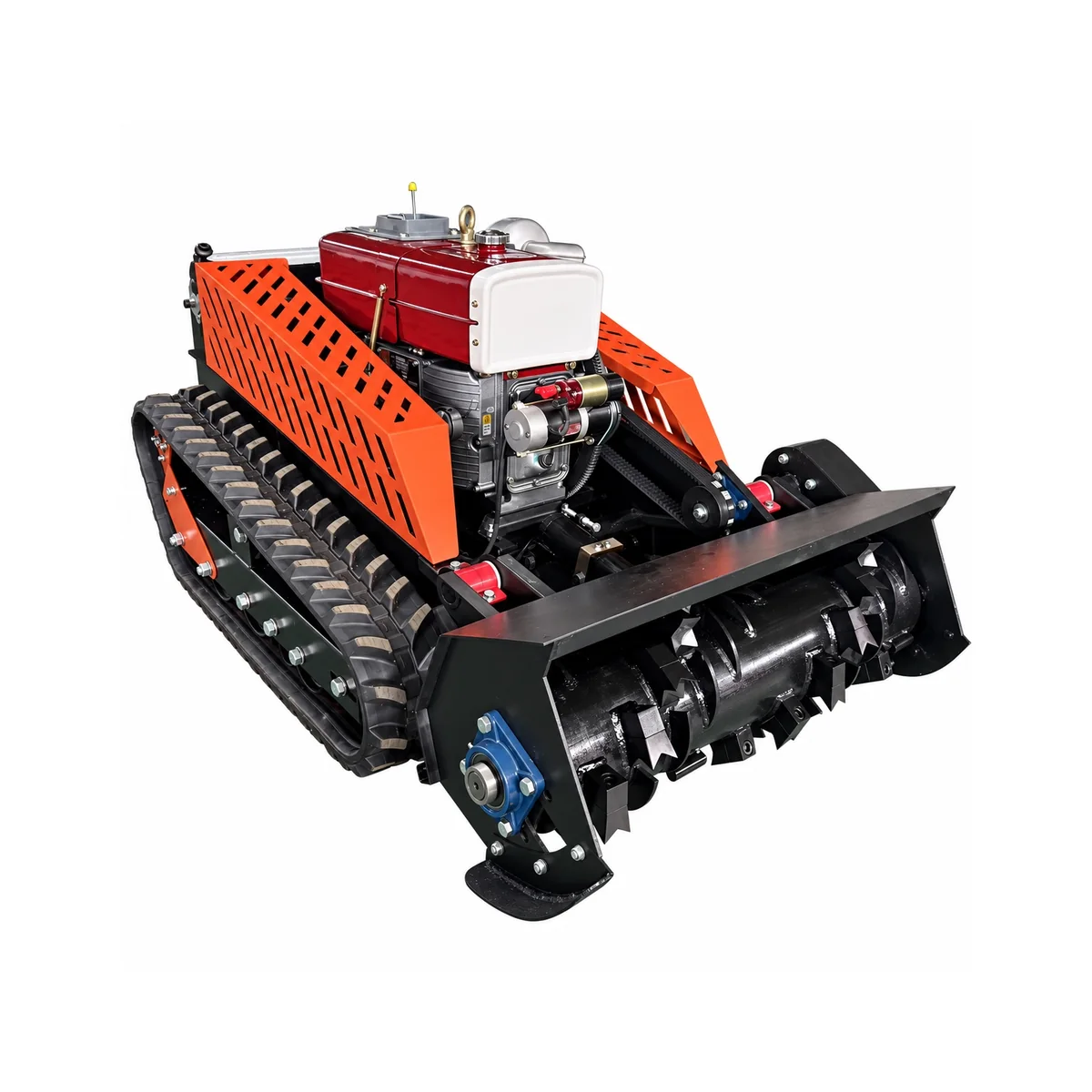
Short answer: Land clearing cost per acre depends mostly on how much woody material there is, how big the stems are, how steep and wet the ground is, and what finish the client wants. For a remote mulcher, estimate machine hours from the area and a realistic output rate, then add transport, set-up, wear parts and follow-up work.
The five things that set the price
- Density: light brush clears several times faster than a dense thicket.
- Stem size: most stems under a few centimetres go fast; many large stems slow the machine.
- Slope and ground: steep, wet or rocky ground slows travel and raises risk.
- Access: gates, distance from the road and trailer parking change set-up time.
- Finish: mulch left on site, stumps at ground level, or stumps removed and soil graded.
Two sites of the same size can differ by a factor of three or more in machine time.
Estimating machine hours
An acre is about 4,047 m². The MERI ME-RFM1000-D lists an indicative output of 3,000–4,000 m² per hour. On ideal ground that is roughly 1–1.4 hours per acre of cutting. Real sites are slower: count turns, uneven ground, stops to check debris and denser patches.
| Site type | Output vs indicative rate | Example hours per acre |
|---|---|---|
| Light brush, flat, open | Close to the rate | About 1–1.5 h |
| Mixed brush, some slope | About half | About 2–3 h |
| Dense thicket, larger stems | A third or less | 4 h or more |
Example figures are calculated for planning only. Measure your own output on the first day.
Costs beyond the cutting
- Transport and set-up per site.
- Fuel or charging.
- Teeth and holder wear; see the mulcher FAQ.
- Operator time for the site walk and debris removal.
- A follow-up cut in the next season.
Pricing per hour suits unknown sites; per acre suits sites you have walked and can measure.
Where a remote mulcher fits
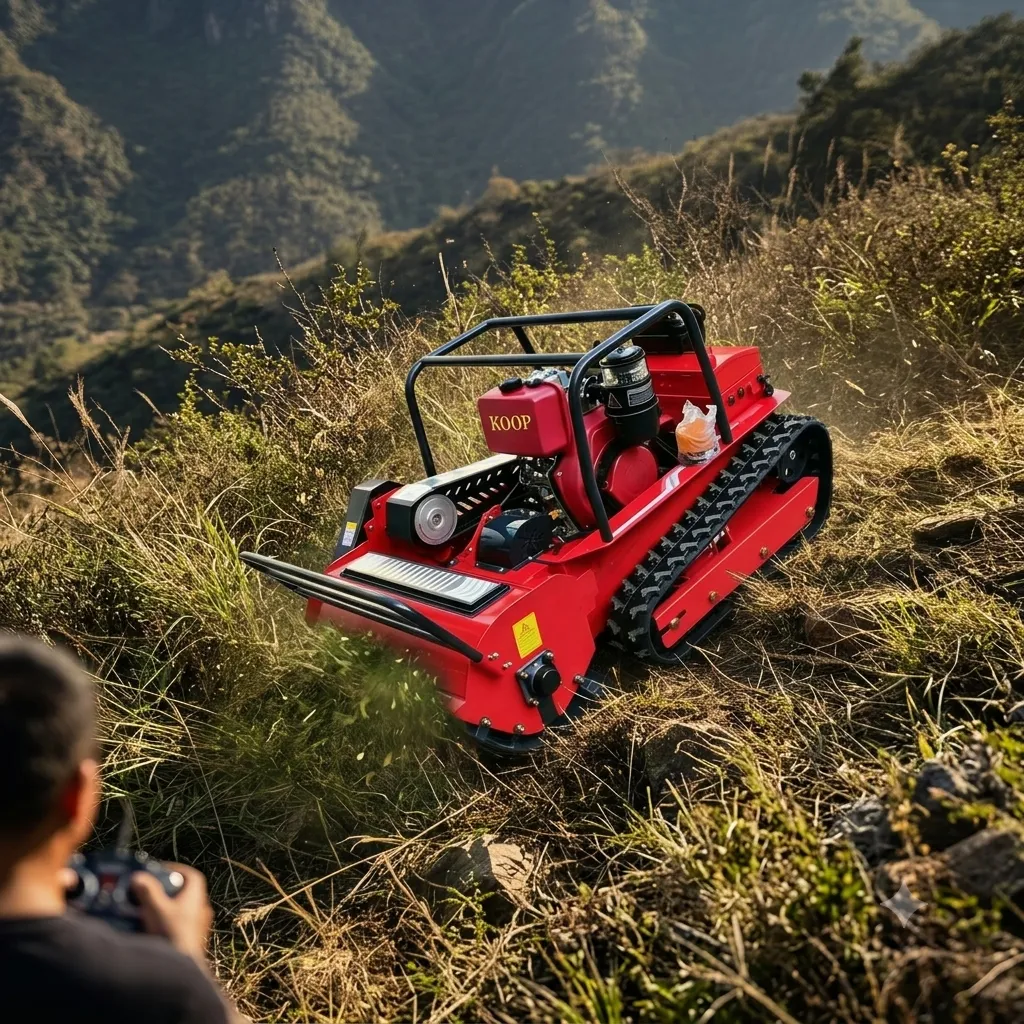
A remote mulcher suits slopes, wet edges and tight sites where a larger carrier cannot go or where the operator should stay back from the cutting head. It takes branches up to 30 cm diameter under suitable conditions (TDS). For large flat blocks of heavy timber, bigger machines may be faster.
Measure output on the first day
The best estimate for the rest of a job is your own first day. Note the start and finish time, the area cleared, fuel or charge used and any stops. Divide the area by the cutting hours to get your real rate for that site. Use it to confirm the price or adjust the plan before the client is surprised.
Getting a fair quote
- Walk the site with the contractor.
- Agree what “cleared” means: mulched, stumps cut low, or grubbed.
- Ask how slopes and wet areas are priced.
- Ask about follow-up mowing.
Reducing cost
Clear in the right season, give clear access and mark boundaries and keeper trees before the crew arrives. Time saved on site is money saved.
Worked example: pricing a 5-acre mixed block
A client has 5 acres of mixed brush on a gentle slope, with a denser 1-acre thicket along a creek. You walk it and split it into two zones.
| Zone | Area | Planning rate | Cutting hours |
|---|---|---|---|
| Mixed brush, gentle slope | 4 acres | About 2.5 h per acre | About 10 h |
| Dense thicket by the creek | 1 acre | About 4.5 h per acre | About 4.5 h |
| Turns, debris stops, refuelling | — | Add 15–20% | About 2–3 h |
| Set-up, site walk, clean-down | — | Per day | About 1 h per day |
Example only. Planning rates come from the ranges above; measure your own on day one.
That gives roughly 17 hours of machine time, or two and a half working days. Quote the days, the wear parts and the follow-up cut as separate lines so the client sees what drives the price. If the first day runs faster or slower than planned, tell the client early.
Which pricing model to offer
| Model | Works best when | Risk |
|---|---|---|
| Per hour | Site unknown, mixed growth | Client worries about open-ended cost |
| Per acre | Site walked and measured | You carry the risk of hidden density |
| Per day | Large sites, steady conditions | Weather days need a clear rule |
| Fixed job price | Small, clearly defined job | Scope creep if “cleared” is not defined |
Many contractors quote per acre for the measured part of the site and per hour for anything outside the agreed area.
Common pricing mistakes
- Using the indicative output rate as the working rate.
- Leaving out transport and set-up on small jobs.
- Not charging for rubbish removal, wire and old fencing found in the brush.
- Pricing the clearing but forgetting the follow-up cut the client will expect.
- Not agreeing what happens on rain days.
The video shows the ME-RFM1000-D in land clearing work, which helps clients see what the machine does.
Related MERI pages
- ME-RFM mulcher FAQ
- ME-RFM1000-D service data
- Land-clearing contractors
- Mulching vs burning vs herbicide
Frequently asked questions
How long does a remote mulcher take per acre?
On light, flat brush about 1–1.5 hours; dense or steep sites take several times longer.
Should I price per hour or per acre?
Per hour for unknown sites; per acre once you have walked and measured the site.
What is the indicative output of the ME-RFM1000-D?
3,000–4,000 m² per hour (TDS, indicative).
Does mulching remove stumps?
No. It leaves stumps at ground level and the mulch on site.
Send us your site details
Tell us the job, area, slope and country. MERI replies within 24 hours.
Need a forestry mulcher recommendation for your terrain or project?
Get a Quote