
Short answer: Mowing leafy spurge before seed set stops that year’s seed, but the deep root system sends up new shoots, so mowing alone will not clear it. Repeated cuts can weaken plants and prepare them for other methods. Keep the milky latex off skin and clean it off the machine.
Why leafy spurge is so persistent
Leafy spurge is a perennial weed of the northern Great Plains and the Canadian Prairies. Its roots go very deep and spread sideways, sending up new shoots well away from the parent plant. Cattle avoid it, so infested pasture loses grazing value.
The plant also spreads by seed. Seed capsules burst and can throw seed a few metres. That is how patches grow at the edges, even without machinery.
What mowing can do
| Mowing role | Result | Limit |
|---|---|---|
| Cut before seed set | Stops that season’s seed | Roots unaffected |
| Repeat cuts in a season | Slowly draws on root reserves | Needs several cuts |
| Cut before other treatment | Gives even regrowth for follow-up | Follow local advice |
| Cut patch edges | Slows outward spread | Ongoing work |
Ask your extension office or provincial specialist for the full plan in your area.
Leafy spurge flowers early in the season, often in late spring. The yellow-green bracts are easy to spot, which helps with timing.
Latex: protect people
Broken stems release a milky latex. It can irritate skin and eyes. Crews should wear gloves, long sleeves and eye protection when handling cut material or cleaning the machine.
Remote operation keeps the operator away from the spray of sap and chopped stems during mowing. The risk returns during clean-down, so do not skip the PPE at that stage.
- Stop the rotor and remove the key before cleaning.
- Wear gloves and eye protection.
- Scrape packed material out of the deck hood.
- Wash latex off skin with water straight away.
- Clean tools and the trailer before leaving the field.
Cut height and timing
MERI flail mowers cut from 30 to 300 mm. On spurge, a cut low enough to remove the flowering stems is the goal, while leaving the grass with leaf to compete. Mow before the seed capsules form. Watch for regrowth and plan a second cut if new flowering stems appear.
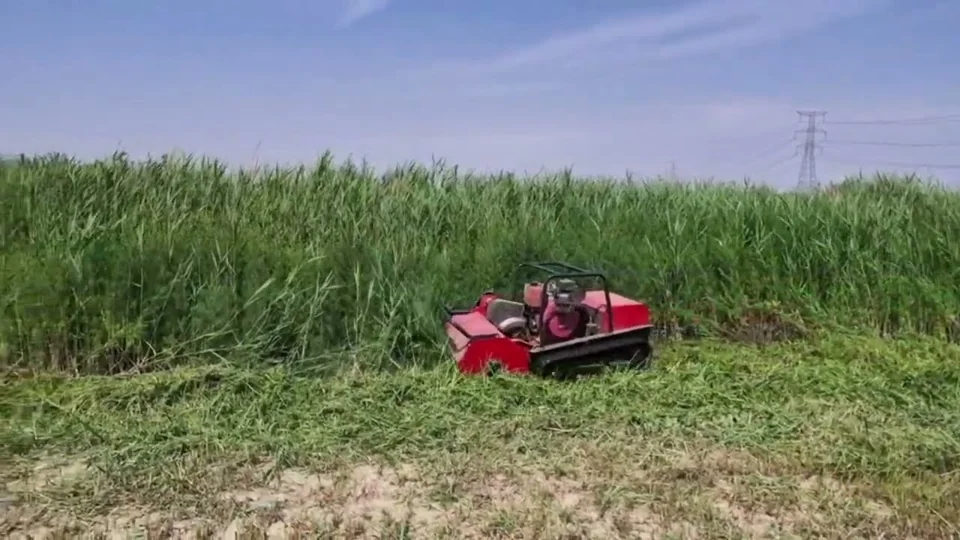
Coulees, draws and creek banks
Leafy spurge often grows on the sides of coulees and creek draws, where tractors cannot work safely. A tracked remote mower works those slopes while the operator stays on the flat. MERI tracked remote mowers are rated to 45°, and the standard remote range is 800 m.
For wider pasture edges, the ME1000-48 and ME1200-48 gasoline flail models give 1,000 and 1,200 mm cuts. Diesel models are not supplied to the US market. Canadian buyers should check available options with MERI.
How mowing fits with other tools
Most leafy spurge programmes use several tools together. Mowing stops seed and can weaken plants. Grazing by sheep or goats is used on many ranches because they eat spurge that cattle avoid. Biological control insects are released in some areas. Other treatment follows local advice.
The mower’s role is often to handle the places other tools do not reach well: steep coulee sides, fence lines and the edges of hay fields. Planning the season with your extension office makes sure each tool is used at the right time.
Common mistakes
- Mowing after seed capsules have formed.
- Expecting one cut to weaken the deep roots.
- Handling cut material without gloves or eye protection.
- Working only your own land when the patch crosses the fence.
- Mowing so low that the grass cannot compete.
Writing the plan down, with dates and photo points, keeps the work steady across several seasons.
Records that help
Record each patch with a GPS pin, the mowing date, the growth stage and any regrowth. Take a photo from the same spot each year. The records show whether patches are shrinking or creeping outward, and help your weed board plan the next season.
Records and neighbours
Spurge patches cross fence lines. A plan that covers neighbouring land is far more effective than one farm acting alone. Keep a simple map of patches, mowing dates and regrowth. Share it with neighbours and your local weed board.
Related MERI pages
- Prairie pasture weed mowing
- Pasture weed mowing calendar
- ME1000-48 remote flail mower
- Machine hygiene between mowing sites
- Remote control mowers in Canada
- Remote control mowers in the USA
Frequently asked questions
Does mowing control leafy spurge?
It stops seed if done before seed set and can weaken plants over repeated cuts. It does not clear the deep root system on its own.
Is leafy spurge latex dangerous?
It can irritate skin and eyes. Wear gloves, long sleeves and eye protection when handling cut material or cleaning the mower.
When should leafy spurge be mowed?
Before seed capsules form, usually soon after the yellow-green bracts appear. Watch for regrowth and cut again if needed.
Which MERI mowers suit spurge on coulee slopes?
Tracked remote flail mowers rated to 45°, such as the gasoline ME1000-48 and ME1200-48. Diesel models are not supplied to the US market.
Send us your site details
Tell us the job, area, slope and country. MERI replies within 24 hours.
Need a mower recommendation for your terrain or project?
Get a Quote