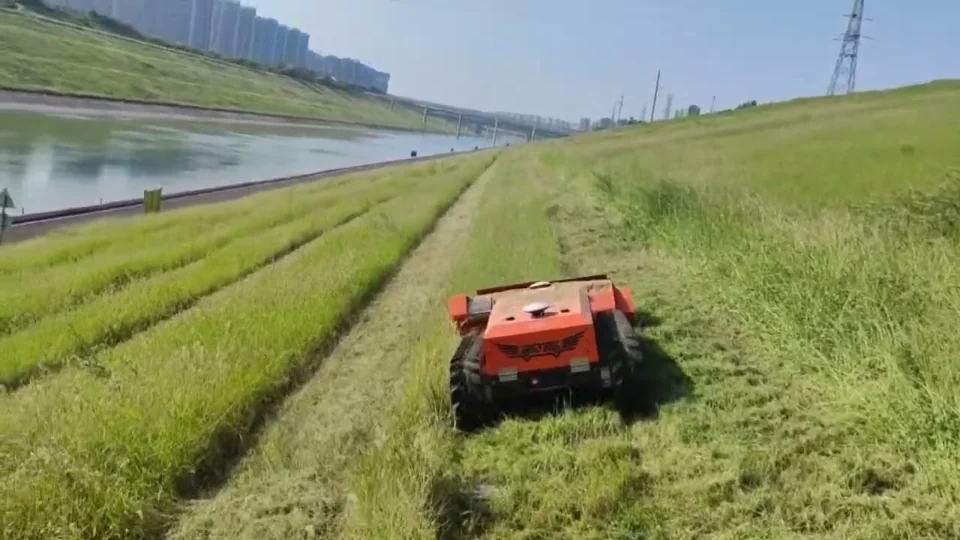
Short answer: Keep the mower on the turf and off the rock. Lift the deck near riprap and gabions, mow along the edge with a small safety strip, and cut growth inside the rock by hand or leave it as the asset owner allows. A remote mower helps on the steep turf above and beside the armour, where crews would otherwise work on loose footing.
The problem
Riprap and gabions protect channels, culverts, abutments and pond outlets. Grass and woody growth soon creep in from the edges. Highway and drainage manuals often ask for vegetation to be kept back so the structure can be inspected. The difficulty is that stone and wire are hard on mowers, and the banks beside them are usually steep.
Most damage happens in a second: a deck set too low hits a rock, or a flail drags against wire mesh.
Where the machine works and where it does not
| Zone | Approach |
|---|---|
| Turf above the armour | Remote mower, normal height |
| Turf beside the armour | Remote mower with the deck raised |
| Edge strip next to the stone | Hand trimming |
| Inside riprap | Hand cutting or left as allowed |
| Gabion face | No mowing; hand cutting of woody growth |
General guide. The asset owner decides what can grow on the structure.
Deck height and stone
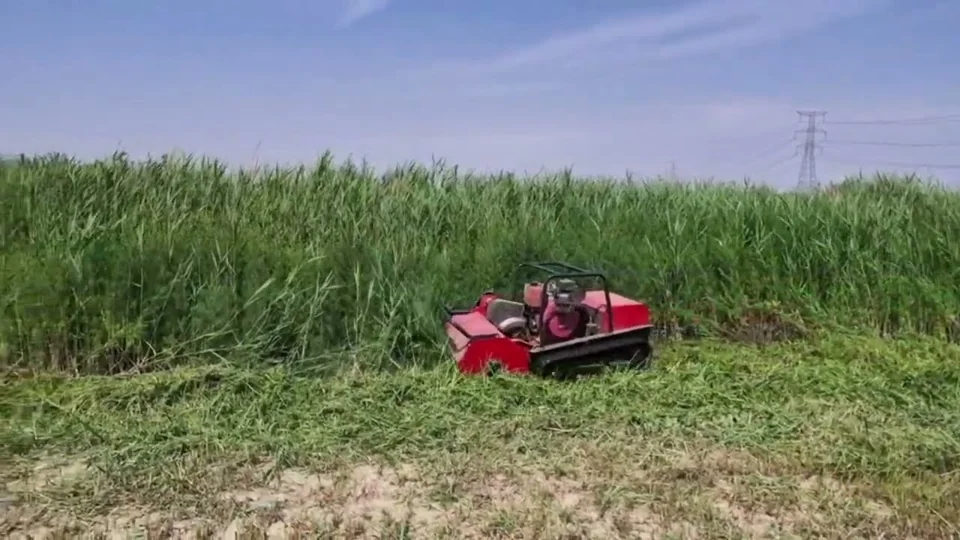
MERI flail models have a cutting height of 30–300 mm. Near riprap, raise the deck well above the usual setting and slow down. Loose stones roll out of riprap over time, so walk the edge first and remove any stones lying in the grass. The tracked chassis keeps traction on the steep turf, and MERI tracked models are rated to 45°.
Walk the edge first
- Remove loose stones that have rolled into the grass.
- Look for broken gabion wire and sharp ends.
- Note settlement or missing stone for the asset record.
- Check for wet, soft ground at the toe of the bank.
- Mark the line where the mower must stop.
That short walk saves blades and gives the client a useful condition note.
Woody growth in the rock
Saplings that root in riprap can lift stone as they grow. Mulching inside the rock is not practical with a flail or a mulcher; the stone would wreck the rotor. Cut stems by hand at the stone surface, and record locations so the asset owner can plan treatment. Woody growth on the turf beside the rock can be mulched if it is within the machine’s limits.
A simple edge record
Each time the edge is mown, note the date, the section, stones removed from the grass, and any damage seen. Add one photo per section. Over a season this gives the asset owner a picture of how the armour is behaving: which sections lose stone, where growth comes back fastest and where the bank is settling.
- Section and chainage.
- Stones found in the grass.
- Woody growth in the rock, with location.
- Wire damage or settlement.
- Blade damage found after the job.
Common mistakes
- Running the deck at normal height beside the stone.
- Turning the machine on the rock edge.
- Leaving rolled stones in the grass for the next pass to hit.
- Ignoring saplings rooted in the armour until they lift stone.
Blade care after the job
After working near stone, check flail blades for chips, bends and missing pieces. Replace damaged blades in pairs to keep the rotor balanced. A rotor that starts to vibrate after a riprap job should be checked before the next site.
Planning by season
| Season | Work |
|---|---|
| After winter floods | Walk the edge; remove rolled stones; note damage |
| Main growing season | Regular cuts beside the armour, deck raised |
| Late season | Cut saplings in the rock while they are easy to see |
| Any time after a storm | Check for new damage before mowing |
Keeping to a fixed pattern each year makes the edge record easier to compare from one season to the next. It also shows the asset owner when repairs are due.
Related MERI pages
- Earth dam embankment mowing
- Mowing stony ground
- Cutting height by model
- Slope ratings by model
- ME1000-48 remote flail mower
Frequently asked questions
Can I mow over riprap?
No. Keep the mower on the turf, raise the deck near the stone and hand trim the edge.
How should woody growth in riprap be handled?
Cut stems by hand at the stone surface and record locations. Machines should not work inside the rock.
What deck height should I use near rock armour?
Raise the deck well above the normal setting. MERI flail models adjust from 30 to 300 mm.
What should I check after mowing near stone?
Blades for chips and bends, missing blades and any new rotor vibration.
Send us your site details
Tell us the job, area, slope and country. MERI replies within 24 hours.
Need a mower recommendation for your terrain or project?
Get a Quote