
Short answer: Under distribution lines, the aim is to keep vegetation low enough that it cannot reach the conductors or block access. Follow the utility’s clearance and approach rules, mow or mulch on a regular cycle, and use remote machines where ground is steep, soft or hard to reach.
Who sets the rules
The utility and local regulations set clearance distances, approach limits for people and machines, and who may work near lines. Contractors must follow them and the job brief.
Typical tasks
- Mowing grass and low growth along the line.
- Mulching brush and saplings before they grow tall.
- Keeping access tracks to poles open.
- Clearing around poles and equipment.
Cycles
| Vegetation | Typical approach |
|---|---|
| Grass | Regular mowing |
| Brush and saplings | Mulching every few years |
| Trees near lines | Specialist arborists |
Follow the utility programme.
Machines
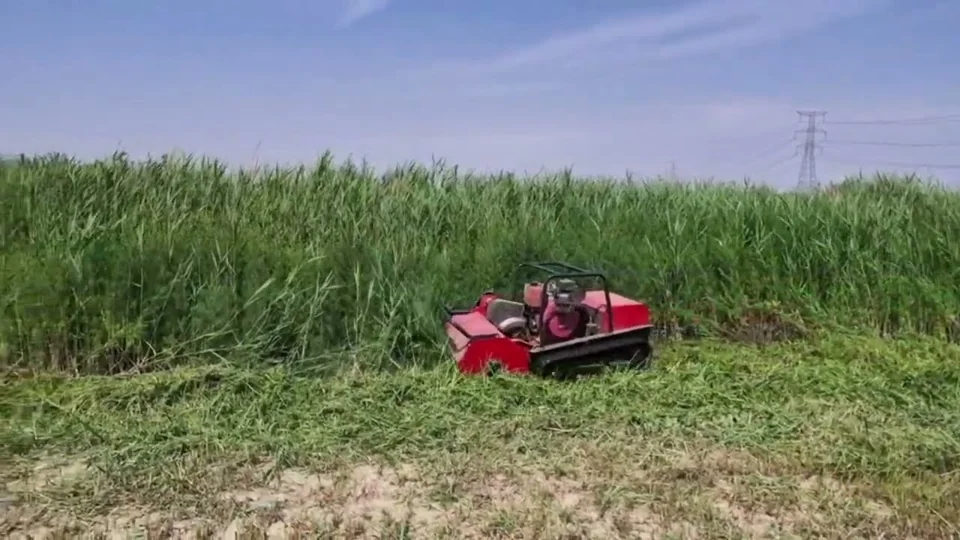
Low machines are useful because they stay far below the conductors. A remote tracked mulcher or flail mower works steep and soft ground with the operator at a distance. MERI tracked mowers are rated to 45°.
Safety
Never let a machine, tool or debris approach the conductors. Tree work near lines is for qualified staff. Watch for guy wires, which can wrap around rotors.
Access and environment
Plan access with landowners, close gates, and follow rules for watercourses and nesting seasons.
Records
Log spans cleared, dates and conditions. Utilities often audit vegetation records.
Typical sites
Distribution lines cross farms, roadside verges, hillsides and wooded edges. Many spans sit on banks or in gullies where tractors cannot work. A compact remote machine can be carried on a small trailer and moved between spans quickly, which suits programmes with many short sections.
Planning a programme span by span
| Span type | Usual method | Note |
|---|---|---|
| Open farmland | Tractor mower | Agree timing with the landowner |
| Steep bank or gully | Remote tracked mower or mulcher | Operator on firm ground |
| Brushy regrowth | Mulcher | Cut before saplings grow tall |
| Around poles and stays | Careful close work | Watch guy wires |
| Wet ground | Tracked machine, dry period | Avoid deep ruts |
Group spans by method so each machine moves along a line of similar work. A small remote machine on a trailer can cover many short, difficult spans in a day.
Daily start checklist
- Read the job brief and check approach limits for the line.
- Walk the span for guy wires, stays, stones and holes.
- Check the remote and the machine before unloading.
- Agree a safe operating position and a way out.
- Record the span number and start time.
Common mistakes
- Letting saplings grow until they need tree crews.
- Mulching close to a stay wire.
- Skipping the walk of a span because it looked clear last year.
- Not closing gates or reporting damage to landowners.
Worked example: a day of short spans
Take a rural feeder with twelve spans to clear in one day, four of them on steep banks. A tractor crew takes the eight open spans in sequence. The remote machine and one operator follow the same route on a small trailer, stopping only at the four bank spans. Each stop is unload, walk the span, cut, load and record. Splitting the work this way keeps the tractor off the banks and the remote machine off the open ground where it is slower.
Seasonal notes
Spring growth is fastest, so the first cut of the year often sets the workload for the rest of the season. Summer is the main window for most spans, with dry ground and good access. Autumn is a good time to mulch woody regrowth, after nesting and before ground turns soft. In winter, plan the next programme from the records and fixed-point photos, and agree access with landowners before the season starts.
Talking to landowners along the line
Many spans cross private land. A short contact plan avoids complaints.
- Send notice before the crew arrives, with dates and a phone number.
- Agree gates, access routes and where vehicles can park.
- Ask about stock, crops, drains and buried services.
- Leave gates as you found them, and report any damage the same day.
Related MERI pages
- Remote mowers for utility rights-of-way
- ME-RFM mulcher FAQ
- Wildfire fuel reduction
- Transmission right-of-way clearing
Frequently asked questions
What is the goal under distribution lines?
Keep vegetation low and access open.
Who sets clearance rules?
The utility and local regulations.
Can mulchers work near lines?
Yes, low machines working within the rules and approach limits.
Who handles trees near conductors?
Qualified arborists.
Send us your site details
Tell us the job, area, slope and country. MERI replies within 24 hours.
Need a mower recommendation for your terrain or project?
Get a Quote