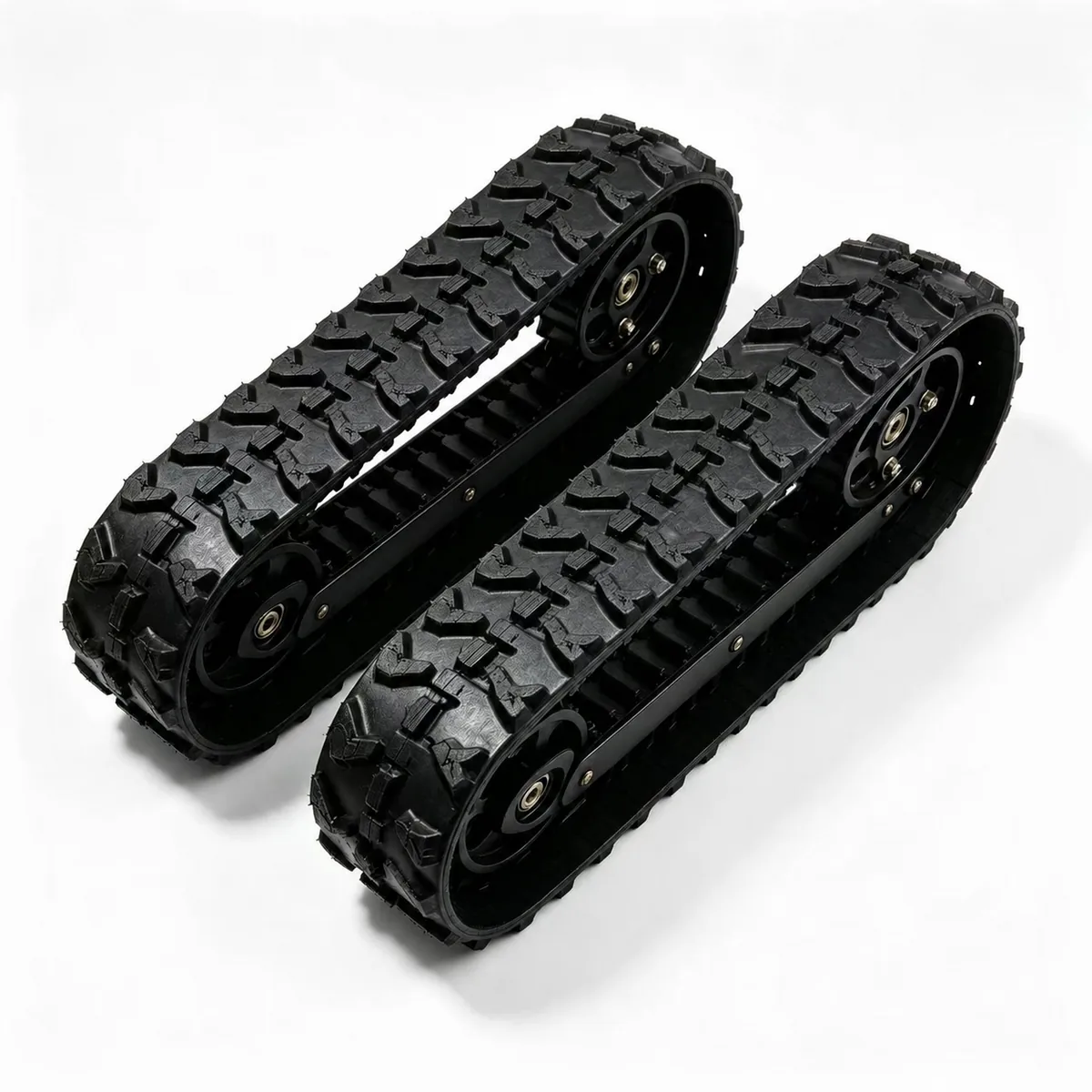
Short answer: Start with the simple causes: uneven track tension, mud or grass packed in one side, or a worn idler. Then check the connectors and wiring to that drive motor. If the fault stays, record what happens and contact your dealer before swapping the motor or controller.
What you notice
- The machine curves when you steer straight.
- It turns more easily one way than the other.
- One track stalls on slopes or in heavy grass.
Check in this order
Do all checks with the engine off, the remote switched off and the machine secured, as the operator manual says.
| Step | What to check | Why |
|---|---|---|
| 1 | Track tension on both sides | A tight track drags |
| 2 | Mud, stones, grass in the undercarriage | Packing adds friction |
| 3 | Idler wheels and rollers | A seized wheel brakes the track |
| 4 | Connectors and wiring to the drive motor | Loose or wet connectors cut power |
| 5 | Remote trim or calibration, if fitted | Settings can be off |
| 6 | Drive motor and controller | Last; needs dealer support |
How MERI drives the tracks
MERI machines drive each track with its own electric motor. The 48 V mowers use two 1,000 W motors; the 24 V mowers use a 1,800 W drive. If one side is weak, it is often a connection or a mechanical drag rather than the motor itself.
Parts that commonly fix it
Idler wheel (MERI-P28), large round wheel (MERI-P29), drive motor assembly (MERI-P21) and the controller (MERI-P15) are stocked spares. Order by quote reference with the serial number.
What to send your dealer
- Model and serial number.
- Which side is slow, and when.
- Photos of the undercarriage.
- Any error shown on the controller.
- Whether it happens on flat ground, on slopes or both.
- When it started and any recent repairs.
- Photos of track tension on both sides.
Step-by-step: a 20-minute diagnosis
Work on level ground with the engine off, the remote off and the machine secured, as the operator manual says.
- Drive the machine 20 m on flat, firm ground with the cutter off. Note which way it curves and by how much.
- Stop, make it safe and clean the undercarriage on both sides. Packed mud on one side is the most common cause.
- Compare track sag on both sides at the same point. Adjust to the manual if they differ.
- Turn the idler and rollers by hand where you can. A wheel that is stiff or rough on one side acts as a brake.
- Look at the connector to each drive motor. Check for water, green corrosion or a loose plug.
- Repeat the 20 m test. If the curve is gone, note what fixed it in the service log.

What the symptom tells you
| Symptom | Most likely area | Next step |
|---|---|---|
| Slow on both flat and slope, from the start of the day | Tension, debris or a stiff wheel | Mechanical checks above |
| Fine when cold, slower after an hour | Drag that heats up, or a motor working too hard | Feel both motor housings after work, compare |
| Comes and goes over bumps | Loose connector or damaged wire | Check plugs and harness routing |
| One side stops completely | Electrical fault on that side | Stop, record, contact your dealer |
| Only on slopes | Weight shift and grip, not a fault | See the slope article |
Record which line fits your machine before calling. It saves a long phone call.
Common mistakes
- Changing the drive motor before checking tension and debris.
- Tightening one track much harder to “fix” the curve. This wears the idler and bearings.
- Pressure washing the connectors and controller.
- Running on with one track dragging, which overloads that motor.
The video shows routine maintenance on a MERI remote mower, including track adjustment.
Preventing it next season
Most slow-track faults start with dirt and neglect on one side. At the end of each working day, clean the undercarriage on both sides, not only the side you can see from the trailer. Once a week, check tension on both tracks with the same method. Before the season, look at idlers and rollers and replace any that are rough. Keep the connectors dry and tidy, with cables clipped away from moving parts.
Related MERI pages
- Spare parts list (46 part numbers)
- Drive motors and batteries
- Electric vs hydraulic drive
- Support and parts
Frequently asked questions
Why does my tracked mower pull to one side?
Uneven track tension, packed debris, a seized idler or a poor connection to one drive motor.
Should I change the motor first?
No. Check tension, debris, idlers and connectors first.
What drive do MERI 48 V mowers use?
Two 1,000 W electric motors, one per track.
Which spare parts might I need?
Idler wheel P28, round wheel P29, drive motor P21 or controller P15.
Send us your site details
Tell us the job, area, slope and country. MERI replies within 24 hours.
Need a mower recommendation for your terrain or project?
Get a Quote