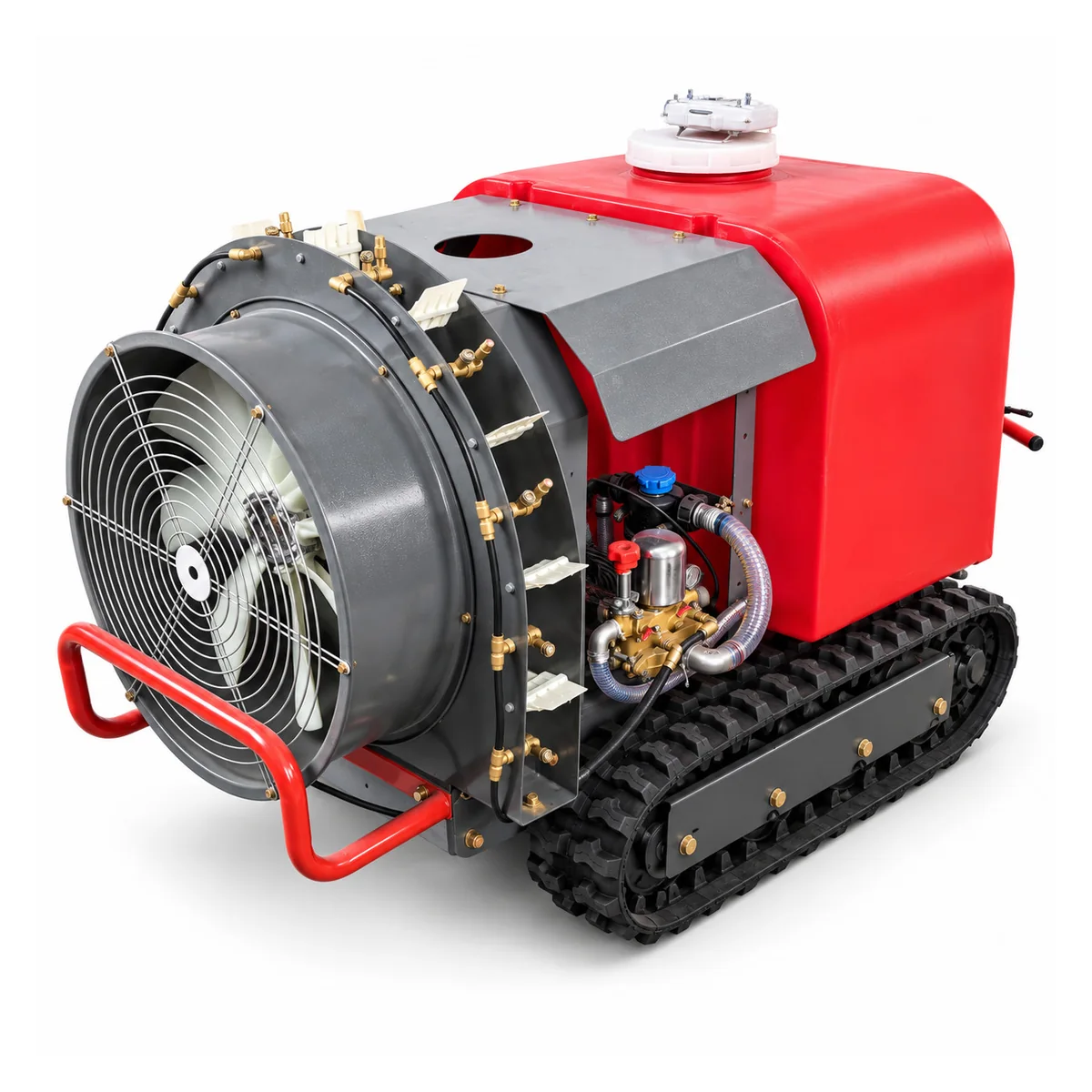
Short answer: An orchard canopy changes a lot between dormant season and full leaf. A sprayer set up once in spring will over-spray small trees and under-spray full ones. At each growth stage, measure tree height and width, turn off nozzles that miss the canopy, adjust air and speed, and re-check coverage with water-sensitive cards.

Why one setup does not fit the season
In winter a tree may be little more than a frame of branches. By summer the same tree can be a dense wall of leaves and fruit. The spray needed to cover it, and the air needed to carry spray inside it, change with that growth.
Many fruit extension services advise re-checking the sprayer at least at the main growth stages. The goal is to put spray where the canopy is, and not into open air or on the ground.
What changes in the canopy
| Stage | Canopy | Setup focus |
|---|---|---|
| Dormant / pre-bud | Bare wood, open frame | Fewer nozzles, lower air, avoid spraying over the top |
| Bud break to bloom | Small leaves, still open | Re-aim nozzles to the growing shoots, keep volume moderate |
| Early fruit set | Leaf area growing fast | Check top nozzles reach new growth, re-test coverage |
| Full canopy | Dense leaf wall | More air into the canopy, check inner and far-side coverage |
| Pre-harvest | Heavy fruit, full leaf | Keep coverage while watching drift and timing |
Product choice and rates follow the label and your advisor. This table covers sprayer setup only.

Measure the trees
- Measure height from the ground to the top of the canopy in a few rows.
- Measure width across the canopy at its widest point.
- Note the gap between rows at canopy height.
- Repeat at each stage and write the numbers down.
- If you use tree row volume to set volume, use the new numbers each time.
Match nozzles to the canopy
Stand behind the sprayer with clean water running and look at where each nozzle points. Any nozzle spraying above the top of the trees or below the lowest branches is wasting spray. Turn it off or re-aim it.
As trees grow, nozzles you closed in winter may need to come back on. Upper nozzles usually need to tilt up as new shoots extend. Keep a simple chart on the sprayer: stage, nozzles open, angle, pressure.
Air, speed and volume
If your sprayer has adjustable air, use less air on open trees and more on dense canopy. The aim is air that just reaches through the tree. Air that blows straight out of the far side carries spray away with it.
Travel speed works with air. A slower speed gives air more time to move leaves and push droplets inside. If inner cards are pale at full canopy, try a slower speed before adding more volume. Measure the new speed and update the calibration.
A quick routine for each stage
- Measure the canopy.
- Set nozzles and angles to the canopy.
- Check pressure on a tested gauge.
- Set air and speed for the canopy density.
- Calibrate output with water.
- Place water-sensitive cards and run one test row.
- Record the setup before you spray the block.
Common mistakes
- Leaving top nozzles open over small or freshly pruned trees.
- Adding more volume when the real problem is air or speed.
- Skipping the re-check after summer pruning.
- Keeping the setup only in the operator’s head.
Example: three checks in one season
A stone fruit grower with three-metre trees sets up three checks. In late winter, only the middle and lower nozzles are open and air is kept low, because the frame is open. At early fruit set, the top nozzles come back on and the grower re-runs water-sensitive cards. At full canopy, inner cards are pale, so the grower slows travel speed instead of adding volume, and the next card test shows better inside coverage. Each setup is written on a card kept in the tractor shed and in the spray record, with tree height and width at the time.
Related MERI pages
- Tree row volume airblast dosing
- Airblast sprayer canopy coverage
- Orchard spraying in hot, dry, windy weather
- ME-RCS sprayer FAQ
- Remote control agricultural sprayers
Frequently asked questions
How often should I re-check the sprayer setup?
At least at each main growth stage, and after pruning or any change to nozzles, air or speed.
Does spray volume need to change with the canopy?
Often, yes. Many growers adjust volume to canopy size. Follow the product label, which may set limits on rate and volume.
Can a small remote sprayer cover full canopy trees?
It depends on tree size, row width and model. Send MERI your tree height, width and row spacing to check which ME-RCS version fits.
What is the quickest coverage check?
Water-sensitive cards on two or three trees, at several heights, inside and outside the canopy.
Send us your site details
Tell us the job, area, slope and country. MERI replies within 24 hours.
Need a agricultural sprayer recommendation for your terrain or project?
Get a Quote