Short answer: Cut purple loosestrife at early flowering, before seed sets, to stop the huge seed crop. Cutting does not kill the root crown, so plants regrow, and cut stems in water can root. Work only from firm ground, keep cut material out of water, and follow local rules for wetland work.
Why loosestrife matters
Purple loosestrife is a tall perennial with spikes of magenta flowers. It came from Europe and has spread through wetlands, ditches, pond edges and wet meadows across the northern US and southern Canada.
A single mature plant can produce a very large amount of tiny seed. It forms dense stands that crowd out native wetland plants. Biological control insects are used in many areas; mowing and cutting play a smaller, supporting role.
What cutting can do
| Action | Effect | Limit |
|---|---|---|
| Cut at early flowering | Stops most seed | Crown regrows |
| Repeat cuts | Weakens plants slowly | Needs several seasons |
| Cut stems left in water | Can root and spread | Remove from water |
| Cut seeding plants | Spreads seed | Avoid |
Many programmes use biological control as the main tool. Ask your local agency what fits.
Wet ground
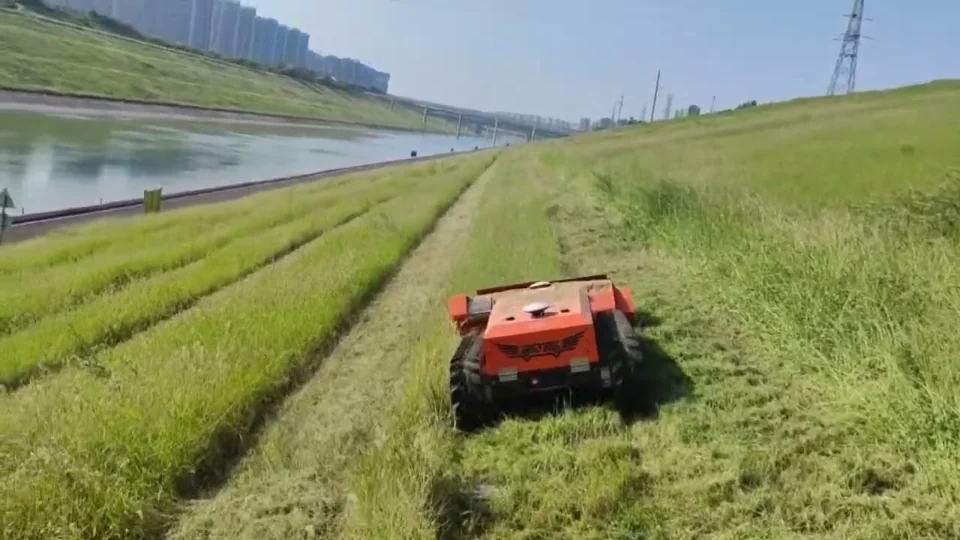
Loosestrife sites are wet. Stay on firm ground at the edge. A tracked remote mower spreads its weight on rubber tracks and lets the operator stand on a dike, road shoulder or field edge.
- Walk the edge and probe soft spots first.
- Keep the machine out of standing water.
- Do not track through saturated ground.
- Plan a recovery method before starting.

Keep cut material out of water
Cut loosestrife stems can root if they land in water or wet mud. A flail deck chops stems finely, which helps, but pieces still travel. Cut from the dry side toward the water only if your plan allows, and remove floating material where you can.
Rules for wetland work
Wetlands and ditches often fall under local, state or provincial rules. MERI does not advise on them. Check before you start, especially for work in or next to water, and keep a record of the advice.
Ditches and roadside drains
Many loosestrife stands are in roadside ditches and farm drains, where access is from the road or field edge. MERI tracked remote mowers are rated to 45°. The standard remote reaches 800 m, and the machine stops if the signal is lost. MERI flail mowers cut from 30 to 300 mm.
Machines for US and Canadian crews
For roadside and pasture strips, the gasoline ME1000-48 and ME1200-48 give 1,000 and 1,200 mm cuts. Diesel models are not supplied to the US market. Canadian buyers should confirm available options with MERI.
Common mistakes
- Cutting seeding plants and scattering seed.
- Leaving cut stems floating in ditches or ponds.
- Driving onto saturated ground and bogging the machine.
- Cutting sites set aside for biological control insects.
- Starting work near water without checking the rules.
Most of these are avoided by a short site plan agreed with the landowner and the local agency.
Small patches versus large stands
Small, new patches are worth extra effort. Cut them before seed, remove cut stems from wet ground and return several times. Large, established stands are usually managed with biological control or other methods, with cutting used on access routes and edges.
Records
Map each stand with its size and the date of each cut. Note any regrowth and whether seed had formed. Share the map with the local agency or biological control coordinator. Over a few seasons, it shows which stands are shrinking and which need a different approach, and it helps agencies decide where to release insects next. Keep the map with the site file.
A season plan
- Early summer: map stands along ditches and edges.
- Early flowering: cut, starting with clean areas.
- After cutting: check for floating or stranded pieces.
- Late summer: check regrowth; cut again before seed if needed.
- Fall: clean equipment and update the map.
Coordinate with any biological control programme in your area. Some sites are kept uncut to support the insects.
Related MERI pages
- Wetland restoration invasive mowing
- Phragmites reed cutting
- Remote ditch mowers
- Machine hygiene between mowing sites
- Remote control mowers in Canada
- Remote control mowers in the USA
Frequently asked questions
When should purple loosestrife be cut?
At early flowering, before seed sets. Check for regrowth and cut again before seed if needed.
Does cutting kill purple loosestrife?
No. The root crown regrows. Cutting stops seed and can weaken plants over several seasons.
Can cut loosestrife stems spread it?
Yes, stems in water or wet mud can root. Keep cut material out of water.
Do I need permission to cut loosestrife in wetlands?
Rules vary. MERI cannot advise on them. Check with your local, state or provincial agency first.
Send us your site details
Tell us the job, area, slope and country. MERI replies within 24 hours.
Need a mower recommendation for your terrain or project?
Get a Quote