Short answer: Old willow coppice is removed in stages: harvest or cut the last crop, mulch the regrowth and low stools, then deal with the roots and soil. A tracked remote mulcher is useful on headlands, wet corners and small blocks where big tractor kit cannot work well. Plan for regrowth after the first pass.
Why old willow blocks are coming out
Energy crop plantings from earlier decades are reaching the end of their useful life on many farms. Forestry and farm press report growers asking how to return the ground to grass or arable. The stools are dense, the roots are wide and wet corners make heavy kit hard to use.
There is no single machine for the whole job. Think of it as a sequence.
A typical removal sequence
| Stage | Aim | Typical equipment |
|---|---|---|
| 1. Last harvest or cut | Remove the standing stems | Harvester, saw or contractor |
| 2. Mulch regrowth and stools | Reduce the stool to low chips | Forestry mulcher |
| 3. Roots and soil | Break up the root mat | Stump grinding, deep cultivation or time |
| 4. Control regrowth | Stop new shoots taking over | Repeat mulching or mowing |
| 5. Seedbed | Prepare for grass or crop | Cultivation and seeding |
A general plan. Your agronomist decides the soil and crop steps.
Where a remote mulcher helps
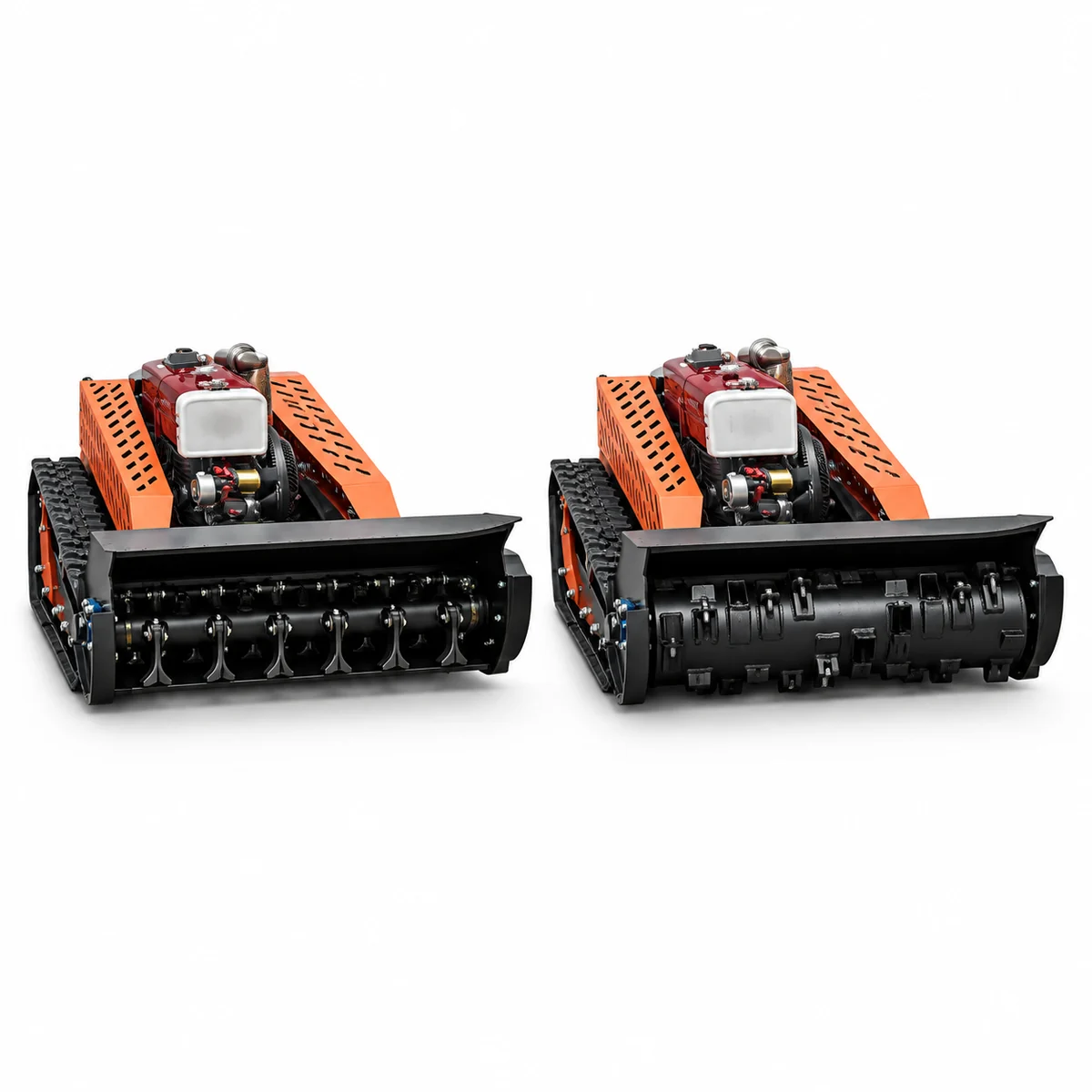
The ME-RFM1000 series has a 1,000 mm working width and is rated for trees and branches up to 30 cm under suitable conditions. That covers willow regrowth and many cut stools. The ME-RFM1000-D is rated to 45°; the ME-RFM1000-E is rated to climb 45° and work up to 35°.
Remote control is helpful on the wet edges of willow blocks, near ditches and on small fields where turning a large tractor-mounted mulcher wastes time. The operator walks firm ground while the tracked machine works the soft rows.
Measure before you price
- Count stools per 100 m² in a few sample squares.
- Measure stool width and stem diameter at cutting height.
- Note how long since the last harvest: older regrowth is thicker.
- Map ditches, drains and wet patches.
- Check for wire, posts and old fencing left in the rows.
Time a trial strip and scale up. Add time for refuelling or charging and for clearing chips from drains.
Rotor and teeth
Willow stools are often full of soil and grit. That wears teeth faster than clean wood. The ME-RFM1000-D offers horseshoe or toothed blades; check tooth condition before the job and keep spares on site. Work the rotor at stool height, not into the soil, unless you plan for the extra wear.

Planning the field work
Willow blocks are often split by drains and headlands, and access can be poor after rain. Plan the order of work so the machine starts on the firmest ground and finishes on the wet corners only if the weather holds. Keep chips out of ditches and drains. On small fields, a remote mulcher can work rows that end close to hedges or watercourses, where larger tractor kit would need extra turning space.
Agree with the landowner what happens to the chips: left as surface mulch, worked in later, or raked off certain areas. Each choice changes the time on site and the next cultivation step.
Diesel or electric for willow blocks
The ME-RFM1000-D runs a diesel engine, which suits long days on remote fields with no power supply. The ME-RFM1000-E is electric and quieter to work with, which helps near houses and farm buildings, but it needs a charging plan. On a big block, diesel is usually simpler; on small blocks near homes, electric may fit better.
After the first pass
Willow regrows from the root system. Expect shoots in the first season. A second mulching or regular mowing keeps them down until the roots are dealt with or the land is cultivated. Agree the follow-up visits in the first quote so the client is not surprised.
Related MERI pages
- ME-RFM forestry mulcher FAQ
- ME-RFM1000-D diesel mulcher
- Remote control forestry mulchers
- Forestry mulcher and stump grinding
- Woody stem measurements for a mulcher trial
Frequently asked questions
Can a forestry mulcher remove willow stools?
It can reduce regrowth and many stools to chips. The ME-RFM1000 series is rated for stems up to 30 cm under suitable conditions. Roots usually need further work.
Will willow regrow after mulching?
Usually yes. Plan follow-up mulching or mowing until the roots are dealt with or the ground is cultivated.
Why use a remote mulcher on willow blocks?
It works wet edges, ditches and small blocks while the operator stays on firm ground.
Does soil in the stools wear the teeth?
Yes. Grit wears teeth faster. Check teeth before the job and keep spares on site.
Send us your site details
Tell us the job, area, slope and country. MERI replies within 24 hours.
Need a forestry mulcher recommendation for your terrain or project?
Get a Quote