
Short answer: Targeted spraying puts product on the canopy and nowhere else: match spray volume and air to canopy size, switch off outlets over gaps and at row ends, aim outlets at the foliage, and keep records so each block gets only what it needs.
Where product is wasted
- Spraying gaps between trees and row ends.
- Outlets aimed above or below the canopy.
- Too much air blowing spray through the trees.
- Same volume on small young trees as on full canopies.
Match the canopy
| Canopy | Adjustment |
|---|---|
| Young or small trees | Fewer outlets, lower volume |
| Full canopy | Full outlets, matched air |
| Gaps and row ends | Outlets off |
Follow the product label for rates.
Aim and check
Point outlets at the foliage band. Check coverage with water-sensitive paper at the top, middle and inside of the canopy. Adjust until coverage is even without run-off.
Remote tracked sprayers
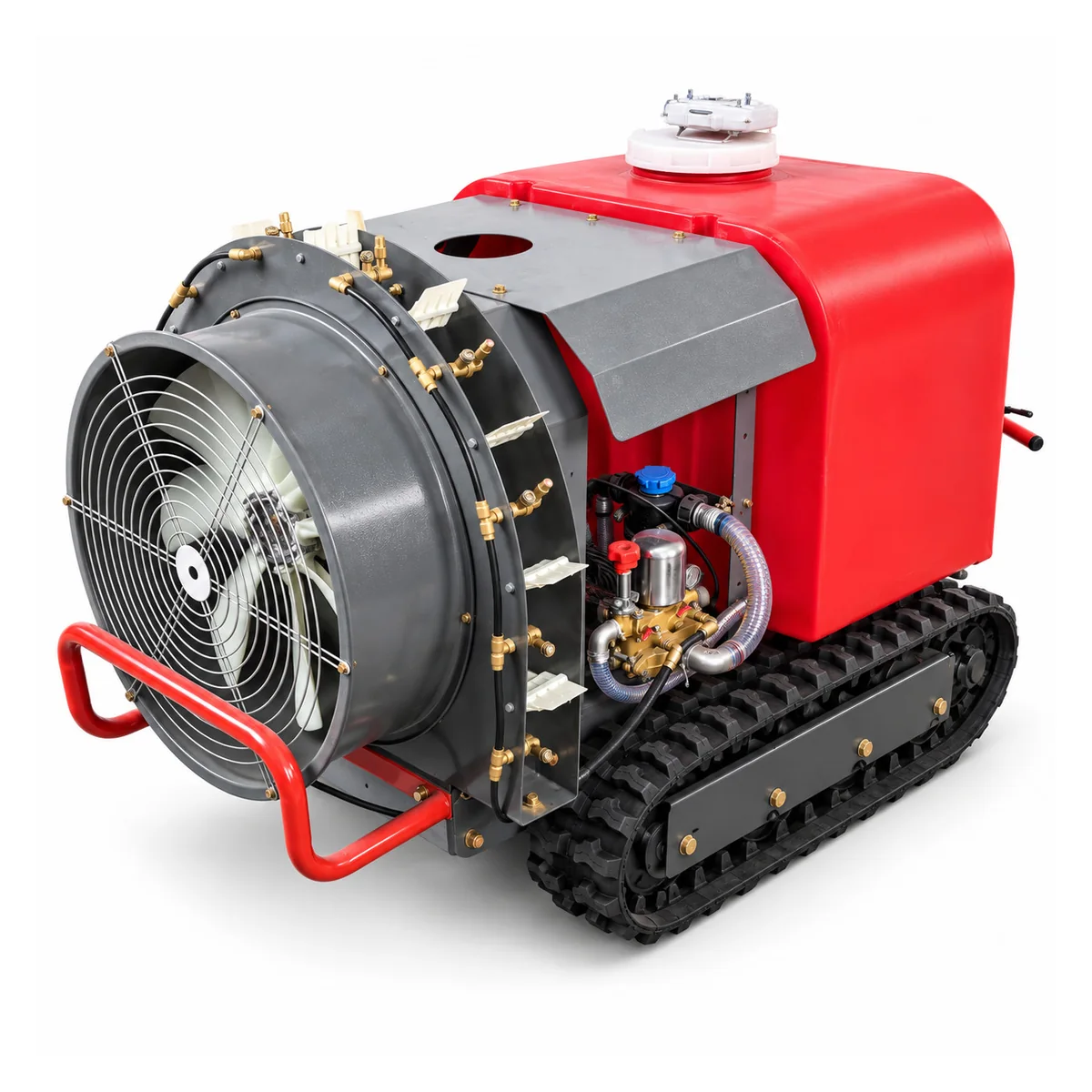
On MERI ME-RCS airblast sprayers, the operator stays out of the spray cloud with the remote and can stop spraying at row ends. Tank sizes run from 100 L to 800 L.
Records
Record block, product, rate, volume and weather. Over a season, records show where the volume can come down.
Planning by block
Keep a simple block sheet: tree age, canopy size, row spacing and the volume and outlet setting that matched it at the last coverage check. Over a few seasons, this shows which blocks need less and stops the habit of using the same setting everywhere.
Working with advisers
Crop advisers and product labels set the dose; the sprayer setup decides how much of it reaches the target. Share coverage results with your adviser. Better coverage can make a lower volume work within the label, and poor coverage explains poor results that might otherwise be blamed on the product.
Worked example: volume by canopy
Say a full-canopy block is sprayed at a set volume per hectare. A young block next to it has trees only half the height and width. If the same setting is used, much of the spray passes over and around the small trees.
| Block | Canopy | Outlets in use | Volume |
|---|---|---|---|
| A | Full | All outlets on the canopy band | Full setting |
| B | Half height | Top outlets off | Reduced, checked with papers |
| C | Gaps after tree loss | Outlets off over gaps | Full on trees, off over gaps |
Set the actual dose and volume from the label and your adviser; check coverage after each change.
After each change, check coverage again. The aim is even coverage on the target, not a fixed volume.
Running a coverage check
- Clip water-sensitive papers at the top, middle and inside of the canopy on several trees.
- Spray the row with water at the normal setting.
- Collect the papers and compare the spot pattern.
- If the top is light and the bottom is wet, re-aim the outlets.
- If the inside is dry, adjust air and travel speed.
- Record the setting that gave the best result for that block.
Speed and the remote sprayer
Travel speed changes how much spray each tree gets. Listed speeds are 80 m/min on the ME-RCS100–200 and 60–80 m/min on the ME-RCS300–500 (TDS). Measure your real speed in the rows and keep it steady. With the remote, the operator can walk at the end of the row, out of the spray cloud, and stop the spray before the headland.
Young blocks and replants
Young trees need far less spray than full canopies. Set the outlets low, shut the top outlets where there is no foliage, and reduce the air so spray does not blow past the small trees.
Check with water-sensitive paper as the canopy grows and update the block setting each season. Record which blocks are set as young, so the change is not missed when the trees fill out.
Common mistakes
- Using one setting for every block on the farm.
- Changing settings without checking coverage again.
Related MERI pages
Frequently asked questions
How can orchards cut spray use?
Match volume and air to the canopy, turn off outlets at gaps and row ends, and aim at the foliage.
How do I check coverage?
With water-sensitive paper at different heights in the canopy.
Should young trees get the same volume?
No, adjust to canopy size within the label.
What tank sizes do ME-RCS sprayers have?
100 L to 800 L.
Send us your site details
Tell us the job, area, slope and country. MERI replies within 24 hours.
Need a agricultural sprayer recommendation for your terrain or project?
Get a Quote