Short answer: Mow wild chervil at early bloom, before seed forms, and expect it to regrow from its taproot. Repeat mowing over several seasons can weaken it, but mowing alone rarely clears a stand. Mow clean areas first, clean equipment before moving on, and work with your local weed authority.
What wild chervil is
Wild chervil is a tall plant of the carrot family with lacy white flowers in late spring. It has spread along roadsides, ditches, hay fields and pastures in parts of Ontario, Quebec, the Maritimes, British Columbia and the northeastern US.
It is a biennial or short-lived perennial with a deep taproot. It flowers early, often before hay is cut, so seed is dropped before the first hay harvest. Livestock do not like it, and it reduces hay quality.
Timing the cut
| Stage | Mow? | Notes |
|---|---|---|
| Rosettes in spring | Little benefit | Plants stay low |
| Bolting, buds forming | Yes | Good window before seed |
| Early bloom | Yes, best window | Stops most seed for the year |
| Seed set | Avoid | Mowing spreads seed along ditches |
Watch for regrowth and a second flowering after the first cut.
Wild chervil flowers earlier than most roadside plants. A roadside crew working to a fixed summer schedule often arrives too late. Moving one round earlier, to late spring, makes a big difference.
What mowing will not do
The taproot survives mowing and sends up new shoots. Mowing reduces seed and can weaken plants if repeated, but it does not clear an established stand. Local guides often combine mowing with other methods. MERI does not advise on chemicals; follow your provincial or state guidance.
In hay fields, an earlier first cut helps. It will lower yield a little that year, but it stops seed and protects later crops.
Ditches and backslopes
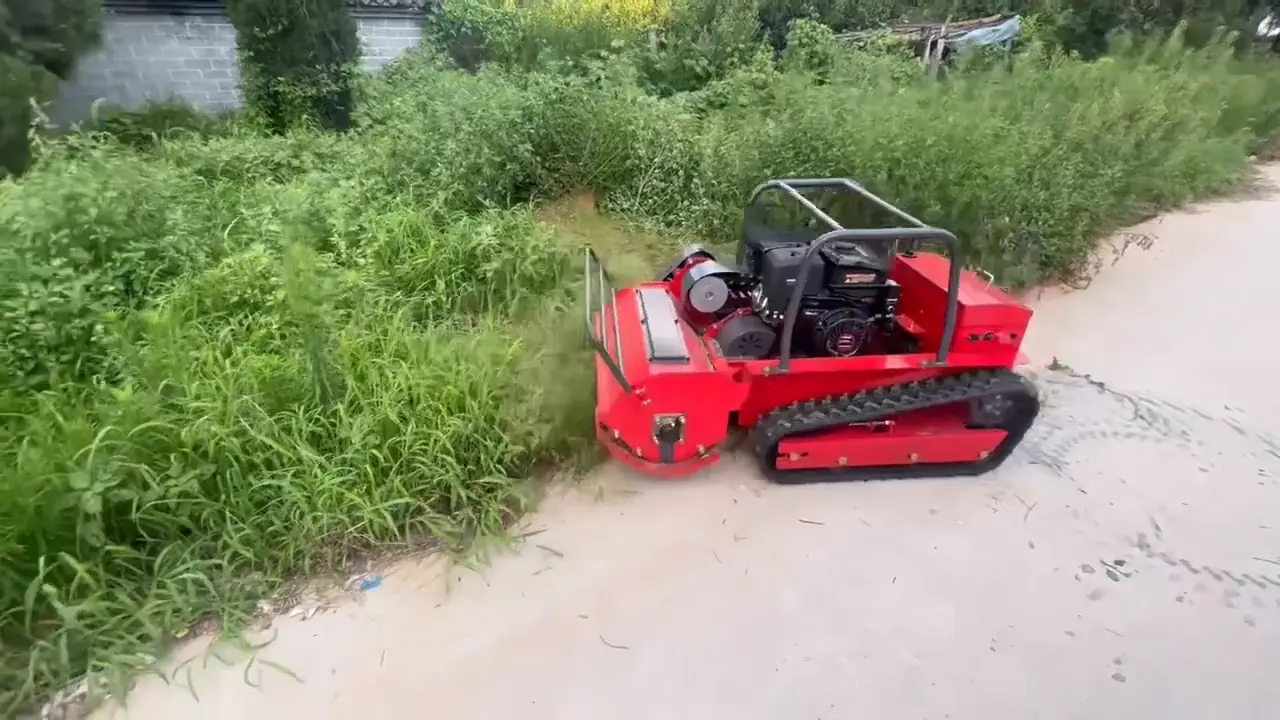
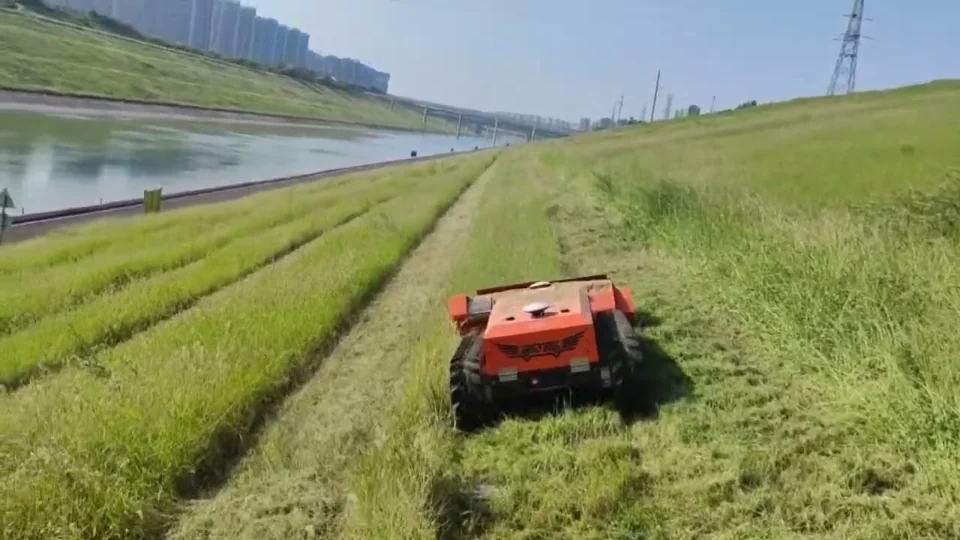
Wild chervil often fills ditch backslopes and wet field edges, where a tractor mower is slow and awkward. A tracked remote mower works those slopes while the operator stays on the road shoulder or field edge.
MERI tracked remote mowers are rated to 45°. The standard remote range is 800 m, and the machine stops if the signal is lost. On roadside work, keep the machine in sight and follow your road authority’s traffic rules.
Clean-down and work order
- Map known patches before the season.
- Mow clean stretches before infested ones.
- Mow before seed forms wherever possible.
- Clean the deck and tracks at the end of each infested stretch.
- Do not clean down next to a stream or culvert.
- Report new patches to the municipality or weed inspector.
Cut height and finish
MERI flail mowers cut from 30 to 300 mm. On roadsides with good grass cover, a moderate height lets the grass recover and compete. Very low cuts open the soil and favour new chervil seedlings. A flail deck chops stems finely, so there are no long windrows to hold seed heads.
Machines for Canadian and US buyers
For roadside and pasture strips, the gasoline ME1000-48 and ME1200-48 give 1,000 and 1,200 mm cuts. Diesel models are not supplied to the US market. Canadian buyers should confirm available engine options with MERI before ordering.
How mowing fits with other tools
Most wild chervil programmes use several tools. Mowing at early bloom stops seed. An earlier first hay cut protects fields. Good grass cover slows new seedlings. Other treatment follows provincial or state advice. The mower’s job is usually the roadside, the ditch and the field edge, where seed moves fastest.
Ask the weed inspector which stretches are priority sites and when they want them cut. Then build the mowing schedule around that list rather than a fixed calendar.
Records
Map each patch with a GPS pin and note the date and stage of every cut. Add a photo from the same spot each year. The records show whether patches are shrinking, holding or spreading, and they help the township plan its next season.
Common mistakes
- Mowing in mid-summer after seed has dropped.
- Expecting one cut to remove the stand.
- Scalping ditch banks so new seedlings establish.
- Moving between townships without cleaning the mower.
A season plan with an earlier first round fixes most of these.
Related MERI pages
- Giant hogweed and wild parsnip mowing
- Remote mowers for highway embankments
- Remote ditch mowers
- Machine hygiene between mowing sites
- Remote control mowers in Canada
- ME1000-48 remote flail mower
Frequently asked questions
When should wild chervil be mowed?
At early bloom, usually in late spring, before seed forms. Watch for regrowth after the first cut.
Does mowing kill wild chervil?
No. The taproot regrows. Mowing reduces seed and can weaken plants if repeated, but it does not clear a stand alone.
Can mowing spread wild chervil?
Yes, if plants are in seed. Mow earlier, mow clean areas first and clean equipment between sites.
Can a remote mower work ditch backslopes?
Yes. MERI tracked remote mowers are rated to 45°, and the operator stays on the shoulder or field edge.
Send us your site details
Tell us the job, area, slope and country. MERI replies within 24 hours.
Need a mower recommendation for your terrain or project?
Get a Quote