
Short answer: Steep chalk turf has thin soil, flints and slopes that grazing animals managed for centuries. Where grazing has stopped, a late-season cut keeps coarse grasses back. Use a remote mower on the steep faces, set the deck high enough to clear flints and anthills, and agree timing and whether cuttings are removed with the site’s ecologist.
The situation on many sites
Conservation and farm press often report chalk grassland losing its short, flower-rich sward once sheep or rabbits are gone. Coarse grasses take over first, followed by scrub. Many sites cannot bring back grazing on every slope. Mowing is the fallback, but the slopes are steep and the ground is hard on machines.
This article covers the mowing side. Scrub already present is a separate job.
Ground conditions to plan for
- Thin soil over chalk with flints at the surface.
- Anthills and old terracettes along the slope.
- Steep faces where hand crews work slowly.
- Dry, slippery turf in late summer.
- Public footpaths across many sites.
Each one affects deck height, travel direction and timing.
Setting up the cut
| Item | Typical approach |
|---|---|
| Timing | Late summer or autumn, after flowering, as the plan allows |
| Height | High enough to clear flints and anthills |
| Direction | Up and down the slope where possible |
| Cuttings | Removed where the ecologist wants low fertility |
| Frequency | Often once a year; some areas twice |
General guide. The site plan and ecologist decide timing and cuttings.
Machine choice
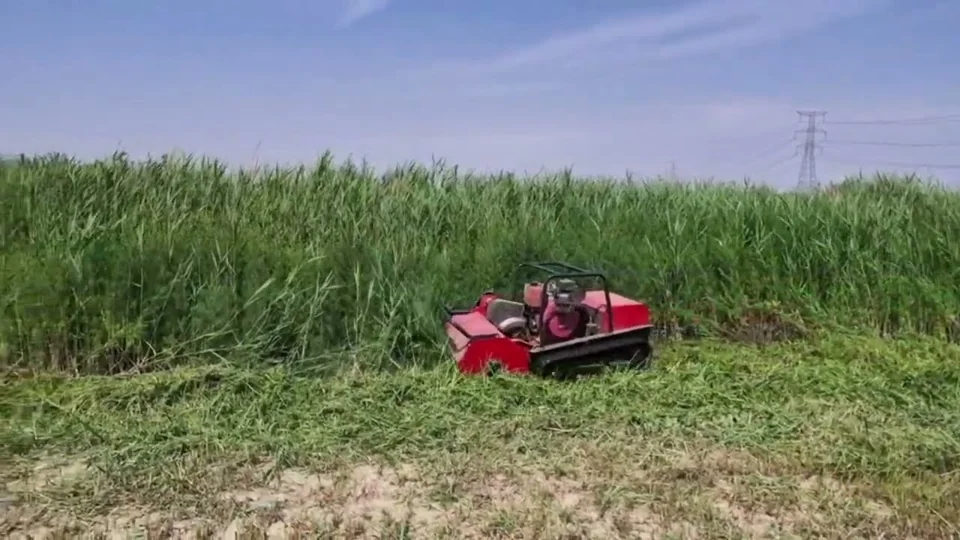
A tracked remote mower lets one operator cut the steep faces from the top or bottom of the slope. MERI tracked models are rated to 45°. Flail models have a 30–300 mm cutting height, so the deck can be set high over flints and anthills, and the flail mulches the cut material. Where cuttings must be removed, plan a separate raking or collection step.
Protecting the machine
Flints chip blades and wear the deck. Walk a sample of the slope first and raise the deck where flints are common. Check blades at each break. Dry chalk turf is slippery in late summer; slow down and avoid turning on the steepest section.
- Check blades and blade bolts at every break.
- Clean chalk dust from radiators or cooling areas at the end of the day.
- Look at track tension after a day on hard, uneven ground.
Grazing and mowing together
Some sites combine both. Light grazing on the gentler slopes, mowing on the steep faces where stock are hard to manage, and hand work on the most sensitive areas. A remote mower can also prepare a site for grazing to return by cutting back coarse growth first.
- Map which slopes are grazed and which are mown.
- Mow fence lines before stock go out.
- Cut the steep faces after flowering.
- Record sward height before and after each cut.
Common mistakes
- Cutting too low and scalping anthills and flints.
- Mowing in early summer when the plan asked for a late cut.
- Leaving thick cuttings where low fertility was the goal.
- Turning on dry, slippery turf on the steepest section.
- Starting without checking where footpaths cross the slope.
Working near footpaths
Many downland sites have public access. Put up signs, agree work times with the site manager and keep the machine in view. The operator can stop the machine at any moment, and it stops if the signal is lost.
A worked example
A trust manages a steep chalk escarpment where grazing stopped some years ago. Coarse grass and young scrub are spreading. The plan asks for a late-summer cut on the steepest faces and light grazing on the lower slopes. The crew walks the faces first and flags the areas with most flints and anthills. A tracked remote mower cuts the faces at a high setting, raised further on the flinty patches. The cuttings are raked down to the foot of the slope and taken away, as the plan asks for low fertility.
Watching the sward over the years
Set a few fixed photo points on each face and take a photo from each one every year at the same time. Over several seasons, the photos show whether the short, flower-rich turf is coming back or whether the cutting plan needs to change.
Related MERI pages
- Slope ratings by model
- Cutting height by model
- Mowing lumpy ground with molehills and anthills
- Native grassland restoration mowing
- ME1000-48 remote flail mower
Frequently asked questions
When should chalk grassland be mown?
Often late summer or autumn after flowering. The site plan and ecologist set the exact timing.
What height should I cut steep chalk turf?
High enough to clear flints and anthills. MERI flail models adjust from 30 to 300 mm.
Should cuttings be removed?
Often yes on chalk grassland, to keep fertility low. Agree this with the ecologist; a flail mulches in place, so collection is a separate step.
Can a remote mower handle steep downland?
Yes, within its rating. MERI tracked models are rated to 45°. Check ground and footing first.
Send us your site details
Tell us the job, area, slope and country. MERI replies within 24 hours.
Need a mower recommendation for your terrain or project?
Get a Quote