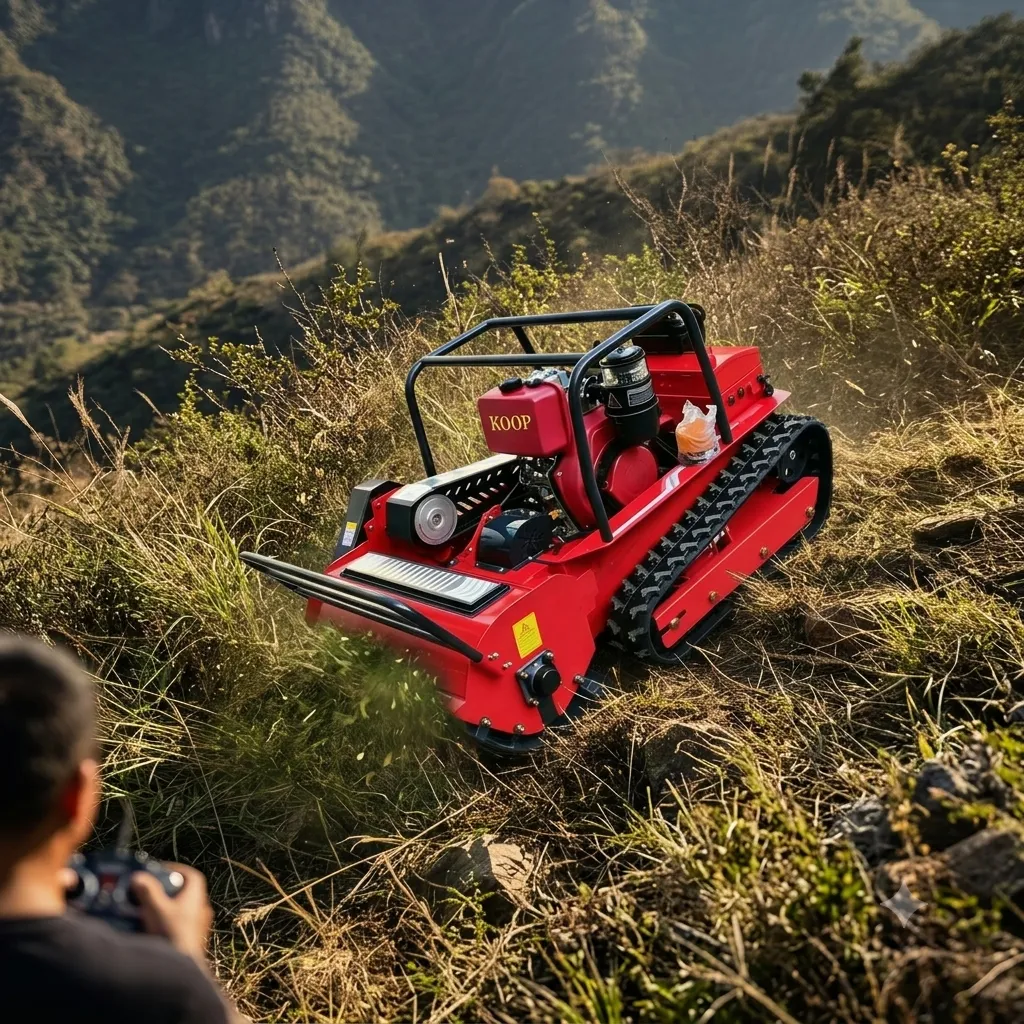
Short answer: Mark the trees to keep, clear the outer brush with a machine, and finish close to trunks by hand. Keep the mulching head away from bark and surface roots, avoid driving over the root zone in wet weather, and leave a thin mulch layer rather than piles against trunks.
Mark first
Tag keeper trees with bright tape so the operator can see them from any angle.
Zones
| Zone | Method |
|---|---|
| Open brush | Machine mulching |
| Near the drip line | Slow, careful machine work |
| Close to trunk | Hand tools |
Protecting bark
Bark wounds let in decay. Keep the head well clear of trunks and exposed roots. Remote operation helps: the operator can stand where the view of the trunk is clearest.
Root zone
Avoid repeated passes over the root zone, especially when wet. Tracks spread weight but still compact soil.
Mulch layer
Leave a thin, even layer. Do not pile mulch against trunks.
Machines
The ME-RFM1000 works with a 1,000 mm path; narrower access around trees is easier than with a large carrier.
After clearing
Check trees for damage and mark any for an arborist.
Which trees to keep
Healthy native trees of good form are usually worth keeping. Damaged, leaning or diseased trees near paths or buildings may be better removed by an arborist. Decide before clearing so the operator knows the plan.
Order of work
| Step | Action |
|---|---|
| 1 | Tag keeper trees |
| 2 | Mulch open brush |
| 3 | Slow work near drip lines |
| 4 | Hand work at trunks |
| 5 | Check trees for damage |
Worked example: a wooded lot
An owner wants a 1-hectare lot opened up, keeping about thirty good oaks and removing the brush and small saplings between them. Day one is tagging and marking. The mulcher then clears the open brush between trees in long passes, slows down as it nears each drip line, and stops short of the trunk. A hand crew follows with saws and trimmers around each trunk. At the end, the crew walks every tagged tree and notes any bark damage for the arborist.

Distances and speed near trees
| Zone | Machine work |
|---|---|
| Open brush | Normal mulching speed |
| Outer root zone | Slower, single passes, avoid turning |
| Near the drip line | Slow, head raised over roots, careful view of trunk |
| Close to trunk | No machine; hand tools only |
Set exact distances with an arborist for valuable or protected trees.
Remote control lets the operator walk round to the side with the best view of the trunk instead of judging the gap from one fixed seat.
Seasonal notes
Dry, firm ground limits root compaction, so late summer and autumn are often good for this work, outside bird nesting periods. Avoid clearing in very wet weather, when tracks compact the root zone, and in hot, dry spells on sites with fire risk. Some trees are more sensitive to wounding in spring when sap is rising; extra care with bark matters then.
Common mistakes
- Not tagging trees, so the operator has to guess.
- Mulching to the trunk with the machine.
- Piling mulch against trunks.
- Repeated passes over the root zone in wet weather.
After the job
Walk every tagged tree with the owner at handover. Note any bark damage, exposed roots or leaning trees, and photograph them. Remove the tags once the owner agrees. Leave a short written note of what was cleared and what follow-up mowing the brush regrowth will need in the next season, so the owner knows the clearing is not a one-time result.
Telling the client what to expect
Clients often picture a park-like finish on the first day. Explain before the work starts: the ground will be covered with mulch, some roots and small stumps stay, and kept trees may look bare at first. Agree what “finished” means in writing, including how close to each tree the machine will work and what is done by hand. Show a photo of a similar job if you have one.
Related MERI pages
Frequently asked questions
How do I protect trees I want to keep?
Mark them, keep the head clear and finish close to trunks by hand.
Why is bark damage a problem?
Wounds let in decay.
Should mulch be piled at trunks?
No, leave a thin layer.
Does remote operation help?
Yes, the operator can choose the clearest view.
Send us your site details
Tell us the job, area, slope and country. MERI replies within 24 hours.
Need a forestry mulcher recommendation for your terrain or project?
Get a Quote