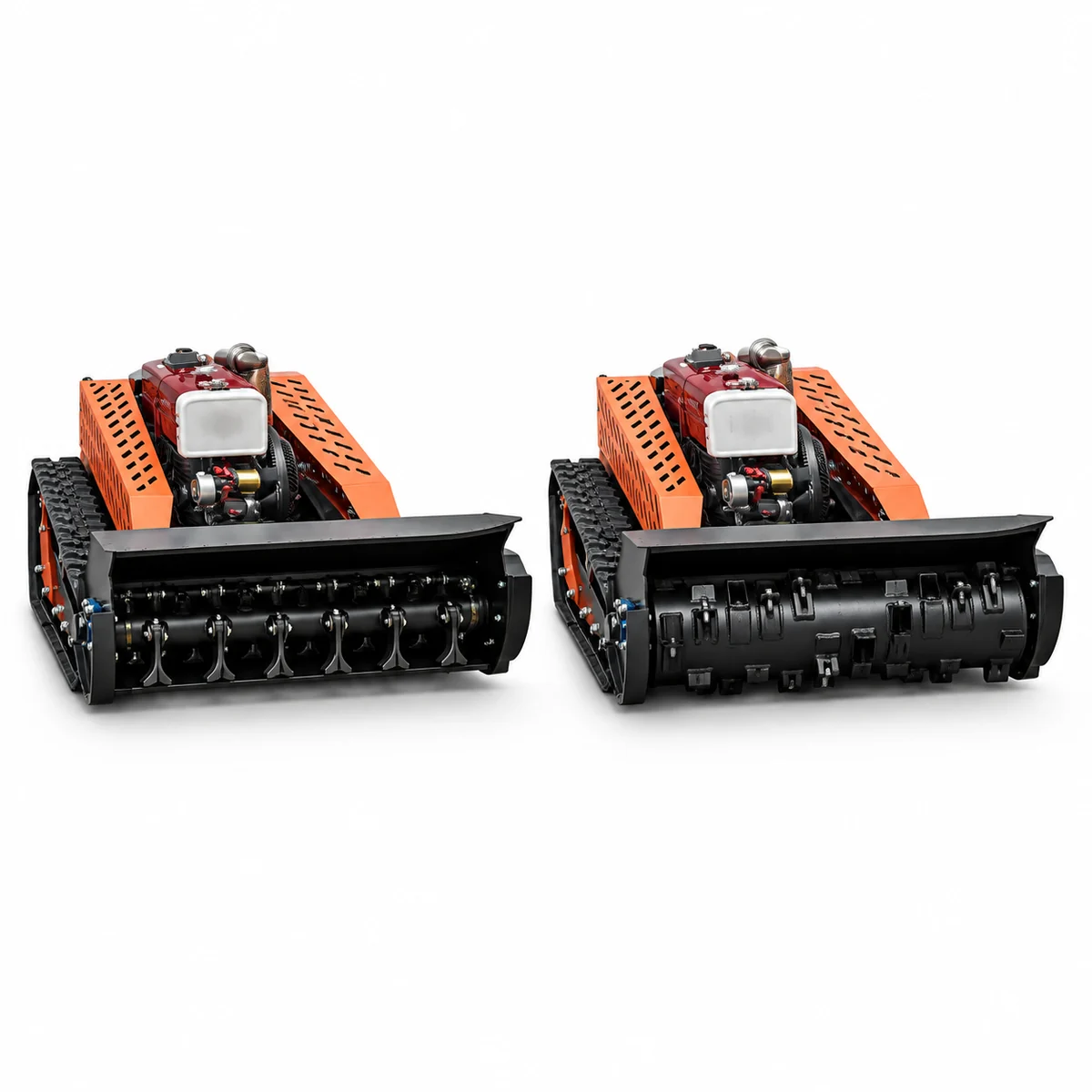
Short answer: Invasive alien plants such as wattle, lantana, bugweed and triffid weed are cleared in South Africa with a mix of hand crews, chainsaws, slashers and mulchers. A remote tracked mulcher suits dense stands on slopes and stream banks where tractors cannot go. Plan follow-up from the start, because most of these plants resprout or seed.
The plants and why they matter
Many landowners face dense stands of wattle, lantana, bugweed, triffid weed (chromolaena), bramble, pine, eucalyptus and prosopis. These stands use water, raise fire risk, block access and push out grazing. Check current species lists and any permit needs with the relevant authority before you start; the duty to control listed plants sits with the landowner.
Mechanical options compared
| Method | Suits | Limits |
|---|---|---|
| Hand crews with brushcutters | Light regrowth, small areas | Slow in dense stands; crew exposure on slopes |
| Chainsaw felling | Trees above mulcher size | Leaves brash to handle |
| Tractor slasher | Flat, open land, light growth | Slopes, stumps and woody stems |
| Excavator or loader mulcher | Large flat to moderate sites | Transport, ground damage, cost |
| Remote tracked mulcher | Dense stands, slopes, stream banks | Tree size and slope limits |
General comparison. Choose by plant size, density, slope and access.
Where a remote mulcher fits
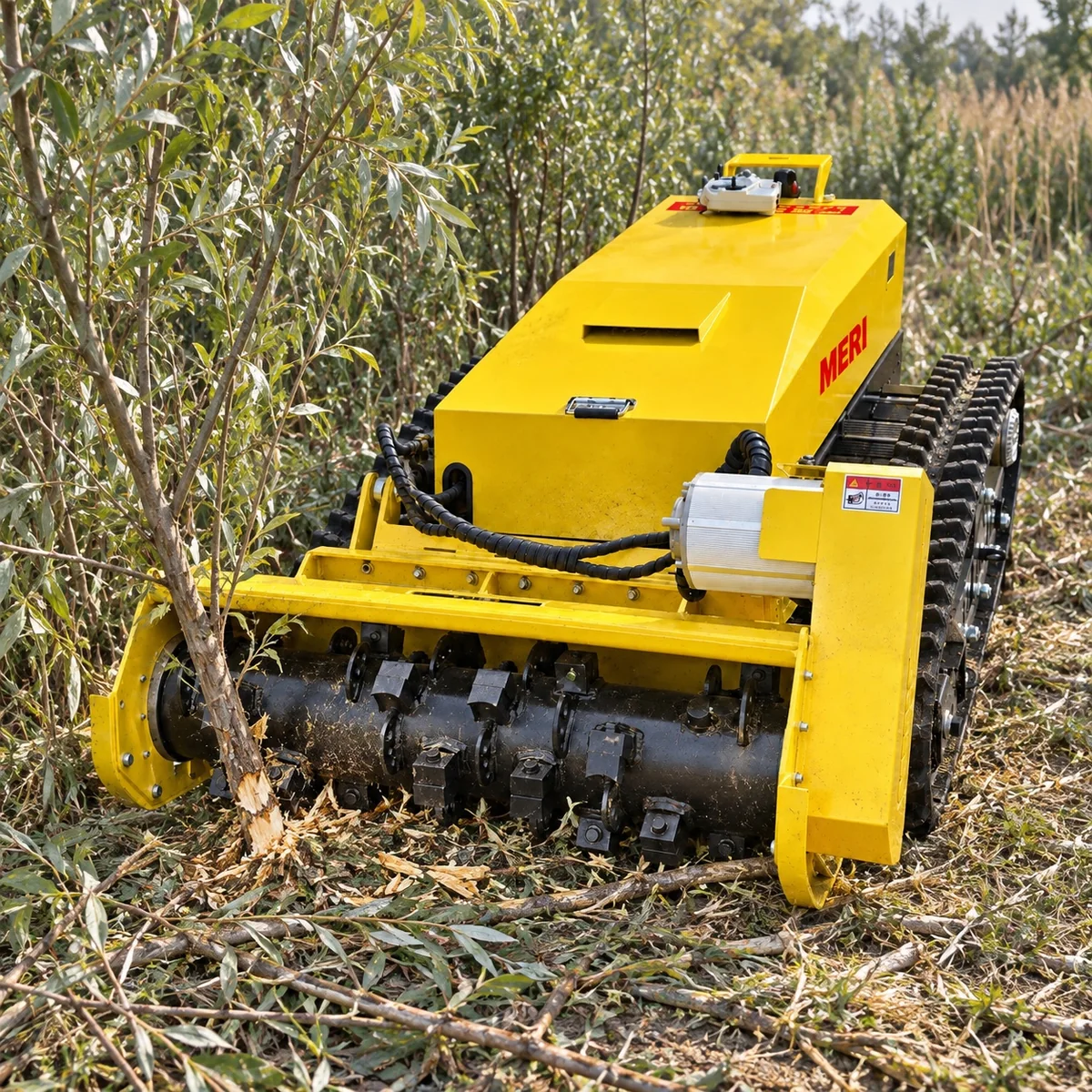
The MERI ME-RFM1000-D works a 1,000 mm strip and is rated for trees and branches up to 30 cm under suitable conditions, on slopes rated to 45°. The operator stands away from the stand, which helps in thorny lantana, bramble and steep kloofs. Larger wattle, pine or gum should be felled first, then the tops mulched.
Follow-up is part of the job
Mulching removes the standing plants but not the seed bank or root systems. Wattle seed can stay in the soil for years and germinates after disturbance and fire. Lantana and bugweed resprout from stumps. Build follow-up into the plan:
- Initial clearing: mulch or fell the dense stand.
- First follow-up: treat or cut seedlings and coppice growth.
- Further follow-ups until the stand is under control.
- Restore cover with grass or indigenous plants where possible.
Agree the follow-up rounds with the client up front, so the first clearing is not seen as the end of the contract.
Working near water
Many alien stands grow along streams and rivers. Keep machines out of the channel, avoid fuel and oil near water, and leave a buffer where the bank is unstable. On wet banks, tracks spread weight better than wheels but can still slide; plan routes on firmer ground.
Planning a contract
- Map the area and stand density from a site walk or drone images.
- Note slope, rocks and water.
- Split the price into initial clearing and follow-up rounds.
- Agree how mulch and brash will be left on site.
- Record before and after photos for each block.
Estimating time and cost
Clearing time depends mostly on stand density and slope. A light stand of young wattle on gentle ground goes quickly; a closed lantana thicket on a steep kloof can take many times longer per hectare. Use sample plots to set density classes, such as light, medium and dense, and time a short trial in each class.
The ME-RFM1000-D data sheet lists a work rate of 3,000–4,000 m²/h. Treat this as the top of the range in open, light cover; dense woody stands will be slower. Add time for felling larger trees, moving between blocks and refuelling.
Write the price per density class and per follow-up round. This lets the landowner see what each block costs and plan funding for the follow-up work, which is often where clearing projects fail.
Diesel or electric
Diesel suits remote farms with long days and no charging point. The electric ME-RFM1000-E runs from a 30 kWh LiFePO4 battery, about 7 hours per charge, and is quieter near homes and lodges. Match the power choice to the site and the support you have nearby.
Related MERI pages
- Remote control mowers in South Africa
- Slangbos clearing with a mulcher
- Wattle and acacia regrowth after fire
- Forestry mulcher for invasive shrubs
- ME-RFM1000-D diesel mulcher
Frequently asked questions
Which invasive plants can a remote mulcher clear?
Dense stands of wattle, lantana, bugweed, bramble and similar plants, with trees and branches up to 30 cm under suitable conditions.
Is one clearing enough?
No. Most invasive alien plants resprout or seed, so follow-up rounds are needed.
Can a remote mulcher work on stream banks?
On firm banks, yes, with care. Keep out of the channel and away from unstable edges.
What about trees bigger than 30 cm?
Fell them with a chainsaw first, then mulch the tops and brash.
Send us your site details
Tell us the job, area, slope and country. MERI replies within 24 hours.
Need a forestry mulcher recommendation for your terrain or project?
Get a Quote