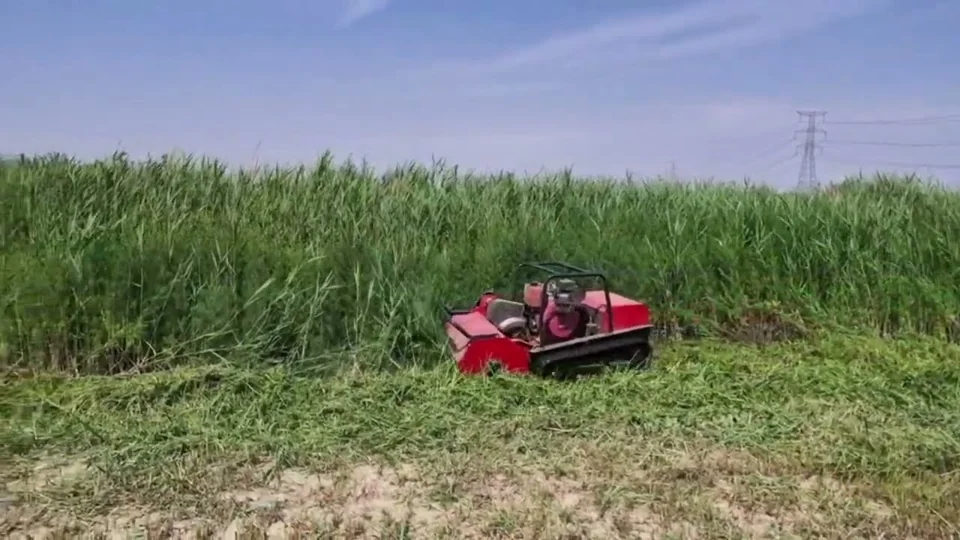
Short answer: Docks are deep-rooted perennials. One cut will not kill them, but cutting before the seed heads ripen stops new seed, and repeated cuts weaken the root over time. Spot spraying, where local rules and the product label allow it, can kill established plants faster. Most farms get the best result by doing both, then thickening the grass so docks have no gaps to fill. A remote mower handles patches on steep or wet fields where a tractor cannot work.
Broad-leaved dock and curled dock are common in grazed and cut grassland. Stock avoid the big leaves, so docks spread and take up space that grass should fill. Their seed can stay alive in the soil for years. This guide is for farm managers, grazing contractors and dealers who need a practical plan for dock patches.
Why docks are hard to remove
- Taproot: the root stores food and regrows after the top is cut.
- Seed bank: each plant can shed a lot of seed, and it lasts in the soil.
- Gaps: docks move into bare or poached ground, gateways and feeding areas.
- Fertile soil: they do well where nutrients are high, such as near yards and manure spreading.
Cutting or spot spraying: how they compare
| Point | Repeated cutting | Spot spraying |
|---|---|---|
| Stops seed | Yes, if cut before seed ripens | Yes, on treated plants |
| Kills the root | Slowly, over several seasons | Often faster on established plants |
| Effect on clover and grass | Grass keeps growing | Can damage clover near the target |
| Rules and records | Few | Follow the label and local rules |
| Weather window | Wide | Needs dry, calm weather and active growth |
This is a general comparison. Ask your agronomist about products, timing and grazing intervals for your country. We do not give herbicide rates here.
A cutting plan for dock patches
- Map the worst patches in spring. Gateways, troughs and feeding areas are usual spots.
- Cut before the flower stems turn brown. Green seed can still ripen on a cut stem, so cut early.
- Cut again when the plants regrow. Each cut uses up more root reserve.
- Keep the cutting height low enough to take the dock crown leaves, but not so low that you scalp the grass.
- Clean the mower before moving to clean fields, so you do not carry seed.
MERI standard-series mowers such as the ME1000-48 list a cutting height of 30–300 mm and a 1,000 mm cutting width. The ME800-24 cuts 800 mm wide with the same height range. Both list travel speed up to 5 km/h and a remote range up to 800 m.
Where remote mowing helps
Many dock patches sit on ground that is hard to reach: steep banks, wet field corners, fence lines and small paddocks. A tracked remote mower lets one person cut these without riding a tractor on a slope. See our page on remote mowers for farms and pasture for typical layouts.
The same approach works for other pasture weeds. See our guides to thistle control by mowing and cutting ragwort before it seeds.

Where spot spraying fits
Spot spraying suits scattered, established plants. Many farms use a lance or knapsack for a few plants. For large, dense patches, a boom sprayer can cover more ground. MERI RCS sprayers come in boom (-B) and airblast (-A) configurations with tanks from 100 L to 800 L. See the RCS sprayer range. Always follow the product label, buffer rules near water and local laws.
Fix the cause, not just the plants
- Reseed bare and poached areas quickly.
- Move troughs and feeders so the same spot is not trampled all year.
- Check soil fertility and avoid heavy nutrient loads on the same area.
- Keep grass dense with good grazing management.
Without these steps, new docks will come back from the seed bank.
A simple season plan
- Spring: map patches and note which fields are worst.
- Before flowering: first cut on all mapped patches.
- Mid-season: cut regrowth; spot spray established plants where allowed.
- Late season: check for missed plants and reseed bare ground.
- Winter: review the map and plan trough or feeder moves.
Keep the map from year to year. You will see which fields improve and which need a new approach.
What to send MERI
- Field sizes and the steepest slope you need to cut.
- How wet the ground gets in the cutting season.
- Whether you also want a sprayer for patch work.
- Gate widths and how you will move the machine between fields.
Frequently asked questions
Will mowing kill docks?
One cut will not. Repeated cutting weakens the root over several seasons and stops new seed if you cut before it ripens.
When should I cut docks?
Before the flower stems turn brown. Green seed can still ripen on a cut stem, so cut early and cut again when they regrow.
Is spot spraying better than cutting?
It is often faster on established plants, but it can harm clover and must follow the label and local rules. Many farms combine both.
What cutting height do MERI mowers offer?
MERI standard-series mowers such as the ME800-24 and ME1000-48 list a cutting height of 30–300 mm.
Plan dock and weed cutting on difficult fields
Send MERI your field sizes, slopes and ground conditions. We will match a remote mower and send the data sheet with your quote.
Need a mower recommendation for your terrain or project?
Get a Quote