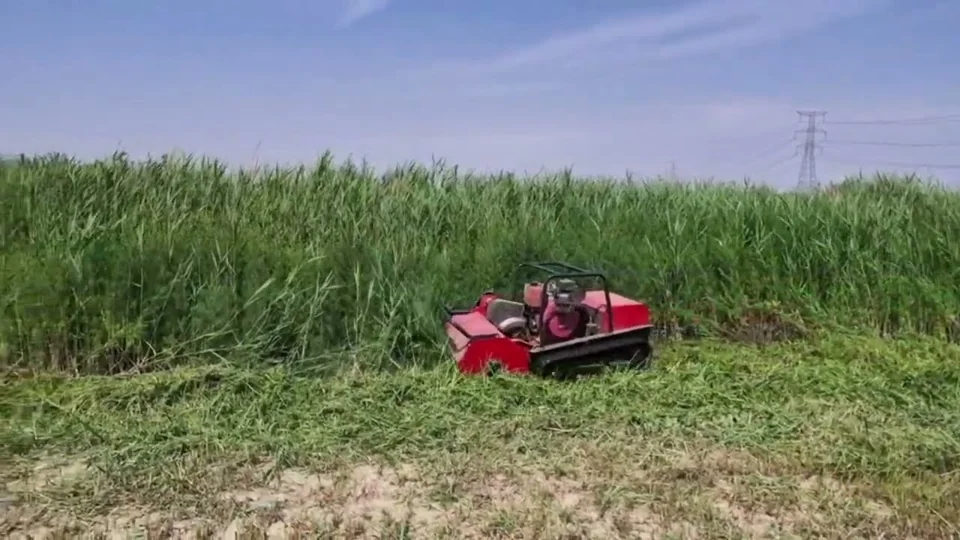
Short answer: In young pine and eucalyptus plantations, keep the space between rows mown until the canopy closes. Cut before weeds grow taller than the young trees, and before they turn woody. A remote flail mower handles grass and soft growth on slopes up to its rated limit. If woody shrubs have taken over, use a forestry mulcher for the first pass instead.
New plantations are most at risk in the first few years. Grass and weeds take water and light from the young trees. They also add fuel for fire and give shelter to rodents. Once the canopy closes, the shade does most of the work. Until then, someone has to keep the rows clear. This guide is for plantation managers, forestry contractors and dealers.
Options for inter-row weed control
| Method | Strengths | Limits |
|---|---|---|
| Herbicide | Long control per pass | Rules, certification limits and drift near water |
| Hand brushcutters | Works anywhere | Slow, tiring and hard to staff |
| Tractor mower | Fast on flat, open ground | Limited on slopes and narrow rows |
| Remote flail mower | Works slopes; operator stays clear | Needs regular cuts before growth turns woody |
Many managers combine methods. They spot-treat a small circle around each tree and mow the inter-row.
When to cut
- Cut before the weeds overtop the young trees.
- Cut again before grass sets seed, to slow the next flush.
- Plan a cut before the fire season to reduce fuel.
- Stop when the canopy closes and weeds no longer grow back strongly.
Follow your local forestry and certification rules for timing near nesting season or water courses.
MERI flail mowers for plantation rows
| Model | Engine | Cutting width | Overall width | Weight |
|---|---|---|---|---|
| ME800D-24 | KOOP192 diesel, 12 HP | 800 mm | 950 mm | 355 kg |
| ME1000D-24 | KOOP195 diesel, 15 HP | 1000 mm | 1150 mm | 376 kg |
| ME1200D-24 | KOOP195 diesel, 15 HP | 1200 mm | 1350 mm | 386 kg |
Source: MERI product pages. All three list a 30–300 mm cutting height, 45° maximum slope and 0–5 km/h travel speed. Gasoline versions with a LONCIN 18 HP engine are also available.
Diesel suits remote sites that refuel from a farm tank. Choose a cutting width that leaves a safe margin from the young trees on each side. Narrow rows usually call for the 800 mm model.
When a mulcher is the better tool
If weeds were left too long, you may face woody shrubs, brambles or regrowth from old stumps. A flail mower is not built for that. A forestry mulcher is. The MERI ME-RFM1000-D has a 1000 mm working width and a 25 hp diesel engine, and lists a 500 m remote range. See our guide to forestry mulchers for forest understory and the remote forestry mulcher range.

Working on plantation ground
- Walk the block first. Mark stumps, rocks, drains and survey pegs.
- Work along the contour where the rows allow it.
- Keep a fixed margin from the young trees on every pass.
- Avoid wet ground that ruts under tracks.
- Keep the operator on stable ground with a clear view of the machine.
MERI flail mowers list an 800 m standard remote range, or up to 1,000 m with the optional R1 industrial remote. In plantations, stay much closer and keep the machine in sight. For slope planning in tree crops, see remote mowers for steep orchard slopes. For fuel breaks along plantation edges, see our guide to firebreak maintenance.
Plan the season across many blocks
Large plantations have blocks of different ages. The youngest blocks need the most cuts. Older blocks near canopy closure may need just one. Rank your blocks by tree age and weed pressure, then plan the mower’s route through the season. Move the machine between blocks on a trailer and refuel at the block entrance.
Keep a short record for each block: date, weed height, hours and any damaged trees. It helps you judge when a block no longer needs mowing, and it gives your forester evidence for certification audits.
What to send MERI
- Tree species, age and height.
- Row spacing and planting pattern.
- Main weed types and height before cutting.
- Steepest slope and ground condition.
- Hectares, number of units and destination country.
To compare models, use the MERI remote mower selector.
Frequently asked questions
How long do young plantations need weed control?
Usually until the canopy closes and shades out the weeds. That can take a few years, depending on species, spacing and site. Your forester will set the target for each stand.
Can a remote mower replace herbicide in plantations?
It can replace or reduce it between rows. Many managers still treat a small spot around each tree. Mowing keeps the inter-row low and cuts fire load without chemicals.
What if the weeds have become woody?
A flail mower handles grass and soft growth. If woody shrubs have taken over, a forestry mulcher may be the better tool. MERI also builds remote forestry mulchers.
How steep can the plantation be?
MERI flail mower product pages list a 45° maximum slope. Check ground conditions too, because stumps, rocks and soft soil change what is safe.
Managing young plantations?
Send your row spacing, tree height, slope and weed type. MERI will suggest a mower or mulcher and quote for forestry managers, contractors and dealers.
Need a mower recommendation for your terrain or project?
Get a Quote