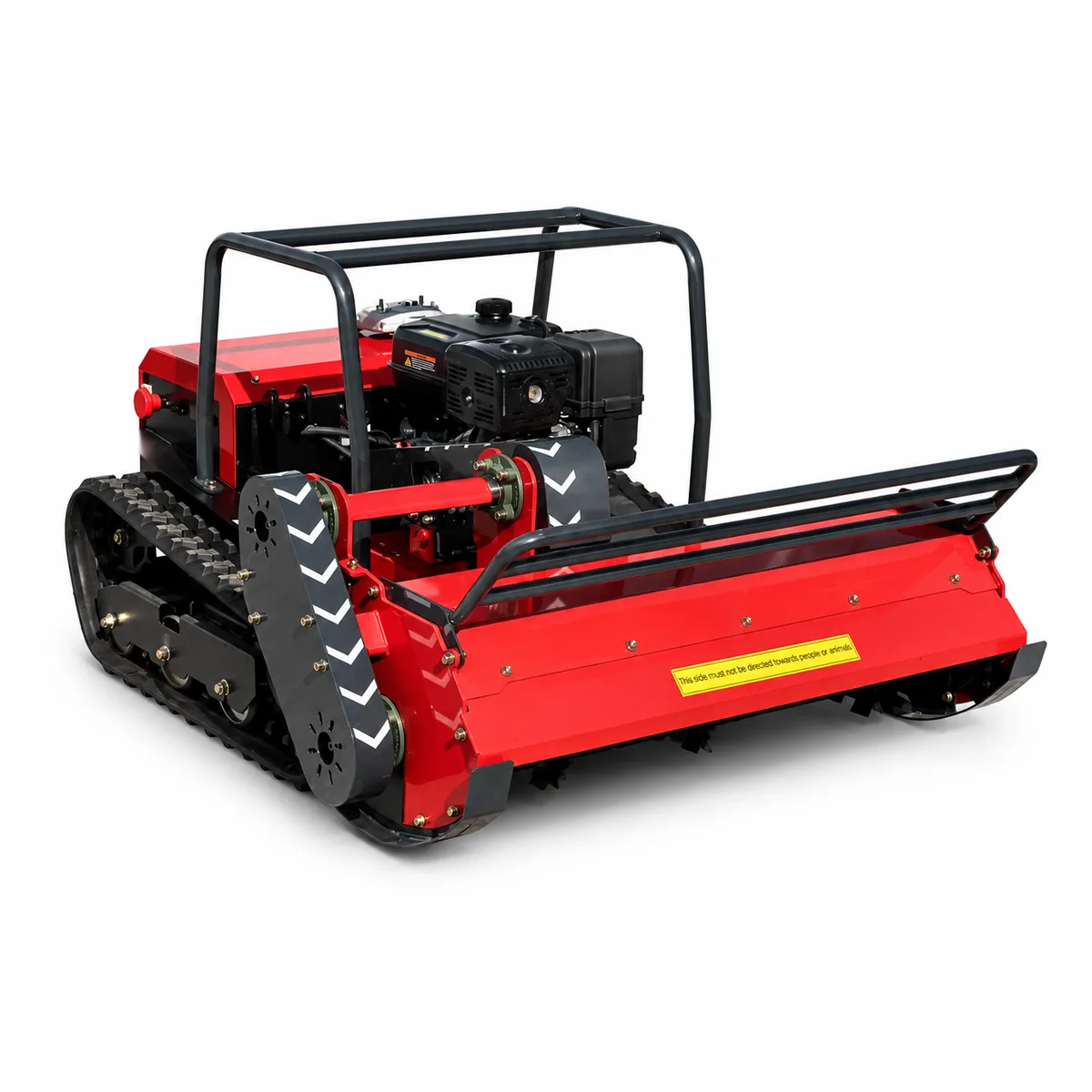
Short answer: On steep hill pasture the ME1200-48 tops rank grass, rushes and weeds where a tractor and topper are unsafe. The product page lists a 1,200 mm flail deck, 30–300 mm cutting height and a 45° slope rating. It works best on open, firm slopes with few rocks.
Why hill pasture needs topping
Grazing animals leave patches. They eat the best grass and leave rank tufts, rushes, thistles and bracken edges. Over a few years these spread and the field loses value. Topping once or twice a season keeps the sward even and gives new growth a chance.
On flat fields a tractor does this. On steep hill fields, many farmers have stopped topping because the risk of rolling a tractor is too high. A remote tracked mower lets the farmer stand at the gate and cut the slope.
ME1200-48 product page figures
| Item | Product page figure |
|---|---|
| Engine | LONCIN 459 gasoline, 18 HP |
| Cutting width | 1,200 mm |
| Control system | 48 V |
| Electric power | 2,000 W |
| Blades | 48 (flail) |
| Cutting height | 30–300 mm (adjustable) |
| Max slope | 45° |
| Remote range | 800 m |
| Travel speed | 0–5 km/h |
| Fuel tank | 5.5 L |
| Weight | 445 kg |
| Dimensions (L×W×H) | 1750×1350×920 mm |
| Listed working efficiency | 6,000 m²/hour |
Data from the live MERI product page. Confirm the order configuration with MERI before you buy.
Why the widest deck
Hill fields are often large and open. The ME1200-48 covers 1,200 mm per pass, the most in the MERI 48 V gasoline range, and the product page lists 6,000 m² per hour on open ground. That matters on a farm where one person has many jobs.
Check your gates first: the machine is 1350 mm wide and 445 kg, so it needs a trailer or a farm track to reach the field.

Timing the cut
| Target | Typical timing |
|---|---|
| Thistles and docks | Before flowering, so they do not set seed |
| Rushes | Summer, often followed by a second cut |
| Rank grass after grazing | Soon after the stock move out |
| Bracken edges | Early summer, repeated over several years |
Starting points only. Follow local agronomy advice and any farm scheme rules.
Ragwort and other toxic weeds should be pulled and removed where stock graze, not mown and left.
Field checks before topping
- Move stock out and shut the gate.
- Walk the field for rocks, fallen wire, old posts and drains.
- Mark wet flushes and springs; stay off them.
- Set a high cut on the first pass, then lower if the ground is clean.
- Work across the slope; slow down on the steepest part.
Rocks and rough ground
Hill pasture often has rocks close to the surface. A flail deck is more tolerant than a flat blade, but stones still wear blades and can be thrown. Raise the cut on rocky areas and check the blades after each field. Keep people and animals out of the work area.
Common mistakes when topping hill fields
- Topping with stock still in the field.
- Cutting too low on rocky ground and wearing blades fast.
- Driving onto a wet flush and losing grip.
- Leaving toxic weeds cut but not removed where animals graze.
- Waiting too long, so weeds have already set seed.
- Taking the machine across a steep field to reach the gate, instead of planning the route along the contour.
Fitting topping around farm work
Topping often competes with silage, lambing or calving. A remote mower helps because one person can run it while others do stock work. Plan topping for settled weather after the stock have moved on, and keep a log of which fields were cut. Next year, the log shows where weeds are spreading and where a second cut paid off.
What to send MERI before ordering
- Total hectares to be topped and the steepest field angle.
- Gate widths and the trailer or track used to reach the fields.
- Main weeds: rushes, thistles, docks or bracken.
- How many cuts per season you plan.
- Whether you prefer gasoline or diesel, and your country.
MERI can then confirm whether the ME1200-48 or a narrower model suits the farm, and which wear parts to keep on the farm so a broken blade does not stop topping in a short weather window.
Smaller fields
For small, steep paddocks and field corners, the ME1000-48 or ME800-48 is easier to turn. Compare the ME1000-48 with the ME1200-48 before you decide. Farms that also need a machine for other jobs can ask MERI about the multi-function crawler range.
Related MERI pages
- ME1200-48 remote flail mower
- Remote control mowers for farms and pasture
- First cut on an overgrown paddock
- ME1000-48 vs ME1200-48
- Slope ratings by model
- Remote mowing time calculator
Frequently asked questions
Can the ME1200-48 cut rushes?
Yes. The flail deck cuts rushes and rank grass. Many farms cut rushes twice in a season.
How steep a field can it top?
The product page lists a 45° maximum slope. Wet flushes, rocks and loose soil lower the safe angle.
Is there a diesel version for farms?
Yes, the ME1200D-48 uses a KOOP 195 diesel engine. Diesel models are not supplied to the US market.
How wide a gate does it need?
The product page lists 1750×1350×920 mm. Allow a gate wider than 1,350 mm with room to steer.
Send us your site details
Tell us the job, area, slope and country. MERI replies within 24 hours.
Need a mower recommendation for your terrain or project?
Get a Quote