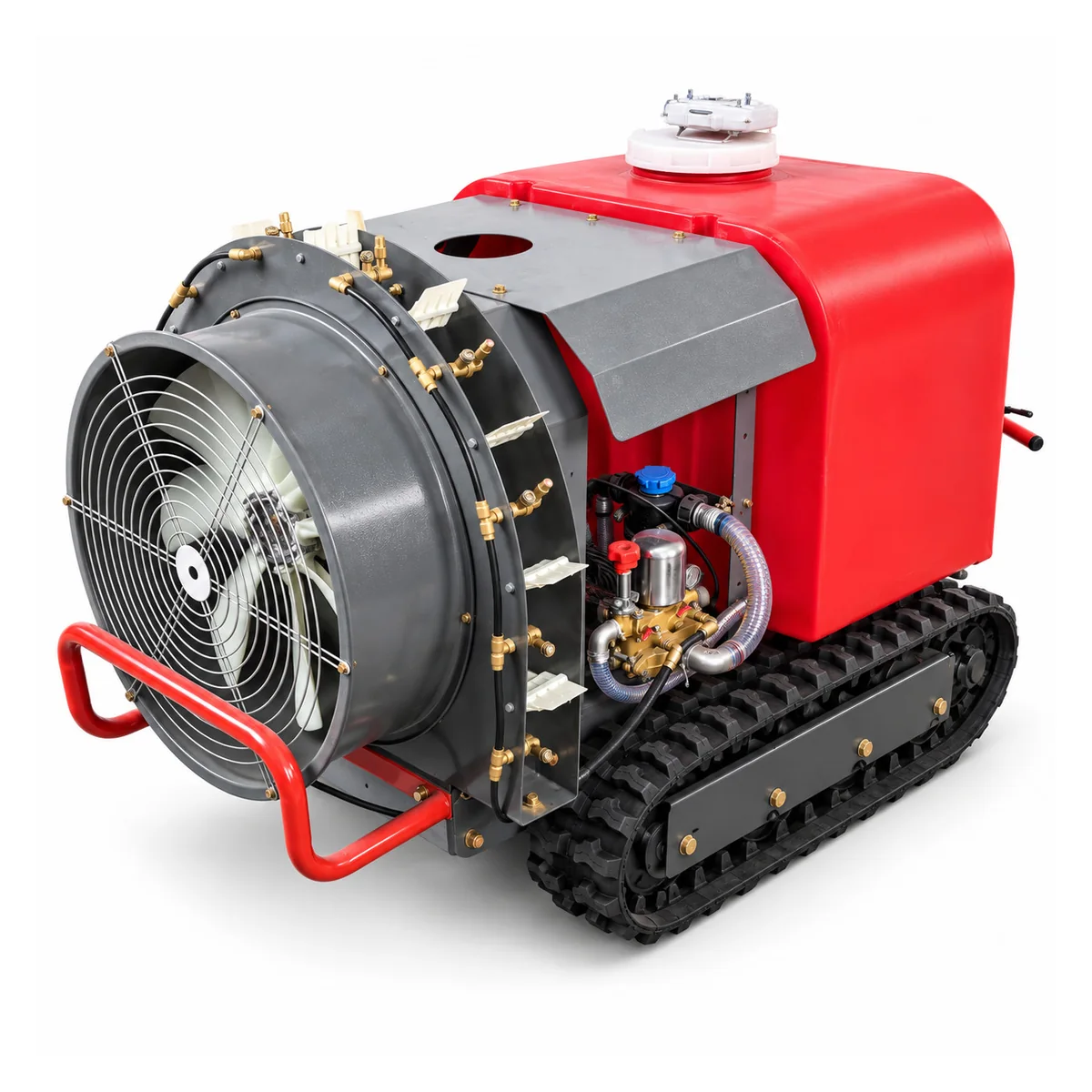
Short answer: Orchard airblast sprayers need steady pressure at moderate flow, so most use piston (plunger) or diaphragm pumps. Centrifugal pumps move large volumes at low pressure and suit boom work more than airblast. Choose by the pressure your nozzles need, the products you spray, and how easy seals and valves are to service.
What the pump has to do
An orchard sprayer pump feeds nozzles around a fan, pushes liquid back to the tank for agitation, and holds pressure steady as the tank empties. Airblast nozzles often run at higher pressure than boom nozzles, so the pump must deliver pressure without pulsing.
Three pump types
| Type | Pressure | Flow | Notes |
|---|---|---|---|
| Piston or plunger | High | Low to medium | Durable; steady high pressure; seals and valves are wear parts |
| Diaphragm | Medium to high | Medium | Tolerant of abrasive mixes; diaphragms are wear parts |
| Centrifugal | Low | High | Simple; large volumes; not for high-pressure airblast |
General comparison. Check the maker’s pressure and flow curve.
Piston and plunger pumps
These pumps build high pressure with pistons or plungers moving in cylinders. They hold pressure well and suit airblast work and hand guns. The MERI ME-RCS series uses plunger pumps; the pump and nozzle guide lists 26-type and 30-type pumps by model. Wear items are seals, valves and plungers, so keep seal kits in stock.

Diaphragm pumps
A diaphragm pump separates the liquid from the crankcase with flexible diaphragms. It copes well with wettable powders and abrasive mixes and runs at medium to high pressure. Diaphragm material must suit the chemicals used; damaged diaphragms can let liquid into the oil, so check oil colour regularly.
Centrifugal pumps
Centrifugal pumps spin an impeller to move large volumes at low pressure. They are common on large boom sprayers and for filling tanks. They are rarely the right choice for airblast orchards, where nozzle pressure matters more than volume.
Matching pump to nozzles
Start from the nozzles. Add up the flow of all nozzles at the working pressure, then add agitation flow back to the tank. The pump must deliver that total at that pressure with spare capacity. A pump at its limit pulses, wears faster and gives uneven coverage.
Signs of pump trouble
- Pressure drops or will not build.
- Gauge needle pulses or jumps.
- Milky or discoloured pump oil (diaphragm pumps).
- Leaks at seals or the crankcase.
- Noise or knocking under load.
Service habits
- Flush with clean water after every job.
- Check oil level and colour on oil-filled pumps.
- Drain or protect against frost in winter.
- Replace seals and valves on a schedule, not only at failure.
- Keep the suction filter clean; a blocked filter starves the pump.
Chemical compatibility
Pump materials must match the products you spray. Seals, diaphragms, valve seats and housings react differently to oils, solvents, fertiliser solutions and strong acids or alkalis. Check the pump maker’s compatibility list for every product in your programme. If you change to a new product, check again before the first fill.
Clean the pump promptly after products that dry hard or crystallise, such as some fertilisers and wettable powders. Residue left overnight scores seals and sticks valves.
Pressure regulation and agitation
The pump does not set the spraying pressure; the regulator does. A well-sized pump runs with some flow returning to the tank through the regulator and agitation line. If the regulator is fully closed and pressure is still low, the pump is worn, starved or too small. Check the suction line and filter before replacing parts.
Spare parts to hold
For a busy spray season, keep at least one full seal and valve kit per pump model, a spare pressure gauge, a regulator repair kit and suction filters. A pump that stops in the middle of a spray window costs far more than the parts on the shelf.
Questions to ask a supplier
- Pump type and maximum pressure and flow.
- Seal and diaphragm materials and chemical compatibility.
- Seal kit part numbers and stock.
- Pressure regulator and gauge type.
- Service interval for wear parts.
Related MERI pages
- ME-RCS pumps and nozzles guide
- Sprayer pump low pressure troubleshooting
- Sprayer pump seal kit identification
- Sprayer pump pulsation and uneven spray
- Mist blower sprayers for orchards
- ME-RCS sprayer FAQ
Frequently asked questions
Which pump type suits an orchard airblast sprayer?
Usually a piston (plunger) or diaphragm pump, because airblast nozzles need steady pressure.
What pump does the MERI ME-RCS use?
Plunger pumps. The pump and nozzle guide lists 26-type and 30-type pumps by model.
Are centrifugal pumps used on orchard sprayers?
Rarely for airblast. They move large volumes at low pressure and suit booms and tank filling.
What wears on a plunger pump?
Seals, valves and plungers. Keep seal kits in stock and replace on a schedule.
Send us your site details
Tell us the job, area, slope and country. MERI replies within 24 hours.
Need a agricultural sprayer recommendation for your terrain or project?
Get a Quote