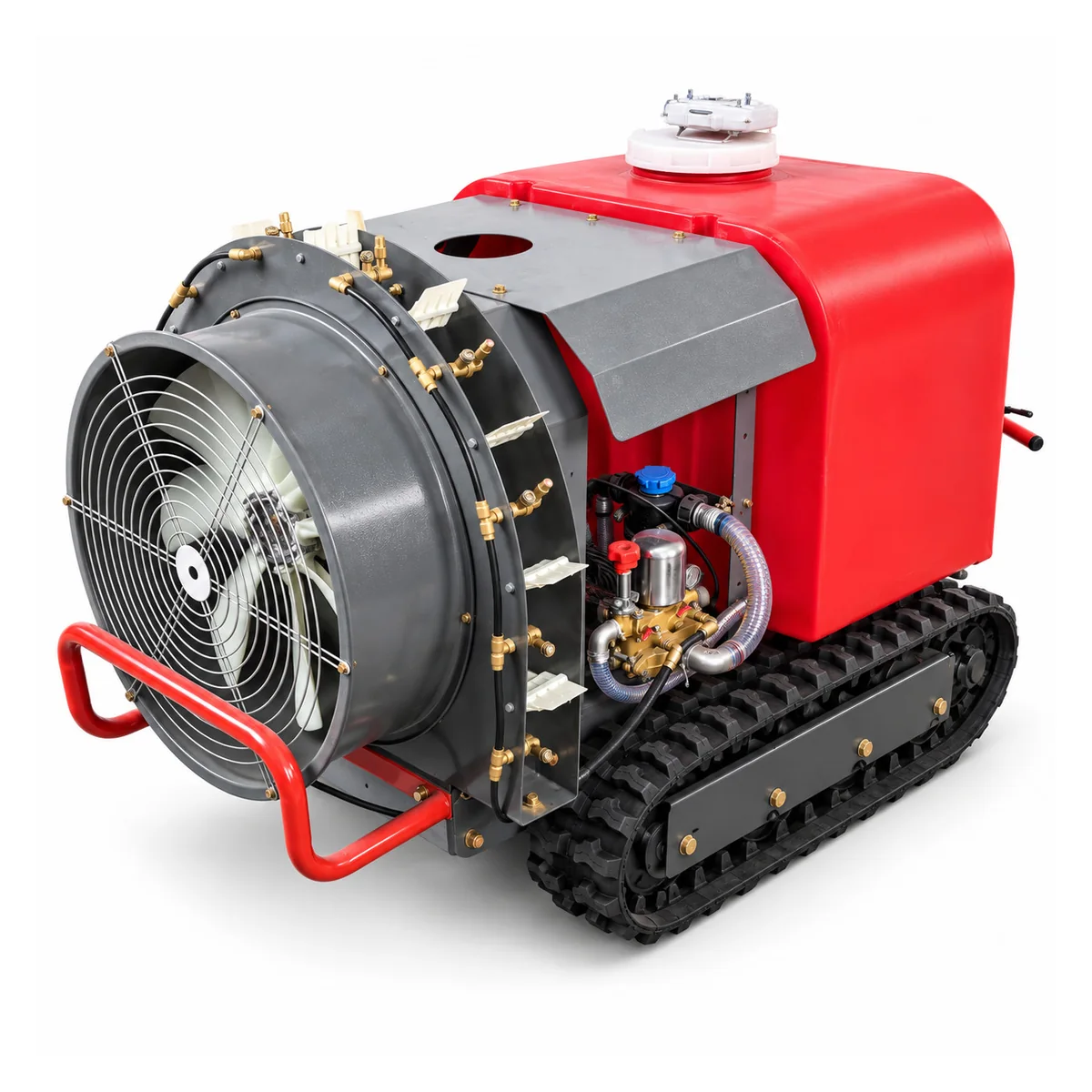
Short answer: A PTO sprayer uses a tractor you may already own and suits flat blocks with wide rows. Self-propelled and remote tracked sprayers carry their own power, fit narrower rows and steeper ground, and keep the operator out of the cab or out of the spray cloud.
Side by side
| Point | PTO trailed/mounted | Self-propelled / remote tracked |
|---|---|---|
| Power | From the tractor | Own engine |
| Row width | Tractor width plus sprayer | Often narrower |
| Slopes | Limited by tractor | Within machine rating |
| Tank size | Often large | Smaller to medium |
| Operator | In the tractor | Cab or remote, away from spray |
Labour
Both need one operator per machine. Remote sprayers remove the need for a cab and filtration, and make it easier for one person to work alone on difficult blocks.
Terrain
Tractors on wet or steep orchard blocks risk sliding and compaction. Tracked sprayers spread their weight and can work after rain sooner. MERI ME-RCS sprayers are tracked and remote-controlled.
Tank size and refills
Large PTO tanks cover more trees per fill. Smaller tanks mean more refills, so plan fill points near the blocks. Use the tank fill calculator to compare. ME-RCS tanks run from 100 to 800 L.
Cost
A PTO sprayer is cheaper if the tractor is already paid for and has spare hours. A self-propelled or remote machine adds a power unit but frees the tractor for other work.
When to choose which
- Flat, wide-row blocks with a free tractor: PTO.
- Steep, narrow or wet blocks: tracked self-propelled or remote.
- Mixed farms: often one of each.
Try before buying
Ask for a demo on your worst block and measure time per row, refills and coverage.
Maintenance and support
A PTO sprayer adds a second machine to maintain behind the tractor. A self-propelled or remote sprayer has its own engine, pump and tracks. In both cases, check how fast parts arrive and who services the machine locally. Spray windows are short; a breakdown in the middle of a programme costs more than the repair.
Worked example: refills per block
Tank size matters less than the number of trips. Hectares per fill = tank volume (L) ÷ application rate (L/ha).
| Tank | Rate | Hectares per fill | Fills for a 6 ha block |
|---|---|---|---|
| 500 L | 500 L/ha | 1 ha | 6 |
| 800 L | 500 L/ha | 1.6 ha | 4 |
| 1,500 L | 500 L/ha | 3 ha | 2 |
Arithmetic example. Your rate and block size will differ.
Then add the time per fill: driving to the fill point, filling, mixing and driving back. A small tank with a fill point at the block end can match a large tank that has to travel far. A remote tracked sprayer that can work steep or wet blocks may also save days the tractor would have waited.

Demo day checklist
- Use your hardest block, not the easiest.
- Time a full tank from fill to empty.
- Check coverage with water-sensitive paper in the canopy.
- Watch turning at row ends and on slopes.
- Ask about service, parts and training.
Common mistakes
- Choosing by tank size alone.
- Ignoring how far the fill point is from the blocks.
- Forgetting the tractor hours a PTO sprayer uses.
- Not checking the slope rating against the steepest block.
Seasonal notes
Spray programmes are tight in spring, when growth is fast and showers cut the number of good spray days. That is when a machine that can go back on the ground soon after rain earns its keep. In summer, heat limits spraying to early morning and evening, so refill speed matters more. After harvest, plan maintenance: pump service, nozzle replacement and a full calibration before next season, whichever sprayer type you run.
Questions about the tractor you already have
A PTO sprayer only works as well as the tractor in front of it. Before you compare, check:
- How many hours a year is the tractor free during the spray season?
- Is the tractor narrow and low enough for every row and under every canopy?
- Is it stable on the steepest headlands and side slopes you spray?
- Who drives it, and are they free on spray days?
If the answers point to clashes or slopes, a self-propelled remote sprayer may fill the gap. MERI ME-RCS models carry 100 to 800 L and are driven by remote control, so the operator stays out of the spray cloud and off the slope.
Related MERI pages
Frequently asked questions
Which is cheaper, PTO or self-propelled?
PTO, if you already own a suitable tractor.
Which works better on slopes?
A tracked self-propelled or remote sprayer.
What tank sizes do ME-RCS sprayers have?
100 to 800 L.
Does remote control reduce exposure?
Yes, the operator stays out of the spray cloud.
Send us your site details
Tell us the job, area, slope and country. MERI replies within 24 hours.
Need a agricultural sprayer recommendation for your terrain or project?
Get a Quote