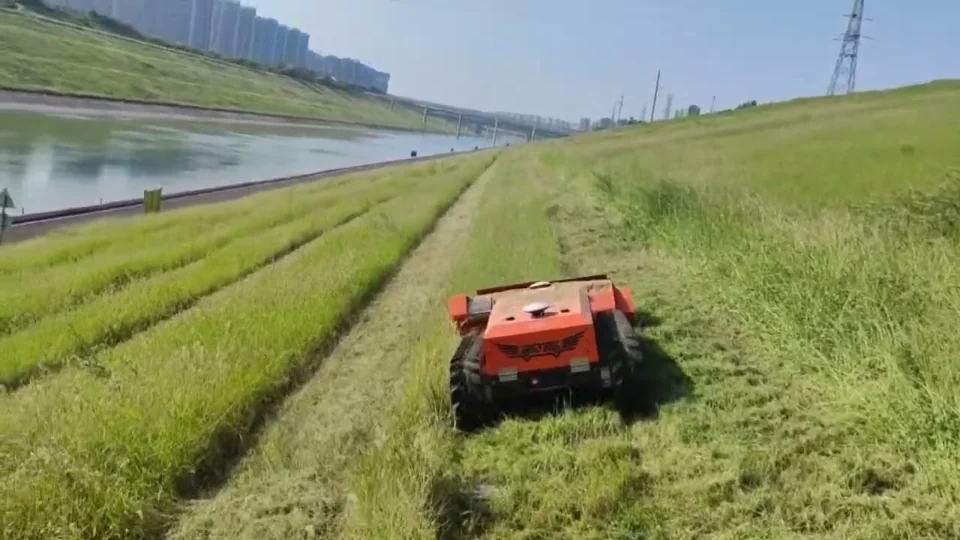
Short answer: Clear red sesbania before its pods ripen, starting at the top of the catchment and working downstream, because seed moves with water. A remote tracked mulcher or heavy flail clears thickets on banks while the operator stays on firm ground. Keep the bank covered and check again after each flood.
What red sesbania is
Red sesbania is a South American shrub with bright orange-red flowers and winged pods. In South Africa it has invaded riverbanks, wetlands and floodplains, especially in the eastern and southern provinces. It forms dense stands that block water flow and crowd out native plants.
The pods and seed float and travel with water. After a flood, new seedlings can appear far downstream.
Start upstream
| Section | Priority | Reason |
|---|---|---|
| Upper catchment stands | First | Seed source for the whole river |
| Tributary banks | Next | Feed seed into the main stream |
| Main river banks | Then | Work downstream in order |
| Isolated plants | Ongoing | Remove while small |
Coordinate with landowners and any catchment programme along the river.
Timing
Clear before pods ripen. Red sesbania flowers in spring and summer and pods follow. If plants are already carrying ripe pods, collect what you can reach before mulching, or accept that a seedling flush will follow.
Machine choice on banks
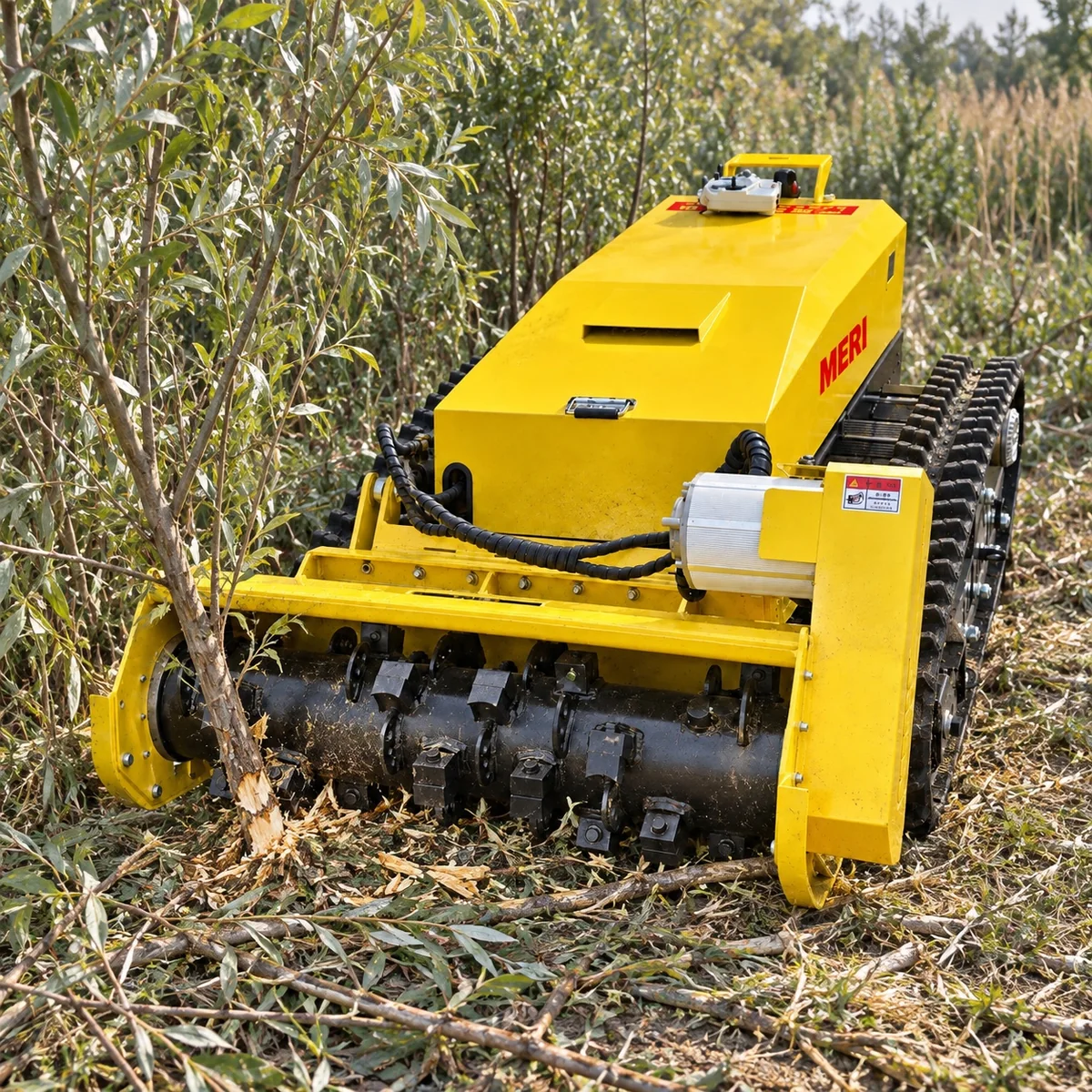
Young stands and regrowth can be cut with a heavy flail. MERI flail models cut from 30 to 300 mm. Older thickets with woody stems need a forestry mulcher. The ME-RFM1000 range clears a 1,000 mm path and handles stems up to 30 cm under suitable conditions.
Riverbanks are often steep and soft. A tracked remote machine lets the operator stand on firm ground above the bank. The ME-RFM1000-D is rated to 45°; the ME-RFM1000-E climbs 45° and works up to 35°.
Bank stability
- Work along the bank, not straight down toward the water.
- Keep off saturated ground and the water’s edge.
- Leave the mulch layer as cover on the bank.
- Clear in sections, so the whole bank is not bare at once.
- Plan replanting with local species where needed.
Check any rules on working near rivers before you start. MERI does not advise on them.
Follow-up after floods
Every flood can bring new seed. Walk the banks after high water and remove seedlings while they are small. Many can be pulled by hand. Regrowth from cut stems should be dealt with as local guidance recommends. MERI does not advise on chemicals.
Common mistakes
- Starting downstream while upstream stands keep seeding.
- Clearing the whole bank at once before the rainy season.
- Leaving ripe pods on cut plants near the water.
- Driving onto soft banks and causing slumps.
- Skipping the walk after floods.
Most of these come from treating each farm on its own. A river-wide plan, even an informal one with neighbours, makes each clearing last longer.
What to record
For each river section, record the date of clearing, the size of the stand, whether pods were ripe, and the dates of follow-up visits. Note any flood events. After a season or two, the records show where seed keeps arriving from and which sections need extra attention. Share them with neighbours and the local conservancy.
Machine care near water
Mud and wet plant material build up on tracks and rollers on riverbank jobs. Clean them at the end of each day. Check seals and bearings after working in wet conditions. Wash off mud before moving to the next property, so seed and soil do not travel with the machine. Keep fuel and oil well away from the water’s edge when refuelling, and carry a spill kit on every riverbank job.
Working along a river
A river crosses many properties. Clearing one farm while the neighbour upstream leaves a dense stand gives only a short break. Talk to neighbours and any local conservancy or catchment group. A contractor with a remote tracked machine can move along the river from property to property, cleaning the machine between them. Keep a record of each section cleared and the date of each follow-up visit.
Related MERI pages
- Clearing invasive alien plants in South Africa
- Tamarisk and Russian olive riparian clearing
- Erosion control after mulching slopes
- ME-RFM1000-E electric mulcher
- Remote control mowers in South Africa
- Remote control forestry mulchers
Frequently asked questions
When should red sesbania be cleared?
Before the pods ripen, usually in spring or early summer. Ripe pods release seed that travels with water.
Why start clearing upstream?
Seed floats downstream. Clearing upstream first stops seed washing into cleared areas.
Can a remote mulcher work on riverbanks?
Yes, within its slope rating. The operator stays on firm ground above the bank. Keep off saturated ground.
How often should I check after clearing?
After every flood and through the next season. Remove seedlings while they are small.
Send us your site details
Tell us the job, area, slope and country. MERI replies within 24 hours.
Need a forestry mulcher recommendation for your terrain or project?
Get a Quote