
Short answer: UK law does not ban lone working with a remote mower. But the employer keeps full responsibility and must cover the risks of working alone in the risk assessment. That means planning how the operator is checked on, how they call for help and what happens if they are hurt. HSE also says remote-controlled mobile equipment must stop automatically if it leaves its control range. Test that, and the stop button, before every lone job.
This guide is for UK grounds maintenance firms, councils and contractors who send one operator out with a remote slope mower. It sets out what HSE guidance says and how to turn it into a simple plan. We read the HSE pages on 18 November 2026. This is a summary, not legal advice.
What HSE says about lone working
HSE defines a lone worker as someone who works by themselves without close or direct supervision. Its leaflet INDG73, “Protecting lone workers”, sets out the main points:
- Employers cannot pass their duties to the lone worker.
- Lone working risks belong in the general risk assessment. With five or more employees, it must be written down.
- There is no general ban. A few tasks, such as confined spaces, need at least one other person.
- New, trainee or high-risk work may need someone with the worker at first.
- Employers should assess medical fitness, including for likely emergencies.
Why remote mowing changes the risk
A remote mower takes the operator off the slope. That removes the rollover risk of a ride-on machine. It also cuts hand-arm vibration from strimmers, as our guide to hand-arm vibration on bank mowing explains.
But the risks of being alone remain. The operator may slip on the bank while walking. They may be far from the road, out of sight of the public and out of phone signal. A machine stuck on a slope tempts people to walk onto it. Your plan has to cover these points.
Machine checks before a lone job
HSE’s guidance on mobile work equipment says self-propelled remote-controlled equipment must stop automatically if it leaves its control range. It must also be protected against crushing and impact risks. These rules come from PUWER.
| Check | How | Why |
|---|---|---|
| Stop button on the handset | Press it with the machine on flat ground | No one is nearby to help if it fails |
| Signal-loss response | Test as the supplier’s manual describes | HSE expects an automatic stop out of range |
| Handset battery | Start the day fully charged; carry a spare if supplied | A flat handset ends the job far from help |
| Working range | Stay where you can see the machine and the ground | Radio range is longer than safe sight lines |
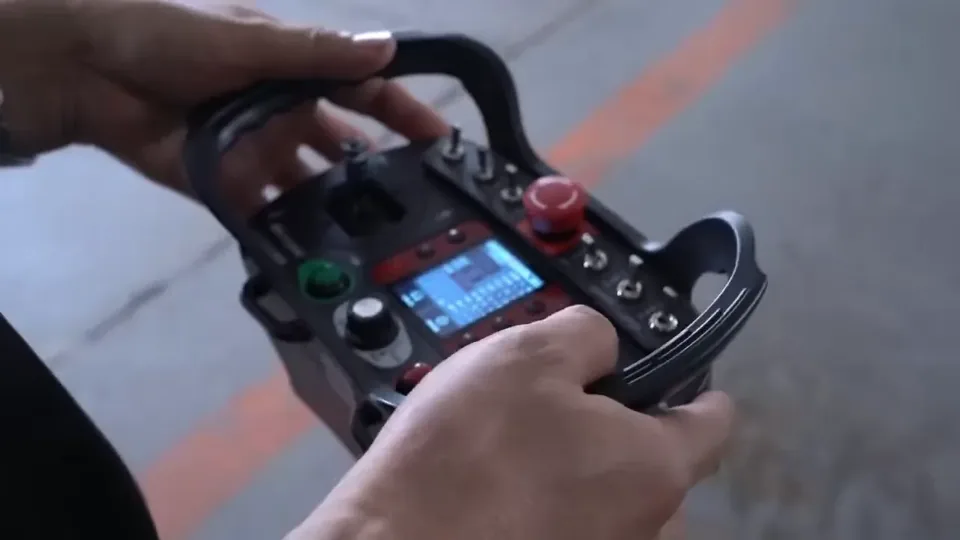
MERI remotes have a standard range of up to 800 m. The R1 upgrade reaches up to 1,000 m. That is a radio limit, not a working distance. MERI tests the emergency stop and signal-loss protection on every unit before packing, as listed on our factory quality control page.
A simple lone working plan
- Name the site, the slope and the planned hours.
- Agree a check-in time by phone or radio, and what happens if it is missed.
- Check phone signal on site, or provide another way to call for help.
- Give the operator a first aid kit and training, including self-aid.
- Set a no-go rule: never walk onto the slope to free the machine alone.
- Confirm the operator is back at the end of the day.
- Test your alarms and check-ins regularly.
HSE lists supervisor visits, agreed phone or radio contact, manual or automatic alarms and an end-of-shift check as ways to monitor lone workers. Pick the ones that fit your sites. Long days add fatigue, so read our note on operator fatigue on long remote mowing days too.
Where the operator stands
Stand where you can see the machine and the ground ahead of the tracks. Avoid standing below the machine on a slope. Our guide on operator position on banks covers this in detail. Set an exclusion zone for the public as well, as shown in our exclusion zone guide.
For road verges and cuttings, lone working is harder to justify near traffic. Read our highway embankment mowing page before you plan solo work there.
What to send MERI
- The types of sites you mow alone.
- Typical slope angles and walking distances.
- The remote type you prefer: C7, R1 or KBR.
- Any training or manual needs for your team.
- Your fleet size and delivery address.
Frequently asked questions
Is lone working with a remote mower legal in the UK?
There is no general ban. The employer must assess the risks of working alone and put controls in place, such as check-ins and first aid.
Who is responsible for a lone operator’s safety?
The employer. HSE says employers cannot pass their responsibility to the lone worker.
What should the remote do if the signal is lost?
HSE guidance says self-propelled remote-controlled equipment must stop automatically if it leaves its control range. Test this before lone jobs.
Should a lone operator walk onto the slope to free a stuck mower?
Set a rule against it. Call for help and wait, so no one is alone on a steep bank.
Plan safe solo mowing with MERI
Tell us your sites, slopes and team size. We will suggest models and remote options for contractors and councils.
Need a mower recommendation for your terrain or project?
Get a Quote