
Short answer: If the gauge shows pressure but nothing comes out, the liquid is usually being stopped after the gauge. Check the simple things first. Is the pump lever still on return? Is the spray switch or a section valve off? Is a line filter or nozzle filter blocked? A gauge can read full pressure against a closed valve. So the reading does not prove liquid is reaching the nozzles.
This problem often shows up at the start of the season, after storage. The engine runs, the pump turns and the needle sits where it should. Yet the nozzles stay dry, or only dribble. The good news is that the cause is often a setting or a blockage, not a failed pump.
Why a gauge can read pressure with no spray
A pressure gauge measures pressure at one point in the line. It does not measure flow. If a valve or filter after the gauge is shut or blocked, the pump builds pressure against it. The gauge reads high, but no liquid moves to the nozzles.
So the question is where the liquid stops. Work along the line in the same order the liquid flows. Our sprayer plumbing diagram guide shows the usual layout: tank, suction filter, pump, regulator, gauge, valves, line filters, nozzles.
Check the controls first
Many no-spray problems end here. Check each control before you open any fitting.
- Pump lever or bypass valve. Many sprayers start with the pump set to bypass or return. Liquid then circulates back to the tank. MERI’s sprayer operating guide describes this start-up step. Move it to the spray position as the manual shows.
- Spray switch. Where a remote spray switch is fitted, check it is on and the remote is paired.
- Section valves. A closed section valve stops flow to that part of the boom.
- Main shut-off. Some setups have a manual valve after the regulator. Make sure it is open.
Then check filters and nozzles
If the controls are right, look for a blockage after the gauge. Stop the engine and release pressure before you open anything.
- Line filters. A blocked line filter can stop flow to a whole section.
- Nozzle filters and tips. Residue, sand or dried product can block every tip at once after storage.
- Nozzle check valves. These anti-drip valves need a set pressure to open. If they are stuck, liquid will not pass.
- Hoses. Look for kinks, crushed sections and hoses that have collapsed inside.
Our guide to clearing clogged sprayer nozzles covers safe cleaning methods.
Symptom guide
| What you see | Likely area | First check |
|---|---|---|
| Pressure, no spray anywhere | Controls or main valve | Pump lever, spray switch, main shut-off |
| Pressure, one section dry | That section | Section valve and line filter |
| Pressure, a few nozzles dry | Nozzle end | Nozzle filters, tips and check valves |
| Pressure drops when spraying starts | Supply or pump | Suction filter, tank level, air leaks |
| Needle stuck at one value | Gauge | Test the gauge |
If pressure falls as soon as liquid flows, the problem is different. See sprayer pump troubleshooting for low pressure.
What the MERI RCS TDS tells you
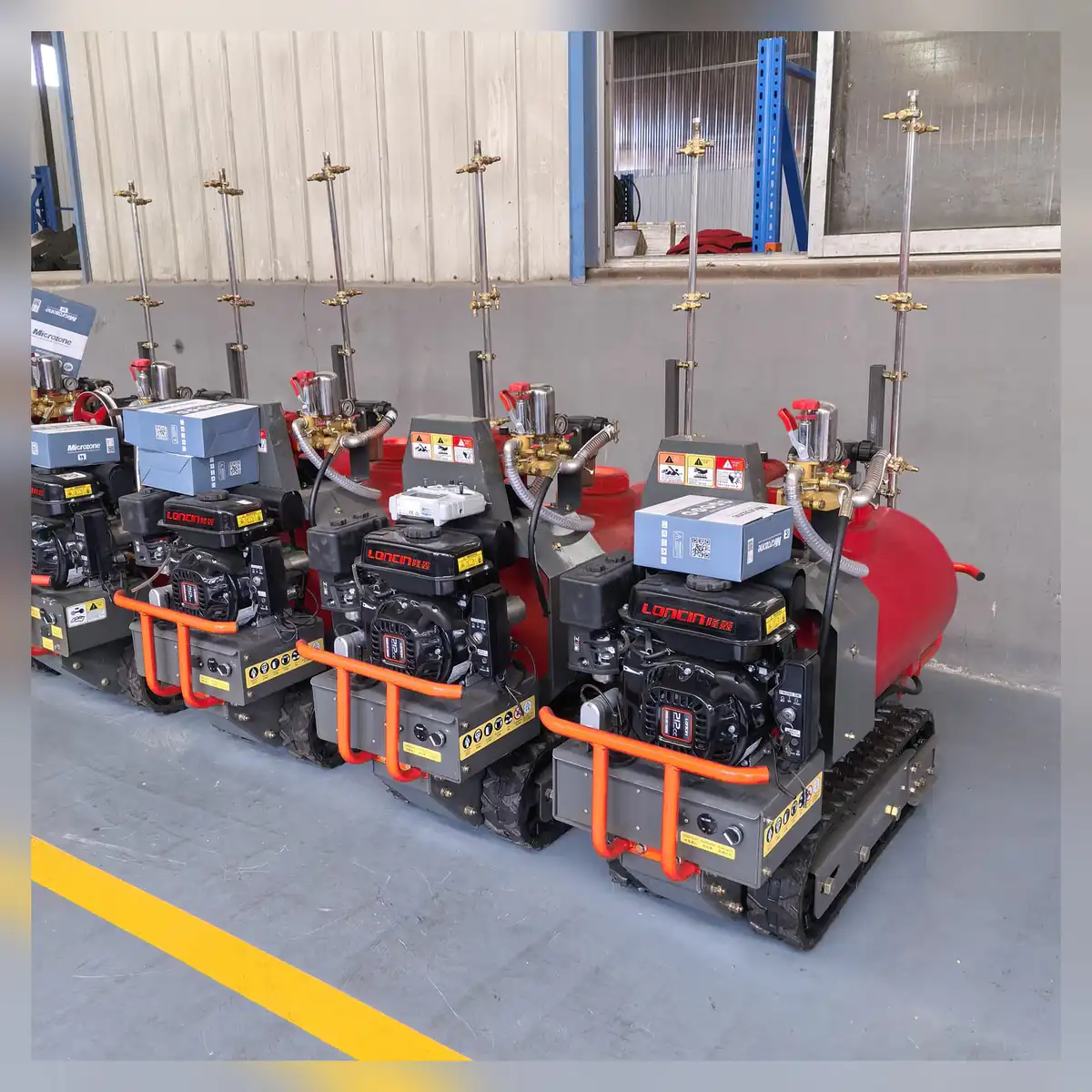
MERI RCS tracked sprayers use plunger pumps. The TDS lists a 26-type three-cylinder pump on the RCS100 and RCS120, and a 30-type three-cylinder pump on the RCS200 to RCS500. The RCS800 lists a 30-type plunger pump. Nozzle counts are 8, 12 or 16 depending on model, and can be customized. Pump pressure and flow are not published; confirm them on the TDS for your configuration.
Because pumps, valves and nozzles vary by order, use the parts list for your own machine. The RCS sprayer series page links each model TDS.
Prevent it next season
- Flush the system with clean water after each job.
- Clean all filters before storage.
- Store nozzles and filters clean and dry.
- Move valves to the position the manual gives for storage.
- Test spray with clean water before the first job of the season.
Dealers can plan filters, nozzles and seal kits ahead of the spray season with our seasonal stocking calendar.
What to send MERI
- Machine model and serial number.
- The gauge reading and which sections or nozzles are dry.
- What you have checked so far.
- A short video of the controls and the boom while spraying water.
Frequently asked questions
Why does my sprayer show pressure but not spray?
The liquid is usually stopped after the gauge. Common causes are a pump lever left on return, a spray switch or section valve that is off, or blocked line filters, nozzle filters or check valves.
Does a pressure reading mean liquid is reaching the nozzles?
No. A gauge measures pressure, not flow. It can read full pressure against a closed valve or a blocked filter.
Is a pump failure likely if the gauge shows pressure?
Less likely. A pump that builds pressure is usually working. Check controls, valves and filters first.
What pump does a MERI RCS sprayer use?
The RCS TDS sheets list plunger pumps: 26-type on the RCS100 and RCS120, and 30-type on the larger models. Check the TDS for your configuration.
Support for RCS sprayer dealers
Send the model, serial number and a short video of the fault. MERI will help with parts and service support for dealers and fleets.
Need a mower recommendation for your terrain or project?
Get a Quote